
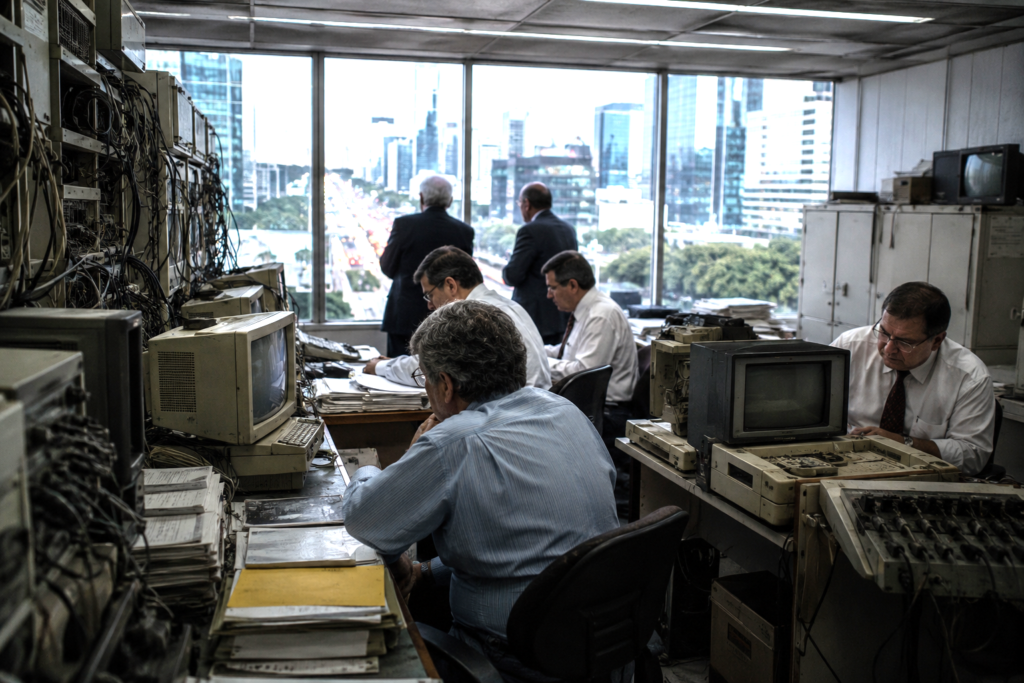
When bureaucracy tries to buy the future with the reflexes of the past.
The State and the Great Technological Blink
By Dr. Nelson Jorge Mosco Castellano
The greatest danger of the Fourth Technological Revolution is not that machines may acquire the ability to think, but that governments insist on not doing so.
Throughout history, humanity has gone through three major transformations in the way it interacts with matter and energy.
The first brought us down from the trees and tied us to the plow; the second replaced human muscle with the steam piston; the third digitized the flow of information.
In each of these leaps, the adaptation interval was measured in generations. There was time for old habits to die peacefully with the elderly and for new ones to be adopted by the young.
But today we are facing what I like to call The Great Blink.
The speed of current change is exponential, while the human mind, and especially the bureaucratic mind, remains strictly linear.
When a government decides to squander its resources on the threshold of this new era, it is not merely making an error in economic calculation; it is committing an evolutionary anachronism.
And in the game of survival, anachronism is always synonymous with extinction.
I. The inertia of steel against the fluidity of silicon
Imagine a ruler of ancient Rome who, sensing that communications are the future of the Empire, decided to invest all the gold in the treasury in buying the finest and fastest racing horses on the Italian peninsula.
The effort would be colossal, the expense astronomical and the patriotic pride immense.
Yet just a few decades later, with the arrival of the telegraph — or even of a differently paved road system — those costly horses would be nothing more than a glorious and expensive pile of consumed alfalfa.
This is exactly what happens when the modern State insists on financing rigid technological megaprojects.
State bureaucracy requires, by its very nature — tenders, commissions, parliamentary debates and ministerial signatures — a span of time that technological progress no longer grants.
By the time the monumental information system of a public agency is finally approved, designed and installed after five years of paperwork, the underlying technology has already changed three times.
The government has bought, at the price of gold, last year’s fastest horse.
Spending taxpayers’ resources on closed and proprietary structures is like building sandcastles before a tide rising at vertiginous speed.
The only sensible financial strategy in the age of silicon is modularity: small, interconnected systems flexible enough to be discarded or updated without bankrupting the republic.
II. The true fuel of tomorrow
There is a widespread blindness that confuses temples with faith.
Many governments believe that taking part in the technological revolution means filling offices with state-of-the-art computers or subsidizing industries that promise to preserve twentieth-century jobs through fiscal forceps.
This is a tragic waste. The real battlefield is not measured in gigawatts or tons of servers; it is measured inside the skulls of citizens.
If a government spends its resources artificially sustaining an obsolete labor structure out of fear of the displacement caused by automation, it commits a double fault.
First, it drains the funds that should be used to prepare new generations in the Liberal Arts of the modern age: critical thinking, adaptability and the ability to program machines instead of competing against them. Second, it accustoms citizens to a false sense of security that will vanish at the first impact of international reality.
Cybernetics taught us that a system that does not adapt dies.
If the State uses public money to shield society from change instead of giving it the agility needed to surf it, it will have created a population of dependents in a world that rewards only the daring.
III. The mirror of distrust
There is a third factor, perhaps the most subtle and dangerous of all.
The citizen of the Fourth Revolution is a hyperconnected individual.
In his pocket, he carries computing power that scientists from the Manhattan Project would have envied.
He sees, compares and analyzes in real time.
When this citizen optimizes his resources, adopts new tools and transforms his small business in order to survive in a hypercompetitive market, he turns his gaze toward the State.
And what does he find?
He finds an apparatus that wastes the money he struggled to earn, using it to maintain nineteenth-century vices, duplicated functions and bureaucratic counters that no longer have any reason to exist.
The result is an ethical fracture.
No political system can survive if the efficiency of the governed advances at the speed of light while the efficiency of those who govern retreats at the speed of mud.
The loss of institutional trust is the prelude to either anarchy or totalitarianism.
Tomorrow does not wait for committees
The solution is not for the State to become a mad scientist trying to guess and finance the next great invention.
History shows that governments are terrible at choosing winners in the free market of ideas.
The role of authority in this change of era must be that of a wise gardener, not that of a builder of artificial concrete trees.
First, set the ground: create clear, stable and predictable rules of the game. A robust legal framework and strict fiscal discipline are the best invitation for the creative genius of the human species to flourish without fear.
Second, remove the weeds: dismantle obsolete regulations that prevent experimentation and decentralization. If technology now allows direct and transparent citizen auditing, the State must shrink its supervisory apparatus and let light enter public accounts.
The Fourth Technological Revolution offers us an unprecedented opportunity to free humanity from the most tedious and repetitive tasks of existence.
But if governments insist on squandering the wealth of nations by trying to buy the future with the tools of the past, we will discover, too late, that tomorrow has left us behind.
And the universe, as we well know, has no sympathy for those who fall behind.
Technological speed and state inertia.
Rigid public investment versus modular systems.
Public trust under obsolete governments.
Continue reading in Global Order & Geopolitics
Apoyá la continuidad de Perspectiva Liberal
Perspectiva Liberal es un espacio editorial independiente. Si valorás este trabajo y querés colaborar con su continuidad, podés hacerlo mediante un aporte voluntario a nuestra cuenta Prex.
Cuenta Prex: 13440