
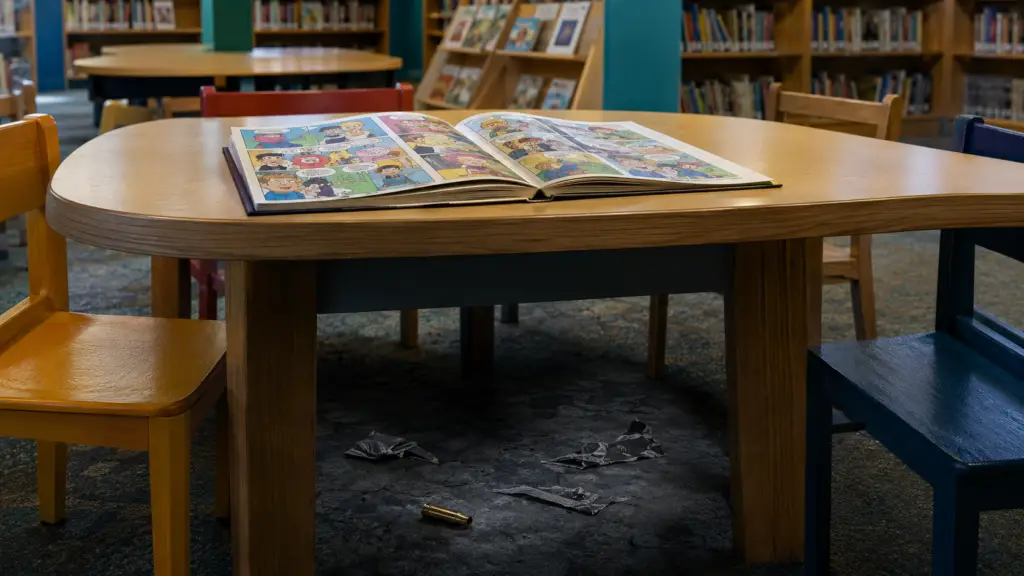
The transformation of a political record into a children’s fable as a strategy of cultural hegemony and historical amnesia.
THE COMIC OF A GREAT DESTROYER
Gramsci’s Best Student
By Dr. Nelson Jorge Mosco Castellano
Designed Amnesia: When a Children’s Story Masks the Smell of Burned Lead
There is an engineering of civic anesthesia that operates with the precision of a Swiss watchmaker and the patience of a cassock-clad weaver.
It is not satisfied with conquering university lecture halls or colonizing government ministries; it seeks something more intimate, more surgical: guardianship over innocence.
In the endless cultural war that Antonio Gramsci devised as a preliminary step toward occupying power without explicit violence—that patient demolition of moral and republican foundations through the superstructures—the final and most precious trophy is the mind of the child.
To achieve this, the official narrative factory has perfected a genre as subtle as it is deceptive: biographical indoctrination through children’s literature.
Under the pretext of tenderness, the “kind grandfather,” and the romantic epic of the campfire and the poncho, an instrument of mass concealment is constructed.
We are presented with a fairy-tale universe in which homicidal violence, attacks on democratic institutions, kidnapping, and extortion are erased from the map of memory as if by magic. In their place appears the sweetened myth, the purified narrative that meticulously conceals the reality of lead, gunpowder, and urban terrorism. And even the government that buried the country by squandering public money, as noted by the succeeding president, who belonged to the same left-wing party as the pampered figure.
—
The Metamorphosis of a Criminal Record into a Fable
Take any product from this factory of guided innocence. The mechanism is always the same: a biography stained by armed clandestinity, by people’s prisons, by the murder of a rural laborer such as Pascasio Báez, or by the institutional strangulation of the Republic is subjected to a cleansing bath of papier-mâché.
Bank robberies carried out to finance anti-republican subversion become, in the story told to children, simple Robin Hood pranks by someone who stole in order to seize power.
Violent occupations, such as that infamous day in Pando that left a tragic toll of innocent Uruguayan blood, treated as a marginal cost, fade away until they resemble somewhat disorganized school outings.
Selective executions, the systematic plan to annihilate opponents, and extortion following kidnapping are omitted with the same naturalness with which a criminal is hidden beneath the bed.
This is not an accidental omission; it is designed amnesia. The quintessential Gramscian objective is not to seek historical truth, but to sculpt the common sense of new generations.
When a child is taught from the cradle to venerate the victimizer as though he were a national hero of domestic simplicity, as a citizen he will be incapable of distinguishing between the law that protects him and the mob, between the rule of law and armed intimidation. Language is emptied of its criminal meaning and filled with deceptive emotionalism.
Against this systematic sweetening, the lucid description offered by former president Jorge Batlle remains fully relevant. With surgical precision, he defined Mujica as “a destroyer, a vile and dangerous destroyer” who builds nothing and whose life has specialized in devastating everything he touches.
Batlle recalled how that destructive impulse first operated by attempting to overthrow institutions through armed force—acknowledging the failure of the armed revolution that indirectly triggered the dictatorship—and then continued by undermining standards of social conduct, republican decorum, language through the systematic use of vulgar expressions intended to degrade communication, and public confidence in authority through the constant contradictions in his discourse. That profound distortion of truth is what is now being injected, beneath the varnish of a children’s story, into the spirit of the youngest generations.
This method of engineering children’s minds is not some bucolic invention from the eastern bank of the Río de la Plata; it forms part of a perfectly standardized continental manual of indoctrination. It is exactly the same device deployed in the Caribbean north through that propagandistic monstrosity known as the adventures of “Super Mustache,” the cartoon designed to turn dictator Nicolás Maduro into a righteous superhero and to caricature the reality of hunger, repression, and institutional collapse.
There, it is the little figure with a cape and superpowers who confronts imaginary imperial villains in order to conceal the real dungeons of El Helicoide; here, it is the little figure of the kind and austere grandfather drinking mate on an ill-gotten farm, stripped of his entire subversive record, of the gunpowder, and of the blood spilled during the 1960s.
The latitudes and aesthetic disguises change, but the totalitarian matrix is identical: replace real history with the bronze comic book, transform the victimizer into a matinee hero, and kidnap the judgment of new generations through the anesthesia of militant cartoons.
The hegemony of disguise. This systematic whitewashing of violence is the posthumous victory of the insurrectionary strategy.
When firearms failed on the military terrain of the 1960s and 1970s, cultural mutation took over. It was no longer a matter of seizing police stations with stolen rifles, but of seizing children’s libraries with moral tales in which the failed revolutionary is reincarnated as an endearing civic mascot.
The criminal record is hidden because displaying it naked would horrify any spirit retaining even the smallest trace of republican decency. That is why it is disguised as literature. The love of “the .45” is exchanged for watercolor, and extortion and kidnapping for the cheap poetry of feigned austerity.
To understand with absolute rigor the architecture of this cultural and political phenomenon, it is essential to break it down through the concepts that explain its profound operational effectiveness:
The “Cultural Battle” and “Hegemony” emerged from the mental sphincters of a communist who, after witnessing Stalin’s massacre, found himself in the prison into which another socialist comrade, later a fascist—Il Duce Benito Mussolini—had thrown him.
Antonio Gramsci wrote on cigarette papers the methodical strategy aimed at conquering a society’s values, language, and common sense through its cultural and educational superstructures, consolidating ideological domination before the seizure or exercise of political power.
The deliberate process of mystification and hagiography: stripping a public figure of his historical complexity and of his criminal or violent acts in order to elevate him into an unquestionable national hero, exempt from all criticism and protected by a golden legend.
Euphemism and narrative construction through the systematic alteration of official language, replacing rigorous legal terms with sweetened labels—such as calling someone who committed crimes under a democratic regime a “political prisoner,” or describing the period of armed subversion as a “dark era”—in order to alter the moral and legal weight of the facts.
All of this in pursuit of early political socialization: the calculated introduction of ideological messages during the formative stages of childhood for the purpose of conditioning future civic perceptions, thereby normalizing and validating conduct outside the rule of law.
Against this subtle offensive that seeks to inject into children the normalization of political crime transformed into a golden legend, the only remaining trench is critical lucidity.
The fable must be dismantled, the hagiographic veil torn away, and new generations shown that freedom is not defended by applauding yesterday’s violent actors, but by honoring the inexorable rule of law and the sacred respect owed to one’s fellow human beings.
Everything else is simply the Gramscian tale of ideological do-goodism, designed to conceal the final destiny of deceived peoples: slavery.
Designed historical amnesia
Children’s cultural hegemony
Whitewashing political violence
Continue reading in Global Order and Geopolitics
Apoyá la continuidad de Perspectiva Liberal
Perspectiva Liberal es un espacio editorial independiente. Si valorás este trabajo y querés colaborar con su continuidad, podés hacerlo mediante un aporte voluntario a nuestra cuenta Prex.
Cuenta Prex: 13440