
Institutional stability can conceal a process of decline when elites prioritize preserving privileges over competition, innovation, and economic freedom.
The Peace of the Graveyard
Notes on Comfort, Stagnation, and Uruguayan Patience
By Dr. Nelson Jorge Mosco Castellano
There is something profoundly anesthetizing about the way we resolve our destiny in this part of the world.
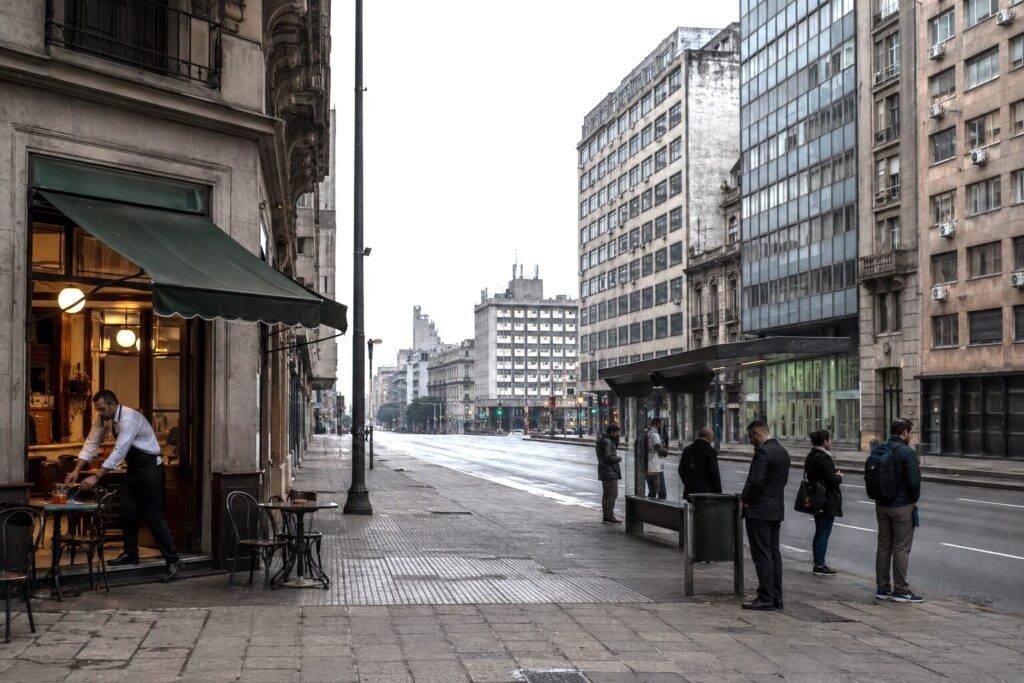
There are no military upheavals, no sudden collapses that awaken the masses in the middle of the night, nor do we hear the sirens of an imminent economic catastrophe. Everything unfolds in a civilized twilight, beneath a leaden sky and with the unwavering certainty that, whatever happens, the bus will arrive on schedule—even if a little late—and the neighborhood café will preserve its familiar ritual.
We live in the kingdom of moderation, in that land where excess is frowned upon and excessive ambition is punished by the suspicious gaze of one’s neighbors.
Yet once we lift our eyes beyond the tranquil surface and dare to compare our national reflection with the world’s most demanding benchmarks—such as the Elite Quality Index (EQx), which from the sober perspective of St. Gallen audits the deeper pulse of nations—the idyllic postcard begins to crack.
We then discover that our proverbial moderation is not necessarily a republican virtue but rather the perfect alibi for a system that has mastered the art of managing decline without making much noise.
The Comfort of Mediocrity and the Neighbor’s Mirror
For decades, Uruguayans have cultivated a pastime as harmless as it is useless: measuring ourselves against the broken mirror of our neighborhood.
Within Latin America, where populist volatility, runaway inflation, and recurring institutional plunder are commonplace, Uruguay stands out as a remarkable exception. We enjoy peaceful alternation in power, relatively low perceived corruption in everyday life, and an institutional tidiness that many parts of the continent would envy.
But this Pyrrhic victory is, at its core, an intellectual trap. Measuring ourselves against the failures of others in order to proclaim success is the preferred refuge of institutional mediocrity. It is the optical illusion of the one-eyed man in the kingdom of the blind.
Once a country becomes satisfied with merely avoiding disaster, it automatically renounces greatness. This is where elite quality metrics become merciless: they place us in a state of global mediocrity, suspended in a statistical purgatory where formal stability conceals painful structural stagnation.
Why does this happen?
Because the elites who lead us—political, corporate, and social alike—do not operate according to the logic of creative destruction, that Schumpeterian force that demolishes the obsolete to make room for the new and the efficient.
Instead, they function under the pact of “moderate extractivism.” No one openly loots the public square, no one arbitrarily confiscates citizens’ savings overnight. Instead, something infinitely subtler takes shape: state corporatism.
It is a tacit arrangement in which the rents of an economy suffocated by regulation are distributed in exchange for preserving social peace, guaranteeing bureaucratic employment, and shielding sectoral privileges that smother any genuine impulse toward innovation.
The Invisible Cost of an Expensive Country
Let us speak plainly about our famous and silent burden: being an expensive country.
This is not a geographical curse or a quirk of fate. The “Uruguay cost” is the exact price we pay to sustain an overweight Leviathan that is inefficient and deeply suspicious of competition.
Every inflated public utility rate, every arbitrary regulation protecting a favored monopoly, every excessive tax or burdensome rule imposed upon the productive sector represents nothing more than a silent transfer of resources.
Value creators—the entrepreneur, the producer, the investor willing to risk capital in uncertain conditions—are stripped of resources in order to sustain a bureaucratic machine whose greatest talent is its own self-preservation.
The gravest consequence, however, is not the money that disappears, but the talent that leaves.
What future awaits a society where the highest aspiration of a talented young person is to secure a government job or find a comfortable place within a protected market?
While the world races ahead through technological breakthroughs, decentralization, artificial intelligence, and systemic agility, we remain trapped in endless debates over corporatist arrangements, prisoners of a nostalgic statism that mistakes dependency for dignity.
The Anesthesia of Tutelage and the Loss of Direction
The most tragic consequence of this model cannot be measured in the Central Bank’s spreadsheets but in the civic spirit of its citizens.
For decades we have been conditioned to delegate our personal sovereignty to the supposedly protective hands of a paternalistic state.
A narrative of exceptionalism has been built to justify crushing taxation under the promise of social protection. In practice, however, that tutelage does not protect the vulnerable; it protects the institutional framework that keeps them dependent.
We have been taught to beg for imaginary rights while quietly surrendering our concrete freedoms. The free citizen, master of his own destiny and responsible for his own achievements, gradually gives way to the obedient electoral client, grateful for the crumbs distributed by a magnanimous bureaucracy fearful of genuine change.
Under this arrangement, politics ceases to be the noble art of establishing fair rules and becomes the peaceful administration of a vast lottery managed by political parties. The color of the banner flying above the mast matters little; the institutional glue binding governments and timid oppositions together is exactly the same: fear of telling the truth.
No one wishes to bear the “political cost” of dismantling entrenched privileges because, deep down, it is assumed that voters are incapable of enduring the responsibilities that accompany freedom.
The Urgency of Awakening from a Comfortable Dream
Today Uruguay resembles a third-class ocean liner sailing through calm waters with its engines shut down for far too long, while the current gently carries it toward the shoals of irrelevance.
We will not sink amid flames and panic. We will slowly fade away, becoming an expensive and boring folkloric postcard—a living museum of what, more than a century ago, we were once capable of building when we dared to face the world with confidence.
Breaking this spell requires far more than cosmetic electoral alternation. It demands a revolution of common sense and intellectual courage. It requires elites to stop behaving as guardians of a shrinking spoils system and instead embrace the risks of genuine competition. It demands dismantling corporatism, sweeping away absurd regulations, and restoring to individuals sovereignty over the fruits of their own effort.
Lukewarmness is not moderation; it is the prelude to collective suicide.
To continue managing decline with a foolish smile is not patriotism—it is complicity with mediocrity.
And history, which has always been merciless toward complacent societies, will ultimately judge us not for the spectacular failures we managed to avoid, but for the unforgivable opportunities we allowed to slip away simply because we feared being free.
Elite quality
State corporatism
Freedom and competitiveness
Continue reading in Global Order and Geopolitics
Apoyá la continuidad de Perspectiva Liberal
Perspectiva Liberal es un espacio editorial independiente. Si valorás este trabajo y querés colaborar con su continuidad, podés hacerlo mediante un aporte voluntario a nuestra cuenta Prex.
Cuenta Prex: 13440