
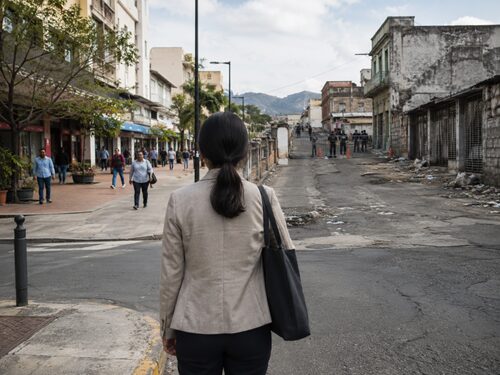
Leydis Aguilera’s testimony exposes the contrast between Cuba’s extractive dictatorship and Uruguay’s institutional tradition of individual freedom.
A CUBAN-URUGUAYAN MEMBER OF PARLIAMENT
Explains in a Free Parliament the Difference Between a Dictatorial Government
and Its Suffering People, Between Forced Exile and Freedom
By Dr. Nelson Jorge Mosco Castellano
How Hard It Is for Us to Understand!
You walk down the street, look at this blessed Uruguay—this corner of the world where we still have the luxury of arguing about interest rates, transaction taxes, or whether the fiscal rule measures debt or spending—and you forget what is happening just two steps away.
We get distracted.
We believe freedom is like air: it is simply there, we breathe it for free, it comes with our ID card, and nobody can take it away from us.
Woe to us if we let our guard down!
Look at the life of Leydis Aguilera.
Look at it closely. It is the stark testimony of what happens when politics comes up with the brilliant idea of nationalizing even people’s souls.
She says it from lived experience, risking her family by saying what she thinks, but she says it clearly and loudly anyway: CUBA IS A DICTATORSHIP.
A tyranny that indoctrinated its people and is being defeated by desperation.
A dictatorship that keeps political prisoners for saying they are fed up with their government.
This is where Daron Acemoglu meets the very reality of twenty-first-century tyrannies.
What does Acemoglu teach us through the political economy of extractive institutions?
That countries do not fail because of climate or bad luck; they fail because of institutions.
And when institutions are extractive, when power is concentrated in a clique, in a nomenklatura that uses the State as its personal estate, the inevitable result is the destruction of the human being.
What Leydis experienced—an engineer in telecommunications specializing in high technology and medical equipment—is not some distant anecdote about bored bureaucrats; it is the perfect X-ray of an extractive system taken to its totalitarian extreme.
What did the Cuban regime do to her and to thousands like her? Extract the fruits of their effort, confiscate their wages, appropriate their highly skilled labor through contracts of modern slavery disguised as “solidarity missions,” and deprive them of their freedom of movement.
They even stole her right to choose her own destiny.
And look at the brutal paradox of education and effort. In communist Cuba, gaining access to university required surviving fierce demands, unforgiving entrance exams, and constant filters where nothing was handed to anyone.
But pay attention: that hyper-meritocratic rigor served a machine of indoctrination and servitude.
And look at the contrast with our country! Here, in our public universities, under the excuse of a misunderstood notion of free education, we have built a paternalistic system where a student can linger forever in the hallways, taking courses for decades at taxpayers’ expense, never graduating and devoting themselves purely and exclusively to activism and student unionism.
An unsustainable corporate privilege that ends up punishing those who work and pay their taxes to maintain faculties transformed from stairways of professional advancement into political placement agencies!
That is why it hurts so much to see the astonishing persistence of that homegrown communism, of that local and corporatist left which, with an unbearable smirk of moral superiority, spends its life lecturing others about human rights while protecting, covering for, and quietly justifying the Cuban dictatorship.
That is their ideological matrix!
They are incapable of raising a single genuine voice to defend the rights of the Cuban people, of political prisoners, of young people who flee on a raft, or of professionals like Leydis, whom they treat like cattle.
They prefer to maintain a complicit silence or manufacture geopolitical alibis to defend tyrants, so long as they do not contradict the outdated dogmatism they use to climb above their fellow citizens.
Faced with that, one looks at our own system, with all its imperfections, with its statist nostalgias that every so often return to the attack like annoying ghosts, and says: Wake up, people!
In Uruguay, thanks to our institutional tradition—the one that built the country on liberal foundations sown by Artigas, on respect for the law, property, and the dignity of the individual—the State is, or should be, an impartial referee, not a slave owner.
Here, the citizen is born free and becomes responsible for his own actions.
Nobody tells him what he must think, what book to read, at what price to sell his effort, or which port he may travel to. Freedom of opinion is not a permit granted by the official in power; it is a sacred right.
What is so profoundly striking is seeing how some people here, even after so many holocausts caused, still flirt with the shiny trinkets of collectivism.
They want to sell us the story that the State solves everything, that centralized planning will bring us a panacea, when reality screams in our faces that collectivism is the prelude to material and moral misery.
Collectivism begins by taking away the fruits of your labor and ends by expropriating your conscience.
Daron Acemoglu demonstrates it with numbers and history: nations prosper when they have inclusive institutions that guarantee property rights, competition, and economic and political freedom.
Jorge Batlle told us so at every turn, with that irrepressible passion of his: Uruguay’s engine is the free individual—the one who takes risks, produces, studies rigorously, and does not ask permission from the police chief or the local party committee in order to succeed.
Leydis Aguilera came to remind us, from the depths of pain and tyranny, that freedom is neither negotiable nor something to be given away.
Her time in our Parliament as a deputy for the National Party cries out to us:
“Protect what is ours. Defend our institutions tooth and nail against the merchants of servitude, because the line between a democracy that tolerates and respects the citizen and a totalitarian dungeon is far thinner than we think.”
Come on, Uruguayans!
Lift your hearts and defend freedom!
Cuban dictatorship
Institutions and freedom
Collectivism and servitude
Continue reading in Global Order and Geopolitics
Apoyá la continuidad de Perspectiva Liberal
Perspectiva Liberal es un espacio editorial independiente. Si valorás este trabajo y querés colaborar con su continuidad, podés hacerlo mediante un aporte voluntario a nuestra cuenta Prex.
Cuenta Prex: 13440