
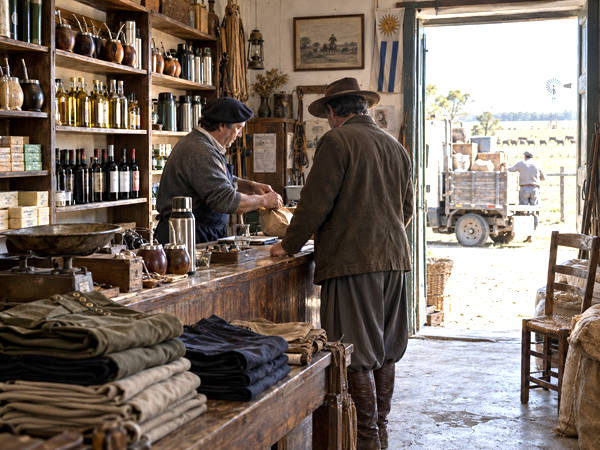
From a general store founded in 1843 to a nationwide distribution network, the story of a family business that has connected products, people and opportunities for more than 180 years.
CARRAU: WHEN COMMERCE CHANGES CULTURE
A general store founded in 1843, a shipment of gaucho trousers arriving from Europe, Yerba Sara, shopkeepers in remote rural areas and a conversation over dinner in London.
The story of a business family that has spent more than 180 years connecting people, products and opportunities.
By Santiago H. Pereira Testa
In 1996 I joined a Uruguayan trade delegation that traveled to England to attend the Royal Show, as part of an activity linked to the British Chamber and the British Embassy.
I was still living in Tacuarembó and chaired the department’s business association.
During that trip I spent quite a lot of time with Ernesto Carrau.
I greatly enjoyed his stories.
I never forgot one of them.
Curiously, it had to do with something that any Uruguayan considers naturally our own.
Gaucho trousers.
According to Ernesto, after the Crimean War a shipment of those enormous trousers made for Turkish troops had been left in England.
Through one of those twists of nineteenth-century maritime trade, the cargo ended up in Montevideo.
Shipping it back would have cost more than liquidating it.
It went to auction.
And, according to the tradition preserved by the family, Carrau bought that shipment for next to nothing.
Then he did what he knew how to do.
He distributed it throughout the countryside.
Rural workers found those loose trousers particularly comfortable for riding and working.
They bought them.
They wore them.
And eventually adopted them.
Years later I had the opportunity to tell that story to Fernando Assunção, probably Uruguay’s most important researcher of gaucho culture.
The story ended up being included in one of his books.
Assunção had studied the origin of gaucho trousers and did indeed document the traditional connection between the garment and the loose trousers worn by troops of Turkish origin, as well as European surpluses left after the Crimean War. He also found documentation showing that similar garments were already circulating in the Río de la Plata before that war, so the story of their origin is certainly much more complex.
But what Ernesto had told me added another fascinating element.
The merchant.
Because customs do not travel by themselves either.
Someone transports the objects.
Someone buys them.
Someone discovers that they can be sold.
Someone takes them to places they had never reached before.
And someone finds a use for them different from the one for which they were originally made.
Then something extraordinary happens.
A foreign commodity happens to appear in a port.
A merchant spots an opportunity.
The stores carry it into the countryside.
Rural people find it useful.
A generation later, nobody remembers where it came from.
And much later, we consider it part of our identity.
That is how commerce also changes culture.
That story made me remember another detail about Ernesto that had surprised me during the same trip.
He knew the shopkeepers of Tacuarembó.
Not only the major merchants in the departmental capital.
He would tell me about small stores in remote rural towns and knew perfectly well who stood behind the counter.
Naturally, I knew my department.
That was why I could appreciate the significance of what I was seeing.
Ernesto did not know “the interior market” as an abstraction written in a commercial report.
He knew the people.
Much later I understood that this probably contained one of the explanations for Carrau’s longevity.
A true distribution company is not simply about placing boxes on a map.
It is about building relationships.
And the history of that particular way of doing business had begun more than a century and a half before our trip.
Juan Carrau y Ferrés arrived in Montevideo on November 17, 1841.
Uruguay had enjoyed constitutional government for only eleven years.
Two years later, with the support of the Catalan Castells family, he acquired a modest general store on the Camino Real, approximately where 18 de Julio and Paraguay intersect today.
He called it El Navío.
It sold wine, yerba mate, oil, soap and other basic products in a Montevideo that was still small.
From those early days there also remained a phrase attributed to the founder:
“With good wine, good yerba, good oil and good soap, the business cannot fail.”
And a motto that would survive for generations:
“Honesty and Integrity.”
In 1855 Juan called on his brothers Pablo and Pedro to join the business.
In 1868 he returned to Catalonia, and his brothers transformed that old retail store into a wholesale house.
Carrau & Cía. was born.
They imported oil, sugar, tobacco and wines.
They exported jerked beef, dry hides and other Uruguayan products.
The general store had become a foreign trade company.
And here we find a first explanation for its survival.
Carrau never limited itself to continuing to do what it had started out doing.
A company that had remained behind the counter of a Camino Real general store waiting for customers would have disappeared along with that world.
Carrau changed. It was a retailer. A wholesaler. An importer. An exporter. An industrial producer. A brand owner. A representative of international companies. A distributor. A logistics operator.
Each generation received an organization from the previous one.
But none could simply preserve it.
In 1912 the family’s history also became linked to one of the best-known events of the twentieth century.
Francisco Carrau Rovira had traveled to Europe on business and was returning accompanied by his cousin José Pedro Carrau Estévez.
The ship was the Titanic. Both died in the sinking. The company continued.
In 1918 it created a brand that would become part of everyday life for generations of Uruguayans.
Yerba Sara.
More than a century later, it remains on the market.
Once again, something similar to the story of the gaucho trousers occurs.
Few things seem more naturally Uruguayan to us than drinking mate.
Yet yerba mate does not grow naturally in our fields.
Behind that everyday product, supply, selection, processing, importing, storage, branding, transportation and distribution all had to be organized.
Someone had to make sure that yerba mate finally reached the store in a small town in Tacuarembó.
Perhaps that is why it was less surprising that Ernesto knew the shopkeeper.
He was part of the business.
Throughout the twentieth century, Carrau continued to transform itself.
In 1944 it became a corporation.
In 1960 it began producing Old Times whisky in Uruguay, which it had previously imported from Scotland.
In 1969 it took on the Castrol representation, a commercial relationship the company maintains to this day.
And so we return to London in 1996.
At one of the dinners to which we had been invited, I happened to be seated next to the manager of United Distillers.
Ernesto came over.
He asked whether I would switch seats so that he could sit beside him.
Naturally, I agreed.
They spent much of the dinner talking.
My recollection is that this relationship eventually led Carrau to obtain the representation of Old Parr, which it had not had until then.
What is interesting is that there is also documentary evidence that places that scene perfectly in context.
In April 1996, a partnership called United Distillers Carrau had been established to market the British group’s international brands in Uruguay. A publication from that year even showed Ernesto Carrau, Ernesto Carrau Jr. and the general manager of United Distillers together.
I cannot know exactly how much of that deal was decided during that dinner.
I can tell what I saw.
Ernesto immediately identified the person he wanted to speak with.
He saw an opportunity. He asked me for the seat. He sat down.
And he talked business.
It may seem like a minor social anecdote.
To me, it seems exactly the opposite.
That too is business craft.
Recognizing an opportunity when it appears and knowing what to do with it.
Some companies survive because they possess enormous assets.
Others because they have a patent.
A mine.
Exceptional land.
A technology that is difficult to reproduce.
The competitive advantage of a distribution company is considerably less visible.
It often consists of an enormous web of relationships built over decades.
With suppliers. With international brands. With supermarkets. With shopkeepers. With transport operators. With salespeople. With consumers. With people.
In an interview conducted years later, members of Carrau explained that the company was in the hands of members of the fifth and sixth generations and that one of the keys to preserving it had been avoiding the endless fragmentation of family ownership.
As the generations expanded, those who remained involved in the company sought to repurchase shares and reconcentrate control.
There was also a revealing family expression.
The young people grew up inside “the store.”
It was not merely an inherited company.
It was a learned craft.
Another Ernesto Carrau, by then a representative of the sixth generation, would later explain that he considered it an obligation to develop the company so that he could hand it over to the generations that followed.
The expression deserves attention.
Not receive it.
Hand it over.
There is an enormous difference between the two.
Today Carrau remains a major distribution organization.
It reports more than five thousand direct customers, dozens of salespeople and vehicles dedicated to reaching the national market.
But when I look at those numbers, I remember something else.
Ernesto talking to me about the owner of a small store in a remote town in Tacuarembó.
Perhaps that was where Carrau’s true infrastructure lay.
Not only in the warehouses.
In memory.
In knowledge of the territory.
In relationships built over generations.
And then I return to that story of the gaucho trousers.
It does not matter very much whether that shipment was exactly the first to reach the Río de la Plata or whether the garment had already begun to circulate through other channels.
What matters for this story is something else.
A commercial company may seem less spectacular than a large factory.
It has no smokestacks.
It does not transform steel.
It does not extract oil.
It does not manufacture automobiles.
But it connects worlds.
It carries a product from a European port to a store lost in the countryside.
It brings an international brand to a Uruguayan consumer.
It brings Brazilian yerba mate to an Oriental mate gourd.
It connects a British executive with a Montevideo businessman over dinner.
And sometimes it puts into circulation objects that end up changing the way we dress, consume or live.
That creates wealth too.
And sometimes it creates culture.
When Juan Carrau opened El Navío in 1843, he could hardly have imagined that more than 180 years later a company would still be operating under his surname.
Nor could I have imagined, during that visit to England in 1996, that thirty years later I would end up remembering Ernesto’s stories in an attempt to understand why that company had survived for so long.
But today I think I understand it a little better.
Carrau did not survive by always doing the same thing.
It survived by doing something fundamentally much deeper.
Connecting people with opportunities.
From a general store on the Camino Real to stores across the countryside.
From a shipment arriving by sea to a garment we would end up believing was our own.
From an executive seated at a dinner in London to a new business in Montevideo.
Commerce also helped build Uruguay.
And sometimes, without our realizing it, it even helped build what we call tradition.
Commerce and cultural change
Distribution and business relationships
Family business continuity
Continue reading in From Lafone to Jodal

Apoyá la continuidad de Perspectiva Liberal
Perspectiva Liberal es un espacio editorial independiente. Si valorás este trabajo y querés colaborar con su continuidad, podés hacerlo mediante un aporte voluntario a nuestra cuenta Prex.
Cuenta Prex: 13440