
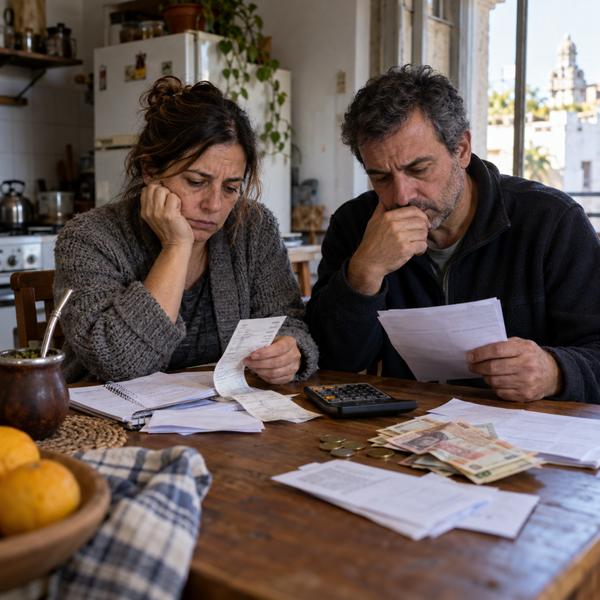
A fiscal survival manual: how to hand your salary over to the State and still owe an arm and a leg
FLEECED
A fiscal survival manual: how to hand your salary over to the State and still owe an arm and a leg
By Dr. Nelson Jorge Mosco Castellano
Imagine for a moment that you are an average Uruguayan citizen, one of those belonging to the glorious platoon of 1,380,000 formal workers.
You religiously get up every morning, clock in, produce, keep the economy moving, and cherish the quaint nineteenth-century illusion that your effort belongs to you. How adorably naïve!
Let us mathematically analyse your financial Via Crucis under the DGI’s apotheotic tax collection in 2025 — almost 700 billion Uruguayan pesos.
Prepare yourself for the feast of numbers, because reality is so acidic that it either makes you laugh or sends a chill down your spine.
Phase 1: The preliminary caress of the payslip
Let us suppose you manage to earn the national median income: a dazzling 40,000 pesos nominal per month, around 480,000 pesos a year.
Before you even get a chance to look at the money, the State swings the scythe.
Between pension contributions, stamps and FONASA’s bite — because being forced to pay for healthcare only to end up paying privately for a service that actually works is a national classic — almost 20% is amputated from the outset.
Of your nominal 40,000 pesos, a meagre 32,000 pesos reaches your hands.
You have already begun the month 8,000 “rupees” down simply for having dared to work formally.
Phase 2: VAT, or the art of charging you even for the air you breathe
With those clean 32,000 pesos, you bravely head out into the street to commit the only act available to a citizen whose State is fleecing him: trying to survive.
You pay rent, buy food, get yourself a pair of sneakers and turn on the lights.
Here you encounter the pillar of national tax collection: VAT, which accounts for 48.4% of the DGI’s revenue pie.
Since mass consumption is carved up by indirect taxes, of the 32,000 pesos you spend, at least some 7,000 automatically dissolve into State coffers as pure, unadulterated VAT.
The partial balance: How much is left to live on?
Let us do the sums without losing heart.
Annual nominal income: 480,000 pesos.
Initial State bite — contributions and social security: minus 96,000 pesos.
Subsequent State bite — VAT on subsistence consumption: minus 84,000 pesos a year.
Total handed over to the Treasury each year: around 180,000 pesos out of your 480,000.
In plain language: you work almost five full months exclusively for the State.
The other seven months are divided between eating, paying debts and praying that you do not become seriously ill.
Personal savings, of course, have been filed away under science fiction.
The grand finale: And what if they also make us pay the foreign debt?
As if the prospect of being a full-time tax slave were not enough, let us add a bonus track worthy of advanced economics.
Uruguay’s total gross external debt stands at around US$50 billion — roughly 2 trillion Uruguayan pesos at the current exchange rate.
Since the State cheerfully spends more and more than it collects and finances the party through ever-growing debt, let us imagine for a moment the diabolical idea that the government decides to pass the hat around the productive sector to cancel the entire external debt in one fell swoop.
If we divide those 2 trillion pesos of hard, uncompromising external debt strictly among the 1,380,000 formal workers who keep the country afloat…
The blow: Each worker would have to pay a lump-sum “patriotic contribution” of 1,449,275 pesos.
Translation into real life:
To cancel the external debt accumulated by the political class over decades of inefficiency, corruption and insatiable spending, each formal worker would have to hand over his entire current salary for more than three consecutive years, without eating, dressing, paying electricity bills or breathing, exclusively to bring the State’s accounts with its international creditors down to zero.
The State, after all, “takes care of you.”
Poetic conclusion
While the DGI celebrates record tax collections, Uruguay’s productive citizen walks along a perfectly designed cliff edge: his salary is confiscated before he touches it, he is fleeced through taxes every time he consumes, he is punished if he retires through the IASS, and, to crown the achievement, he is saddled with a burden of external debt that would require three lifetimes of slave labour to repay.
A truly well-rounded model: the State spends, the politician applauds, and the worker pays for the party… until the candles finally burn out.
Now let us look at the calculation for a typical family: a married couple with a seven-year-old child.
The model family versus Leviathan: when the entire household works for the State
If the fiscal squeeze already borders on the absurd at the individual level, applying the same exercise to a family reveals the true dramatic scale of Uruguay’s tax architecture.
Let us take the classic household consisting of a married couple and a seven-year-old child.
To make the simulation realistic, let us assume that both spouses work formally and each earns the national median income — 40,000 pesos nominal per month per person.
The household therefore has a total nominal income of 80,000 pesos per month, or around 960,000 pesos per year.
Prepare yourself to see how the pincers of the DGI, public spending and State liabilities dismantle this family’s budget.
Phase 1: The double-barrelled blast to the payslips
Before even setting foot outside, the couple suffers the first institutional blow twice over.
Between pension contributions and social-security/FONASA deductions from both salaries, the State immediately confiscates close to 20%.
Of the original nominal 80,000 pesos, the family is left with a combined net income of around 64,000 pesos.
They have already started the month 16,000 pesos poorer before buying a single litre of milk.
Phase 2: Family VAT, or the punishment for having a school-age child
With those 64,000 net pesos, the couple goes out to face the month.
And this is where the equation becomes merciless, because raising a seven-year-old child in Uruguay — notebooks, school uniform, footwear, specific foods, healthcare, transport and medicine when he comes down with a throat infection — pulverises whatever margin remains for survival.
Since mass consumption is suffocated by VAT, which represents 48.4% of DGI tax collection, and virtually 100% of that money is poured into household survival, at least around 14,000 pesos disappear relentlessly at the checkout counter in indirect taxes.
The household balance: Who is supporting whom?
Let us calculate the annual total for this typical family.
Gross nominal household income: 960,000 pesos per year.
Initial bite — contributions from both workers: minus 192,000 pesos per year.
Subsequent bite — VAT on household consumption: minus 168,000 pesos per year.
Total handed over to the Treasury each year: around 360,000 pesos.
In plain language: between them, the two spouses work almost five full months of the year exclusively to finance the State, while during the other seven months they juggle rent, food and school supplies for their seven-year-old child.
Family savings are nowhere to be seen.
Their room for manoeuvre has been reduced to a waterline.
The dystopian epilogue: the family burden of external debt
As though it were not enough for this couple to spend half their working lives supporting the machinery of the State, let us draw back the curtain on macroeconomics and see how much their seven-year-old child stands to inherit in public liabilities.
The total gross debt of Uruguay’s public sector stands at around US$64.1 billion, equivalent to more than 2.5 trillion Uruguayan pesos.
The bill per household: If we divide that mountain of State liabilities among the households formally supporting the system, this married couple would be responsible for a “proportional share” of sovereign debt of approximately 1.8 million pesos.
The literal translation: For this family to cancel its proportional share of the debt accumulated by the political class, both spouses would have to hand over the entirety of both salaries for more than two consecutive years, literally living on air, without eating, paying the electricity bill, buying school sneakers for their child or turning on the heating.
Final conclusion
The Uruguayan model is a masterpiece of fiscal engineering: it begins by fleecing the father and mother through their payslips, robs them again through VAT when they buy their child’s school notebooks, penalises them if they manage to retire, and leaves future generations with a monumental mortgage so that the public-spending party never has to end.
A perfect machine designed to ensure that the effort of an entire family ultimately becomes nothing more than an accounting entry in the Excel spreadsheet of an insatiable bureaucracy.
P.S.: tissues are subject to VAT too.
Tax burden
Disposable income
Public debt
Continue reading in Global Order and Geopolitics
Apoyá la continuidad de Perspectiva Liberal
Perspectiva Liberal es un espacio editorial independiente. Si valorás este trabajo y querés colaborar con su continuidad, podés hacerlo mediante un aporte voluntario a nuestra cuenta Prex.
Cuenta Prex: 13440