
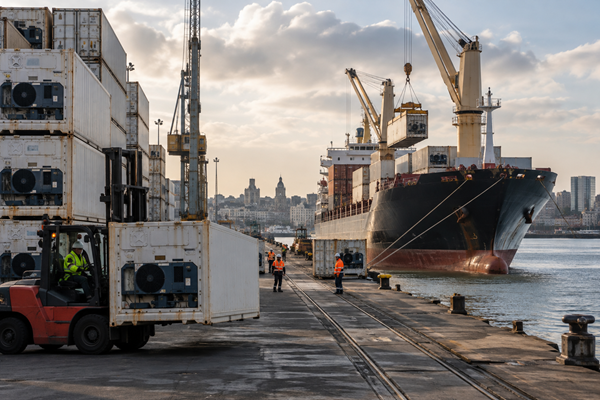
A satire on political alignment, trade sovereignty, and the geopolitical pressures shaping Uruguay’s decisions.
WITH ME OR WITHOUT ME
By Dr. Nelson Jorge Mosco Castellano
It all began with a slip of the tongue at a fervent political rally in nineteen eighty-three, when a hoarse-voiced caudillo proclaimed before the crowds that victory would come “with me or without me.”
This famous phrase was uttered by Argentine politician Herminio Iglesias in 1983, during his campaign as the Justicialist Party candidate for governor of the Province of Buenos Aires.
The exact phrase he pronounced was: “Peronism will triumph with me or without me,” committing a famous linguistic slip by incorrectly applying the structure of the Spanish word conmigo to the preposition sin.
At the time, grammarians tore their hair out and newspapers mocked the blunder, unable to see that the lapse was not merely a stumble of the tongue, but the involuntary christening of the purest form of totalitarian philosophy.
That grotesque neologism in fact contained the perfect synthesis of political dogma: the absolute cancellation of the other.
Either you are inside the apparatus, or the apparatus does without you, but your very existence remains confiscated under the guardianship of the Leader.
Forty years later, in the offices of the Ministry of Truth and Hemispheric Alignment, control panels no longer measure tons of pig iron or metres of fabric, but degrees of ideological docility.
The screens display a map of the great southern plain, where a small wedge-shaped country insists on maintaining the ridiculous pretension that its compass points toward its own Lusophone north.
Fools!
The Geometry of the Collective Spirit has decreed that compasses have only two poles: the immaculate East and the impure West, while between them lies only the abyss of free will.
Applied to this scenario, the logic of “with me or without me” materializes in the demand for political alignment and in pressure on the resources and trade advantages of Uruguay’s left-wing government for the benefit of the geopolitics of the northern giant, and of its president Lula, who needed to show his beleaguered beef producers that he had secured them a borrowed escape route.
In the language of political satire, the scene would read as follows:
—And what if the Broad Front does not fully align itself, or gives priority to the interests of Uruguayan producers over those of the northern colossus?
—It does not matter: the deal goes ahead with me or without me.
Beyond the political game, institutional and commercial reality ultimately imposed a strict limit: despite Orsi’s efforts and political intentions to assist Brazilian producers by force, once their own quota had been exhausted, Beijing stopped the manoeuvre and made it clear that quotas and preferential tariffs cannot be freely transferred among Mercosur partners, thereby protecting the availability of its quota authorisations, which are non-negotiable, for Uruguayan exports.
The slogan echoing through the loudspeakers of the Plaza of Obligatory Consensus updates that old slip of the tongue in all its rawness:
“The herd will march with me or without me.”
There are no middle positions in the Ministry of Livestock, content as long as the cattle are exported at a good price without affecting its morbid condition.
Seeking to trade with a bloc that harbours hegemonic ambitions while sympathising with the ruins of the other constitutes a crime of doublethink.
The bureaucrats of the continental diplomatic institutional apparatus, whose bank accounts and fiery speeches about other people’s poverty contrast with the opulence of their accommodation in five-star hotels, demand unconditional surrender.
The State is not an instrument for administering the lives of citizens; it is a temple where national sovereignty must be sacrificed on the altar of the progressive abstraction that is collapsing into pieces on both sides of the ocean.
On one side, through the democratic vote.
On the other, through the pressure foretold in 2015 by Michel Houellebecq in “Submission”:
“Europe is not many generations away from becoming a Muslim population.”
A predominance that is being achieved through uncontrolled immigration (“the feared invasion”) or “through the wombs of our women, who will give us victory.”
Facts are stubborn, and economic reality cannot withstand the pressure.
In the streets of European capitals, ordinary citizens watch as welfare systems collapse under the weight of their own bureaucracy, expanded to an unbearable ecstasy that raises foreign flags of hatred.
Meanwhile, academic ideologues, vulgar thieves of other people’s lives, continue exporting recipes for misery toward the south; our south.
In Latin America, the trail of suffocated economies, pulverised currencies and societies burdened by dependence on the State is presented by official propaganda as a “triumph of social justice.”
If reality contradicts the narrative, so much the worse for reality.
In this new phase of the Great Game, the freedom to choose with whom to trade or which alliances to enter into becomes a counterrevolutionary offence; or an expensive exercise in freedom and sovereignty.
Either one meekly accepts the gifted quota, the manipulated tariff, ideologically branded technology and the guardianship of regional strongmen who are leaking from every seam, or one is labelled a traitor to the dogma.
The dilemma is merciless.
On the great global chessboard, where empires fall, as they have throughout history, and narratives rot in their own arrogance, the slogan of ideologised centralised power continues to echo through the corridors of the Palace:
Either you are with us or you are against us… but since Herminio’s dissent is fictitious, it does not exist; if you are not with us, you are wrong, and therefore you march anyway: with me or without me.
The psychological battering drives us along the imposed path; and the cost, much to our regret, will be paid dearly for associating ourselves with tyrants.
Trade sovereignty
Geopolitical alignment
Dogma and dissent
Continue reading in Global Order and Geopolitics
Apoyá la continuidad de Perspectiva Liberal
Perspectiva Liberal es un espacio editorial independiente. Si valorás este trabajo y querés colaborar con su continuidad, podés hacerlo mediante un aporte voluntario a nuestra cuenta Prex.
Cuenta Prex: 13440