
The path of an entrepreneur who helped connect Uruguay with modernity without escaping the prejudices of his time.
JOAQUÍN SERRATOSA: MODERNITY AND CONTRADICTIONS
General Motors, Goodyear, Westinghouse and Rotary: the trajectory of a businessman who brought modernity to Uruguay’s interior and eventually projected himself onto the world stage.
By Santiago H. Pereira Testa
Long before I truly knew who Joaquín Serratosa Cibils had been, his name already belonged to my family’s history.
My grandfather, Humberto F. Testa, maintained such a close commercial and personal relationship with him that, when he sent his children as boarders to the Methodist Crandon Institute in Montevideo, he appointed Don Joaquín as their guardian. Serratosa was closely connected with the school and served on its board.
My mother was among those children.
Something else happened there that would prove fundamental to her future: her physical education teacher, Alcira López Ibarburu, introduced her to Logosophy, which would come to occupy a central place in her life.
You do not entrust your children to the care of a mere supplier.
There was trust there.
In my family, it was also always said that Serratosa had been the one who granted my grandfather the Chevrolet representation in Tacuarembó.
The documentation recently sent to me by the Rotary Club of Montevideo helps us better understand that family tradition. Serratosa y Castells, a firm founded in 1914, represented General Motors in Uruguay, as well as Goodyear, Westinghouse and other international companies.
That is how an extraordinary document from 1928 that I still keep falls into place: General Motors sent Humberto Testa a special train of eighteen railcars carrying thirty Chevrolets, a shipment the company itself described as a national record.
The relationship no longer appears to have been the sum of two independent dealerships, but rather a single commercial chain: General Motors, Serratosa y Castells in Montevideo, Testa in Tacuarembó and, from there, the countryside.
That says a great deal about how modernity reached Uruguay’s interior at the time.
Joaquín Serratosa Cibils had been born in Montevideo in 1884.
He pursued university studies that he did not complete and, while still very young, chose rural life.
Contemporary biographies portray him starting with basic farm work and eventually becoming a trusted man responsible for driving cattle.
In 1914, together with Alberto Castells, he founded Serratosa y Castells. Automobiles, tires, electricity, radio and heating were all part of the commercial universe he helped introduce and distribute.
Behind that list, a pattern emerges: Serratosa traded in modernity.
Innovation could be invented thousands of miles away, but until someone obtained the representation, imported it, financed it and built a distribution network, it had not yet changed anyone’s life.
My grandfather was part of the next stage.
In Tacuarembó, he sold automobiles, shearing machines and radios intended for the countryside.
Modernity arrived in crates, on trains, in machines and in automobiles.
But Serratosa’s networks did not end with business.
He was a director of Banco Italiano del Uruguay, served on the International Olympic Committee and developed an intense institutional activity.
Rotary expanded that dimension even further.
He joined the Rotary Club of Montevideo in 1921.
In 1936 the Rotary Club of Tacuarembó was founded, and its preparatory meetings took place at my grandfather’s country property, as he was part of the founding group.
The commercial network carried products, but it also carried relationships and institutions.
In 1941, Serratosa joined a three-member Rotary commission seeking a way out of the border dispute between Ecuador and Peru.
According to The Rotarian, they worked for four days at his home in Montevideo and devised a formula very close to the solution later proposed in Rio de Janeiro.
The businessman was also revealing himself as an international conciliator.
In 1953 he was elected President of Rotary International.
During his term, 487 new clubs were added.
Joaquín and his wife, Sofía, traveled some 35,000 miles in three months, visited around one hundred Rotary communities in twenty countries and met with heads of state and international figures.
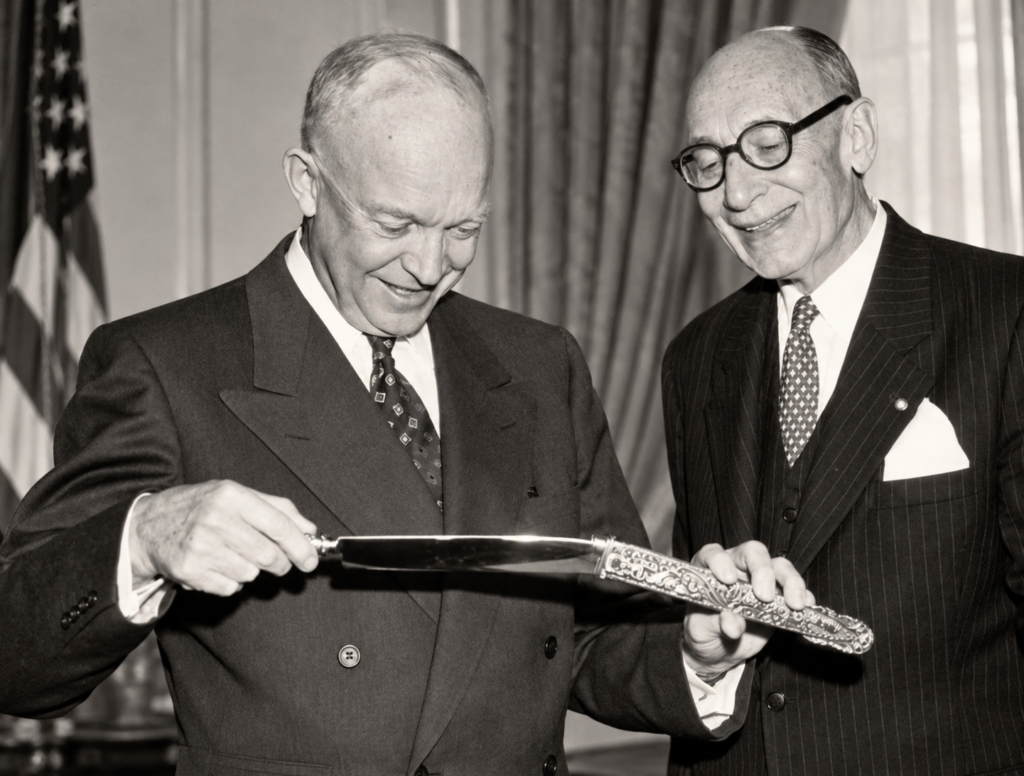
A photograph shows him alongside President Dwight Eisenhower at the White House.
Serratosa presents him, on behalf of Uruguay’s 51 Rotary clubs, with a gaucho knife.
The photo caption points to a coincidence: both men had grown up in cattle-raising environments.
The distance from the Uruguayan countryside to the White House was enormous. Serratosa had traveled it.
Sofía was a traveler, cosmopolitan, and spoke Spanish, English, French and Italian.
Contemporary sources describe her as her husband’s companion, interpreter, adviser and inspiration.
Precisely for that reason, it becomes even more difficult to ignore the memory my mother retained of Don Joaquín.
When, as a young woman, she told him that she wanted to go to the United States to study, Serratosa tried to dissuade her.
According to what she told me throughout her life, he replied: “Women don’t need to study to spread their legs.”
My mother remembered that remark with pain. And she went anyway.
I have no other source for that episode than her direct testimony.
But to conceal it because it does not fit the biography of a great businessman would betray the purpose of this series.
The same man who moved among General Motors, Westinghouse, the White House and a worldwide organization could still retain extraordinarily old ideas about a woman who wanted to study.
The modernization of a society never occurs simultaneously on every level.
Machines travel fast.
Mindsets, considerably less so.
Joaquín Serratosa died in Montevideo on October 22, 1958.
He had connected companies, technologies, institutions and people.
He was one of those intermediaries who enabled a small country to participate in great global transformations and helped those transformations reach the interior as well.
From Lafone to Jodal does not seek to manufacture heroes or hand down condemnations.
It seeks to recover real people and understand how they did what they did.
Serratosa was remarkably modern in many respects.
And, like so many men of his time, considerably less modern in others.
Entrepreneurial modernity
Networks and institutions
Progress and contradiction
Continue reading in From Lafone to Jodal

Apoyá la continuidad de Perspectiva Liberal
Perspectiva Liberal es un espacio editorial independiente. Si valorás este trabajo y querés colaborar con su continuidad, podés hacerlo mediante un aporte voluntario a nuestra cuenta Prex.
Cuenta Prex: 13440