
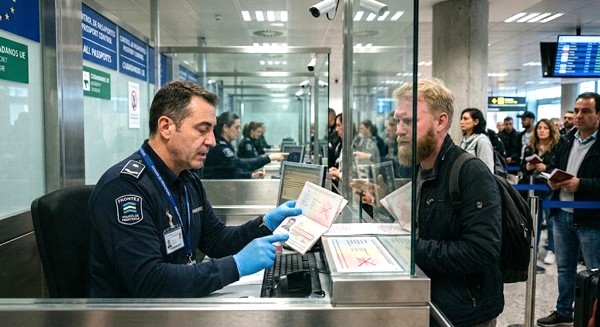
Citizenship, passports and origin traceability in a debate that may extend beyond Uruguay’s borders
There is a mechanism often described in intelligence, diplomatic and organized-crime circles as “identity laundering” or “origin laundering”.
It consists of a maneuver through which a person seeks to detach themselves from their country of birth and from the background or restrictions associated with it.
At the international level, this phenomenon can operate through various channels.
One of them is the omission of the “Place of birth” field.
For organized crime, fugitives, internationally sanctioned individuals or intelligence agents, the place of birth shown in a travel document can be a critical piece of information.
Although a person may legally change their name, surname or nationality, their place and date of birth are immutable.
International security databases, such as Interpol, trace identities by cross-checking different personal data, including name and place or country of birth.
If a passport omitted the place of birth or allowed it to be replaced by the place of naturalization or by a generic entry, the traceability of the holder’s true origin would be reduced and difficulties could arise in immigration and background checks.
The International Civil Aviation Organization (ICAO), which establishes global standards for travel documents, treats the inclusion of place of birth as optional. However, every destination country remains sovereign in setting the conditions for the entry of foreigners.
The United States, for example, applies entry restrictions linked to certain nationalities and travel histories, making the traceability of such information particularly relevant.
The European Union and the Schengen Area also cross-check identity and security information against international databases.
Even in its relations with Latin American countries, the European Union assesses the security and reliability of travel documents.
Canada and the United Kingdom likewise maintain identification and origin-control requirements.
If we add Japan, Australia, New Zealand, the United Arab Emirates or Qatar, we may conclude that documentation perceived as insufficiently traceable can create difficulties for travel to a significant part of the world.
Security agencies regard the absence of verifiable information about identity and origin as a vulnerability that may have consequences for the document holder.
In Uruguay, a foreigner may obtain legal citizenship after meeting certain residence requirements.
However, travel documentation must allow receiving countries to identify the holder and their origin clearly.
An attempt to modify the way such data are recorded in order to place legal citizens and natural citizens on the same documentary footing may come into tension with the security and traceability requirements of other states.
From this we may infer that, if the “interpretive” law proposed by the government were to pass, the harm might affect not only legal citizens but potentially the international credibility of the Uruguayan passport itself.
On the other hand, we should not forget forgery networks and intermediaries dealing in so-called “fantasy passports”.
There are schemes in which corrupt officials in consulates or civil registries issue false birth certificates so that a foreigner can be presented as having been born in a given territory.
In that way, when an authentic passport is later issued on the basis of false documentation, the official document may end up displaying a “laundered” place of birth.
Criminal networks also trade in old documents from countries that no longer exist or passports issued in jurisdictions with lax controls, with the purpose of making it harder to associate a wanted person with their true origin.
This may facilitate attempts by people subject to financial sanctions to operate or enter the global banking system, while at the same time making it more difficult for border authorities to identify individuals wanted by the courts.
When a country issues travel documents perceived as opaque or vulnerable to “origin laundering”, it risks damaging international confidence in those documents and, eventually, affecting visa-waiver arrangements.
The proposed solution of interpreting the Uruguayan Constitution by statute is risky for several reasons.
The Supreme Court of Justice could ultimately consider it unconstitutional.
From a critical perspective, the procedure may be seen as a way of circumventing constitutional reform while at the same time calling into question the reliability of the Uruguayan passport before the international community.
Nor, on the other hand, would all differences between natural and legal citizens disappear.
Legal citizens would continue to be barred from holding the offices of President and Vice President of the Republic, as the Constitution currently provides.
In addition, the time periods established for obtaining legal citizenship and for fully exercising the rights derived from it would remain in force.
Children of legal citizens born abroad would continue to be subject to the regime applicable under the rules in force.
Opposition sectors argue that the urgency with which the government is pursuing the measure could also respond to political and electoral calculations.
Perhaps the governing party believes that tens of thousands of citizens of Cuban, Venezuelan, Dominican, Argentine, Russian or other origins could influence future elections.
Although the logic of electoral gratitude does not always work.
After all, many of those most directly interested in holding a Uruguayan passport without obstacles may be more concerned with travelling or settling in another country than with establishing themselves permanently in Uruguay.
It would seem that what is at stake here is not merely a documentary issue.
The design and composition of the future electorate are also under discussion.
In Spain, reforms linked to the so-called “Grandchildren’s Law” also generated debates over citizenship, nationality and their political effects.
The Uruguayan outcome could ultimately be similar in one essential respect: opening a controversy over the relationship between citizenship, the electoral register and institutional legitimacy.
With the resulting loss of confidence — even more of it — and a persistent suspicion regarding the legitimacy of the electoral roll.
Apparently, faced with the series of defeats the left has been suffering across the region, its leaders seem willing to run the risk.
Citizenship and traceability
Document security
Institutional legitimacy
Continue reading in Global Order and Geopolitics
Apoyá la continuidad de Perspectiva Liberal
Perspectiva Liberal es un espacio editorial independiente. Si valorás este trabajo y querés colaborar con su continuidad, podés hacerlo mediante un aporte voluntario a nuestra cuenta Prex.
Cuenta Prex: 13440