
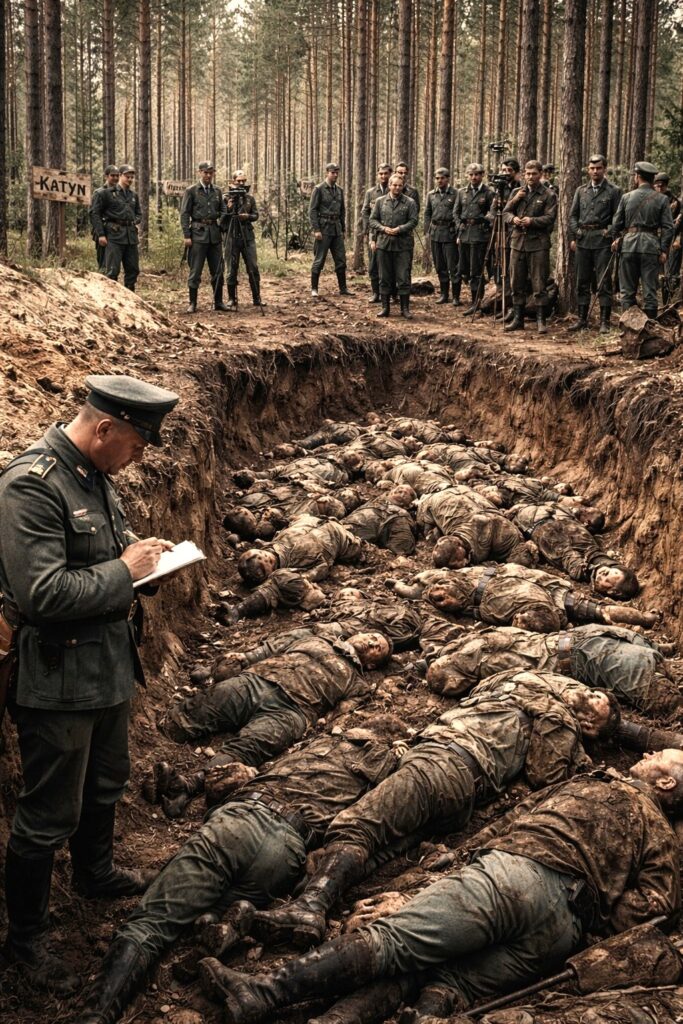
The massacre of Polish officers and the struggle between Nazis and Soviets to impose a historical narrative amid total war
The Orwellian manipulation of History through one of the most macabre wartime discoveries.
Twenty-two thousand bodies, executed with a bullet to the back of the head.
Nazis and communists entangled in a horror that, eighty-five years later, still fuels debate.
The use of History as a political weapon is a constant throughout time.
And if, as Clausewitz observed, war is the continuation of politics by other means, it is precisely in that realm where historical manipulation becomes most evident.
The case we are about to examine began with wolves searching for food in a forest.
Or perhaps it was railway workers who uncovered the mass graves.
What is certain is that World War II was at its peak, and German forces had occupied the Russian city of Smolensk, ninety kilometers from the Katyn Forest.
In April 1943, the Spanish press reported that a Red Cross commission had arrived at Katyn, “where more than ten thousand Polish officers, prisoners of war, had been executed.”
The newspaper added, commenting on the investigation’s findings, that forensic evidence, personal documents dated no later than March or April 1940, testimonies from local inhabitants, and letters found on the victims led investigators to conclude that the mass executions occurred at that time.
The source was the newspaper Falange Española.
The date was crucial.
In 1940, the area was under Soviet control.
The Germans only occupied the region in July 1941.
From this, responsibility pointed clearly toward the Soviets.
The Germans blamed the Bolsheviks.
The Bolsheviks blamed the Germans.
Two totalitarian systems separated by little more than a letter.
Each accused the other of responsibility for the massacre.
The media, as usual, aligned reporting with ideology.
As Jean-Marie Domenach noted, propaganda is the continuation of war by other means.
Both the Third Reich and the Soviet Union mastered that art.
Franco’s Spain, having fought communism in its civil war and with the Blue Division deployed on the Eastern Front, was inclined to accept Soviet guilt.
Communists, unsurprisingly, sought to construct the opposite narrative.
But in this case, one side lied, and the other told the truth.
On April 30, 1943, the Red Cross issued a definitive conclusion: the executions had taken place between March and April 1940.
There was no ambiguity.
The crime was Soviet.
The report was signed by university professors of medicine from across Europe.
The Soviet response was swift and forceful, dismissing the findings as Nazi propaganda.
In September 1943, Soviet forces retook the territory.
A year later, Stalin appointed a new investigative body with a clear objective: rewriting history.
The Burdenko Commission concluded that the Katyn killings were carried out by the Germans.
L’Humanité, the clandestine newspaper of the French Communist Party, proclaimed “The truth about the Katyn massacres” in February 1944.
That “truth” asserted that Polish prisoners had been killed in late 1941, supposedly proven by documents found on the bodies.
The same bodies.
The same documents.
The same evidence.
Opposite conclusions.
For some, the Nazis were guilty.
The red star shone brightly, wrapped in an aura of innocence.
For the Red Cross, the truth was exactly the opposite.
In any case, this was not a battle between good and evil.
It was simply evil confronting evil.
And the story does not end here.
Apoyá la continuidad de Perspectiva Liberal
Perspectiva Liberal es un espacio editorial independiente. Si valorás este trabajo y querés colaborar con su continuidad, podés hacerlo mediante un aporte voluntario a nuestra cuenta Prex.
Cuenta Prex: 13440