
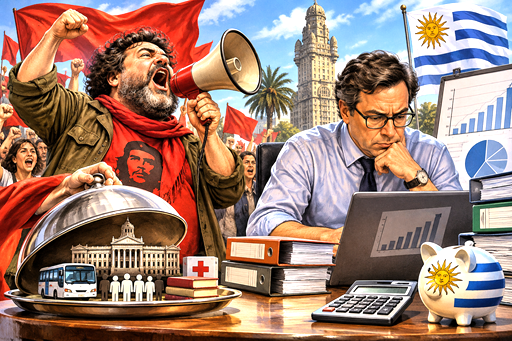
When the communist machete meets Gabriel’s Excel spreadsheet
There is something profoundly poetic about Uruguay’s twenty-first-century left: while some of its leaders take to the streets, megaphones in hand and scarves around their necks, to demand higher taxes and recite epic verses about social justice worthy of a youth camp in the Sierra Maestra, the economic team settles neatly into its armchair, takes a deep breath, and says three Our Fathers before the sacred fiscal discipline of Danilo Astori.
It fondly recalls Astori’s proposals to gradually reduce the number of public employees.
It is the supreme art of ideological schizophrenia turned into state policy.
On one side stands the ever-fiery Fernando Pereira, whose throat trembles whenever he utters the word “people,” with the fervor of someone who believes the economy can run entirely on mystique, assemblies, and slogans from the trenches.
Just the sort of rhetoric indispensable for getting reelected again and again.
In Pereira’s telling, the local left exists to bring big capital crashing down, confiscate the income of the wealthy, and shake off the IMF’s yoke to the beat of a drum.
But reality, of course, has a stubborn streak, and unfortunately for the romantics of the party committee, markets do not accept stirring speeches as payment.
That is where Gabriel Oddone enters the scene: a liberal-minded left-wing economy minister.
While Pereira rails against the wicked oligarchs, Oddone speaks with polished technical assurance in Argentine television studios and lays out truths so uncomfortable for his own political comrades that they border on heresy: macroeconomic order is untouchable, fiscal discipline is nonnegotiable, inflation is a tax on the poor, and trade openness is indispensable.
And what about wealth redistribution? Oh, what a vulgar term.
In Oddone’s mental universe, redistribution is a timid, well-mannered, and above all conditional concept.
Equity may be discussed, certainly, but only after the macroeconomic outlook has crossed its fingers, foreign investors have fallen in love with a country-risk premium of around 70 basis points, and the fiscal balances are as straight as an architect’s ruler.
Essentially, the house motto could be summed up as follows:
“First let’s save the Excel spreadsheet and, if there is any empathy left over, we’ll see how to help the vulnerable.”
It is a beautifully cynical balancing act.
Fernando Pereira performs the sacred duty of keeping the party faithful happy with the illusion that we are on the verge of a Cuban revolution, while Oddone sets about running the country as though it were a Swiss branch office, complete with agreeable unions and a fossilized labor minister.
Because, naturally, any proposal for real redistribution—the kind that reaches into deep pockets and upsets delicate macroeconomic balances—is strictly forbidden by the ruling triumvirate: Orsi, Pacha, and Díaz.
Undermine growth?
Touch the sacred altar of stability to finance radical social justice?
Not a chance!
That is for banana-republic populists; we have none here—we import the bananas.
What remains is a system that exploits workers, one the left scrupulously keeps quiet about.
There is the IRPF income tax on wages, the IASS tax on pensions, and a 22% value-added tax to finish the job.
Only informal workers are left outside that narrative, pursued mercilessly by the tax collector and abandoned by a left that reserves its overprotective discourse on rights for union members. Informal workers do not qualify.
A society that tolerates neither fence-sitters nor middle ground: either you are with me and I find you a place in the state, or you are cooked in the pot of transfers from the less poor to the poorer.
The state that the economy minister takes pride in is a bottomless, untouchable barrel, with more than 300,000 public-sector employment relationships on the books, bureaucratic inertia, deficient services, and monopoly-priced public utilities.
And even the subsidies do not reach all users in the same way.
A Uruguay that appeals to Pagni, who compares it with Argentina’s experience on Odisea Argentina and smiles approvingly at an effective, efficient left.
At the end of the day, the Uruguayan model offers us a wonderful lesson: you can be center-left, wave red flags at May Day rallies, but when the bills come due, everyone quietly ends up voting for Milton Friedman with a Frente Amplio badge pinned to his lapel.
The IMF applauds the model—and calls for even more pressure.
And everyone else?
They will be seen to at the next Rendición de Cuentas budget review… if the imperialists are still willing to lend us the money.
Political rhetoric and fiscal discipline
Frente Amplio’s contradictions
Taxes and public employment
Continue reading in Global Order and Geopolitics

Apoyá la continuidad de Perspectiva Liberal
Perspectiva Liberal es un espacio editorial independiente que no cobra por las notas.
Si valorás este trabajo y querés colaborar con su continuidad, podés hacerlo mediante un aporte voluntario a nuestra cuenta Prex 13440.
o por Mercado Pagolink.mercadopago.com.uy/perspectivaliberal