
Why aid and subsidies do not guarantee political support
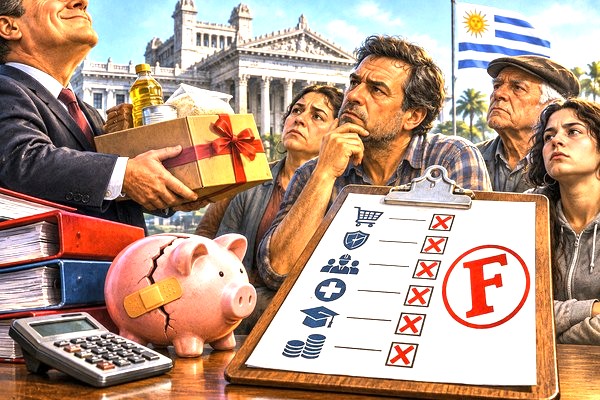
Public dissatisfaction with a government’s performance, even when it distributes aid or announces benefits, reflects a phenomenon studied in political science and sociology: short-term economic relief does not always offset perceptions of structural stagnation or a declining quality of everyday life.
When inflation, utility rates, or the prices of essential goods rise steadily, any cash transfer or temporary benefit is quickly consumed.
Citizens feel that the extra money simply ‘vanishes,’ while their purchasing power continues to fall.
Public opinion polls often reveal political priorities that money cannot buy.
Public safety, quality employment, the performance of healthcare and education, and the tax burden on wages are decisive factors in how governments are judged.
If people see no substantial improvements in those areas, welfare measures end up looking like inadequate stopgaps in the face of serious structural problems.
Expectations are usually high at the beginning of an administration, particularly after campaign promises.
When the pace of economic change or the state’s capacity to respond falls short of those expectations, political wear and tear accelerates and public frustration grows.
Often, middle-class groups and self-employed workers who do not qualify for government benefits face significant economic pressure and feel they bear the cost of financing the state without receiving tangible returns.
They also perceive that greater effort or merit can bring a heavier tax burden, while the political caste seems untouched by that sacrifice.
All of this fuels a climate of rejection toward the administration in office.
In contemporary politics, it is not unusual for administrations that devote substantial resources to assistance, subsidies, and promised benefits to face very high levels of public disapproval at the same time.
When people feel that ‘nothing is getting better’ and that problems are piling up—cost of living, public safety, employment, and basic services—cash transfers cease to translate into political support.
This disconnect is not necessarily a communications problem: it also reflects processes examined in political sociology and development economics.
The Weight of a Systemic Crisis Against Temporary Relief
When hardship is not confined to one sector but simultaneously affects household finances, public safety, and opportunities for advancement, dissatisfaction becomes a structural crisis of trust.
In that setting, temporary welfare assistance runs up against an unforgiving reality: money cannot buy solutions to structural problems.
Citizens do not judge a government solely by the money they receive at any given moment, but by its ability to provide a predictable social order, quality jobs, safety in the streets, and stable purchasing power.
If prices and utility bills continue to squeeze households, any government benefit soon disappears, and public spending comes to be seen as a useless patch over general decline.
Key Contributions: Hirschman and Rosanvallon
To understand why welfare-oriented policies can fail to achieve their political purpose, it is useful to turn to two thinkers whose work helps explain public expectations and distrust.
Albert O. Hirschman and Frustrated Expectations
Albert O. Hirschman studied how expectations of progress shape social tolerance of inequality and obstacles to development.
When people expect improvements eventually to reach them, they may endure adverse conditions for a time.
But when those expectations are frustrated and problems persist, discontent intensifies.
Applied to welfare-oriented political strategies, this perspective helps explain why temporary economic relief loses its political effectiveness when fundamental obstacles remain unchanged or worsen.
A subsidy ceases to be seen as a governing achievement and begins to be interpreted as a symptom of stagnation.
Pierre Rosanvallon and the Democracy of Distrust
French historian Pierre Rosanvallon has examined the role of distrust in modern democracies and the practices through which society monitors, challenges, and judges those in power.
His analysis helps explain why demanding citizens do not give governments a blank check in exchange for campaign promises or targeted distributions of public resources.
Government performance is subject to constant scrutiny, especially on issues affecting everyday life.
When an administration fails across the board, its word loses credibility and the gap widens between its rhetoric and citizens’ lived experience.
Under these conditions, efforts to turn welfare assistance into political advantage prove fruitless.
Public disapproval of a government, despite its expenditure of resources, exposes the political limits of welfare assistance when it is not accompanied by structural change.
As the contributions of Hirschman and Rosanvallon help us understand, people overwhelmed by simultaneous crises seek more than temporary relief to get through the month: they want genuine conditions for predictability, safety, and progress.
When the state loses sight of that compass, distributing benefits ceases to be a source of political support and becomes the clearest reflection of its own ineffectiveness.
Government aid and political support
Expectations and social frustration
Distrust and public governance
Continue reading in Global Order and Geopolitics

Apoyá la continuidad de Perspectiva Liberal
Perspectiva Liberal es un espacio editorial independiente que no cobra por las notas.
Si valorás este trabajo y querés colaborar con su continuidad, podés hacerlo mediante un aporte voluntario a nuestra cuenta Prex 13440.
o por Mercado Pagolink.mercadopago.com.uy/perspectivaliberal