
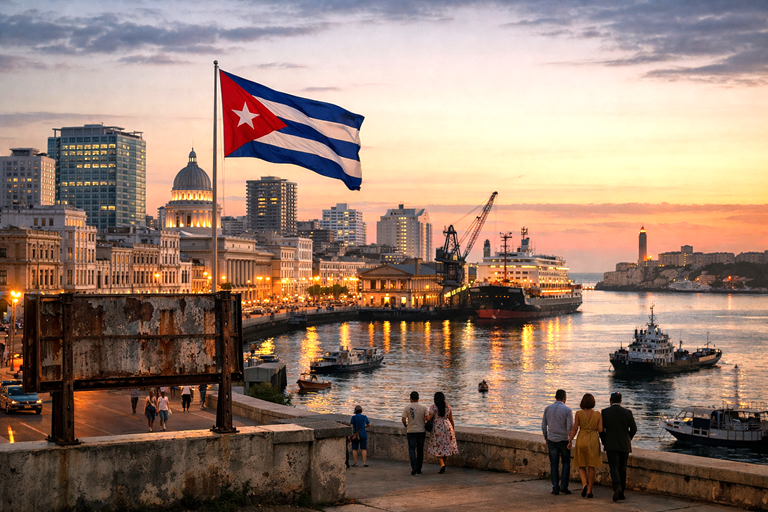
On openly exposed ruin and misplaced blame.
What would have happened in Cuba and Latin America if Fidel Castro, instead of aligning with the Soviet Union, had purged corruption from Cuba and aligned himself with the free nations of the world?
How different would the destiny of the Americas be without the violent ideological fracture spread by Castro?
To truly assess the cost of Castro’s Cuba to the American continent, we must understand uchronia: imagining how regional development and integration into the free world might have unfolded, how many lives could have been spared, and how many people—on all sides of later military conflicts—might have lived ordinary lives.
This remains one of the great unanswered questions of modern Latin American history.
Had Fidel Castro honored his initial promise to restore the 1940 Constitution, clean up institutions, and maintain a pragmatic alliance with the United States, today’s geopolitical landscape would be unrecognizable.
Dear readers, allow a literary license. Let us walk through that unrealized past, imagining ourselves as correspondents from a history that never occurred, envisioning the Cuba we wished for, for its people and for our continent after Batista’s fall.
Let us step away from rigid narratives and hollow epics that transformed hope for freedom and prosperity into tyranny, scarcity, and the absence of basic necessities.
That ideological pandemic still persists, leaving behind economic stagnation and social decay across Latin America, a continent rich in resources yet unable to offer dignified livelihoods to its people.
Under a worn-out and deceptive narrative, entire societies fell under the control of criminal elites sustaining a fabricated interpretation of Marxism.
As a result, we continue to endure some of the most incompetent and corrupt governments, using a failed ideology as justification for collective impoverishment.
Impact on Cuba: “The Singapore of the Caribbean”
In 1959, Cuba was already among the most advanced countries in the region in terms of health, education, and consumption, despite political corruption and inequality.
Once criminal networks were dismantled, Cuba could have fully leveraged its proximity to the United States.
The island might have become the financial and logistical hub of the Caribbean.
Capital flight following the revolution would never have occurred, instead modernizing infrastructure, logistics, and productive diversification.
Rather than becoming a frozen relic, Cuba could have competed with Miami and Las Vegas, perhaps surpassing them in cultural influence and commercial flow.
A liberal reformist Castro would have led to a multiparty system, avoiding decades of one-party domination.
A Strategic Alliance with the United States
Had Fidel aligned with Washington, Cold War dynamics would have changed dramatically.
The Cuban Missile Crisis would never have happened.
Soviet military presence in the Western Hemisphere would have been nonexistent.
A prosperous, freedom-aligned Cuba could have exerted regional influence comparable to Israel’s strategic role, shaping Latin America’s autonomous foreign policy.
The Domino Effect Across Latin America
The Cuban Revolution catalyzed radical leftist violence across the continent.
Without that ideological and operational export, history might have followed a peaceful course.
Groups such as the FARC, FMLN, Tupamaros, and Montoneros would have lost their main source of training, refuge, inspiration, and weaponry.
Many military dictatorships arose as reactions to the fear of “another Cuba.”
Without that threat, armed forces would not have been drawn into counterinsurgency wars that overwhelmed civilian institutions.
Political alternation within democratic frameworks might have emerged earlier, without decades of polarization.
Regional integration would have focused on trade, productivity, and shared development rather than ideological confrontation.
Comparative Summary
Cuba’s economy would not have depended on distorted Soviet sugar subsidies.
A service, tourism, and financial hub would have emerged.
Regional politics could have avoided Cold War polarization and guerrilla warfare.
Institutional stability would have generated sustained economic growth and reduced poverty.
Resources wasted on arms and repression could have been invested in social development.
Geopolitically, Cuba would never have become a Soviet satellite.
Instead, it could have stood as a beacon of economic freedom and private enterprise.
This counterfactual exercise suggests that Latin America might have avoided decades of bloodshed and division.
If the struggle was against corruption, it should never have become corruption itself.
Authoritarianism tolerates no dissent and justifies the unjustifiable.
It turns societies into informants and accomplices, trading dignity for survival.
The true struggle should always have been between freedom, corruption, and despotism.
Apoyá la continuidad de Perspectiva Liberal
Perspectiva Liberal es un espacio editorial independiente. Si valorás este trabajo y querés colaborar con su continuidad, podés hacerlo mediante un aporte voluntario a nuestra cuenta Prex.
Cuenta Prex: 13440