
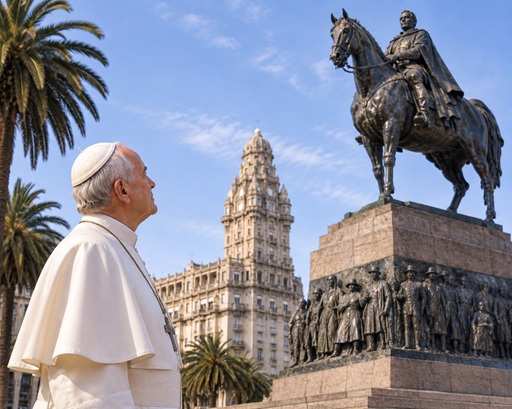
From Zorrilla de San Martín to Leo XIV’s reading in Montevideo
Following Garibaldi’s death in 1882, President Máximo Santos proposed a monument to his memory to Parliament in the middle of the following year.
Although the proposal was received favorably in the Chamber of Deputies, dissenting voices could still be heard.
David Buchelli, the representative for Florida, opposed it.
Among other reasons, he argued that neither Artigas nor Lavalleja had monuments in public squares. He attributed this to a lack of resources… How, then, could funds be available for Garibaldi?
The monument to Lavalleja was inaugurated in Minas in 1902.
The address, as could hardly have been otherwise, was delivered by the Poet of the Nation, who had also been commissioned to write the account that would inspire the artists.
The statue of Artigas began its slow journey toward Plaza Independencia in 1907. It would not be inaugurated until 1923, sixty years after legislator Tomás Diago had advanced the idea before his chamber.
For Artigas had to struggle not only against Spaniards, Portuguese and the authorities of Buenos Aires, but also against his own damnatio memoriae.
For Sarmiento, our national hero was “[…] a highwayman […] Thirty years murdering or robbing […] the monster […] barbarous, absurd, cynical, incongruous […]”. When he wants to “express ideas of government or liberty, it is his secretary Mataroso [SIC], an apostate friar whom we must assume to be a renegade or an outcast of society […]”, who speaks for him, he asserts in Conflict and Harmony of the Races in America (1883).
Curiously, those derogatory remarks have not prevented a Montevideo avenue from bearing Sarmiento’s name.
In the same decree that proposed vindicating the “greatly maligned figure in the History of America”, President Claudio Williman commissioned Juan Zorrilla de San Martín to prepare an account to guide the artists responding to the call.
Thus, what at first promised to be a brief biographical sketch became The Epic of Artigas.
For Zorrilla, the historian’s mission is not so much to teach as to instill “the rational feeling of love for one’s homeland”.
By homeland he means “a community of images, memories and emotions among the inhabitants of a region […] which constitutes a passion or powerful feeling, the seed of virtues”.
It is also, of course, a community of destiny.
And that homeland of Artigas, he says, is the fruit of the encounter between the providential hero and the people.
“The fulfillment of laws […] stronger than the free will of men.”
The revolution of Artigas is not subversive.
It does not seek to change the names of the months of the year or to crown a prostitute disguised as the “goddess Reason”, as the French Revolution of 1789 did.
“The revolution for Latin American independence was not,” Zorrilla reminds us, “the daughter of the European anti-Christian revolution,” but “the work of the instinct for Christian liberty [of] men equal before God […] since all power and all authority proceed from God”.
Thus, [true] democracy is the legitimate daughter of the brotherhood of the cross.”
And the true American caudillos were those who were “essentially Christian”. Those who, in the poet’s words, were not “contaminated by the rebellions of reason, nor by the apostasies of utilitarian thought”.
In this sense, Artigas is the archetype: “…a hero of the Hispanic people. He did not wish to be politically Spanish; but he loved and glorified his race, which he never disowned,” Zorrilla de San Martín observes.
Nevertheless, the monument to the national hero was not inaugurated until 1923.
The two finalists were not selected until January 1913.
They were the sculptors Juan Manuel Ferrari and the Italian Angelo Zanelli, to whom the commission decided to award the work.
The First World War delayed the execution and transport of the monument.
But the great day finally arrived, and with Plaza Independencia filled to capacity, the choice of Zorrilla to address the gathering was no coincidence.
On a radiant February 28, 1923, the poet delivered another of his memorable speeches.
“At last it has sounded, gentlemen; it is sounding among the hours of time, like a blow upon a shield: the hour of the morning we have thought about so often…,” he says.
And he concludes his address with these words:
“The heavens sing. Nature sings, and the song resounds on high, among the ancient sailing constellations: Glory to God in them, in all the heights, in heaven, on earth, in the abysses. And in that monument, in which, because His presence, His power and His design shine forth, we shall always see the palladium and prudent stronghold of the homeland we acclaim…”
Zorrilla recovers the Hispanic and Christian Artigas, an Artigas who does not emerge quite so clearly from the history textbooks used in secondary schools.
And that is the Artigas whom Pope Leo XIV came to remind us of during his recent visit to Uruguay.
He came to teach us to read the monument. For centuries, teaching relied heavily on images, engravings, illustrations and plates.
They were not mere decorations accompanying the text. They served an educational purpose, allowing people who could not read to visualize historical events, figures, biblical episodes and abstract concepts.
Uruguay is a highly literate country. According to UNESCO, its literacy rate is 98.9%.
And although literacy does not necessarily mean reading comprehension, it is nevertheless a good indicator.
But have we read the monument? Have we stopped to examine the frieze and interpret it? Have we drawn any lessons from “The Exodus of the Eastern People” depicted there?
The Pope reminds us that Artigas appears in the frieze among his men, part of the crowd. He pauses at the figure of a woman carrying her baby in her arms. That life which begins in the mother’s womb. A relationship of dependence that “does not diminish the dignity to which that life is entitled or the protection it deserves”. And he recalls the words of John Paul II: “the future of humanity is forged in the family”.
He then turns to the figure of “an elderly woman, bent over, who moves forward with difficulty, leaning on her cane”, and to several people approaching to help her. He points out that “the value of a person cannot be measured by what he or she produces, by work or by the ability to manage independently”. And so, step by step, without naming them, he refers to abortion, euthanasia, suicide…
It has taken the Pope’s visit to teach us how to read the monument.
Will we have sufficient reading comprehension to understand it?
Artigas and historical memory
Zorrilla and Christian tradition
Interpreting the monument
Continue reading in Global Order and Geopolitics

Apoyá la continuidad de Perspectiva Liberal
Perspectiva Liberal es un espacio editorial independiente que no cobra por las notas.
Si valorás este trabajo y querés colaborar con su continuidad, podés hacerlo mediante un aporte voluntario a nuestra cuenta Prex 13440.
o por Mercado Pagolink.mercadopago.com.uy/perspectivaliberal