
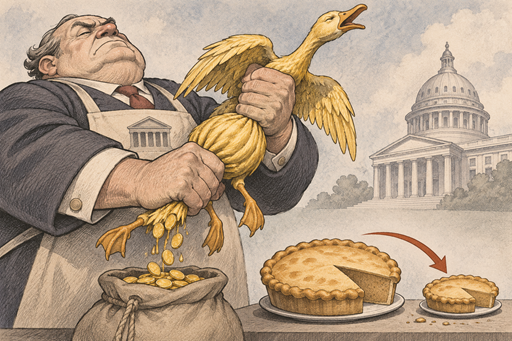
How to impoverish everyone in the name of strict social justice
It is moving to discover that the physical universe and the fiscal universe obey radically opposite laws.
While in physics energy is neither created nor destroyed (it merely changes form), in the enlightened minds of left-wing governments other people’s money multiplies magically through the simple act of wishing for it with materialistic fervor.
To understand this modern miracle, we must consult the sacred scriptures of liberal and supply-side economics, those manuals of insolent scientific wickedness that insist on spoiling the afternoon naps of the state’s benefactors.
The mystery of sovereign taxing power: when your money is really at the disposal of political power
It all begins with the sacred dogma of sovereign taxing power.
According to this endearing theory—which would have made Friedrich Hayek and Ludwig von Mises recoil in horror—the state enjoys a sort of divine and earthly right to every penny a citizen manages to earn lawfully.
To left-wing governments, the entrepreneur who hires people, risks capital, invents useful products or solves everyday problems to improve people’s lives is merely a temporary administrator of public funds.
Isn’t that charming? You rack your brains sixteen hours a day, pay wages, face the risk of bankruptcy, plead with the bank manager and deal with labor lawsuits; yet, deep in his communitarian heart, the politician whom part of the electorate chose to represent it knows those profits belong to him.
All that remains is to formalize the transaction by decree, bearing his signature and justified by child poverty, endlessly invoked for that purpose.
As one might infer from Milton Friedman’s critique in Free to Choose, nothing is more touching than a politician spending someone else’s money with the generosity of a man buying the first round at the pub with a corporate card that does not belong to him.
The trouble is that once your money runs out, they turn back to the same goose that lays the golden eggs, looking innocently bewildered that it has yet to pay its tithe to the cult.
But of course, in this fiscal fairy tale some ill-tempered scientist always turns up to spoil the party. Enter Arthur Laffer’s little prank: when fiscal numbers become downright rude.
Arthur, the spoilsport, backed by the great Jude Wanniski in The Way the World Works, had the audacity to remind us of something extraordinary: the more you punish those who produce, the less inclined they may be to produce. What a tremendous surprise!
According to the famous Laffer curve, if the state decides to confiscate 90% of the profits of some wicked rich person who dared to succeed, that wicked rich person may decide to shut the factory, retire at forty to an island in the Aegean or move capital to a country where it is not greeted with fiscal hatred.
The result? Tax revenues could plummet.
But our redistribution-minded rulers, blessed with an anthropological optimism impervious to bullets, ignore the curve, bend it, break it and throw it in the trash.
For them, if a 50% tax raises too little revenue, the logical, scientific solution is to impose another tax of 150%.
If people stop investing, the enlightened ones blame “savage capitalism” rather than their own obsession with squeezing the goose until it bleeds.
“Capitalist altruism” and the banquet of the offended
This is where George Gilder’s argument in Wealth and Poverty comes in. Gilder had the audacity to defend a scandalous concept: capitalist altruism.
While the politician lives off the gracious rhetoric of compulsory solidarity—someone else’s solidarity, of course—the entrepreneur risks personal wealth to offer jobs, goods or services to a society that had never even heard of him.
For Gilder, the true capitalist serves consumers; if he fails to offer what people want, he goes broke.
But left-wing governments seem to favor behavior that public choice theory, developed in part by Nobel laureate James Buchanan, helps explain.
Buchanan, with the academic coolness that so irritates the ministries of economic handouts, reminded us that politicians are not heavenly angels driven exclusively by love for humanity, but ordinary human beings who may also seek to maximize their power, distribute favors and buy votes with other people’s money.
Why encourage society’s “pie” to grow if all they care about is handing out crumbs and staying on the throne?
Cutting the pie into ever more microscopic portions while burying it in a fiscal graveyard is their favorite sport. Naturally, they keep their own share safely tucked away while celebrating their “solidarity” in an immaculate blue suit.
The great innocent question: where did we put economic growth?
And so we reach the climax of the farce. Years pass, decades pass, along with five-year plans, price controls, budgets and their accountability reports, more taxes on “wealth,” more little handouts in the name of “solidarity,” “the wind” and “social justice”; and the economy endures decades of stagnation, barely managing growth that has already been spent and financed with debt.
Then, with the innocence of a sweet child who has just set the carpet on fire with a box of matches, the ruler stands before the television cameras and sighs wistfully:
“Oh, dear God… Why hasn’t the economy grown for so many years? It must be the bad weather, intergalactic speculators or global warming. Perhaps if we raise taxes again, we can get through this difficult spell.”
A biblical misunderstanding: raise taxes and conjure up fish.
Meanwhile, Laffer, Friedman, Hayek, Mises, Gilder and Buchanan look on from the pantheon of history with a mixture of sardonic laughter and deep pity, knowing full well that the left’s one enduring miracle is not “social justice”—an eternal utopian falsehood, according to this chronicle—but its boundless, fascinating ability to drive even a desert of sand into bankruptcy.
Tax burdens and incentives
Public choice and power
Stagnation and redistribution
Continue reading in Humor and Satire
Apoyá la continuidad de Perspectiva Liberal
Perspectiva Liberal es un espacio editorial independiente que no cobra por las notas.
Si valorás este trabajo y querés colaborar con su continuidad, podés hacerlo mediante un aporte voluntario a nuestra cuenta Prex 13440.
o por Mercado Pagolink.mercadopago.com.uy/perspectivaliberal