
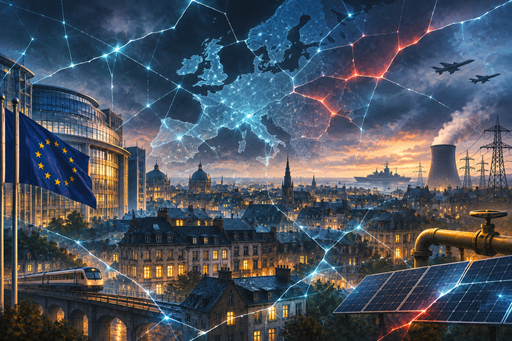
Europe confronts hybrid warfare, the fragility of interdependence, and the challenge of regaining strategic sovereignty
Introduction: The End of the Illusion of Peace
For three decades after the fall of the Berlin Wall, the West inhabited a comforting dream: the “end of history.”
Liberal democracy and the globalized free market were dogmatically assumed to have become humanity’s universal and inevitable destination. In this new technocratic paradise, borders blurred, traditional armies lost their raison d’être, and transnational value chains promised perpetual peace through doux commerce (the pacifying influence of trade).
Politics gave way to economic management, and the sovereign state was reduced to a mere agency of administrative regulation.
Reality, however, has shattered this mirage.
The present—marked by the extreme vulnerability of Europe’s critical infrastructure, the return of naked geopolitics, and the lack of civilian protection against gray-zone attacks—bears witness to history’s return.
European governments, trapped in a rigid institutional architecture divorced from political realism, now find themselves defenseless against revisionist powers that turn global interdependence itself into a weapon of systemic destruction.
The Breakdown of Political Realism and the Naivety of Interdependence
The neoliberal premise that no power could survive economically without the others overlooked the fundamental asymmetry of power and the primacy of security over commercial gain.
As historian Niall Ferguson argues, Western democracies fell into a profound “institutional fatalism,” unable to read the signs of a multipolar world in which the global economy no longer unites nations but is instead weaponized for coercion.
This fallacy is compounded by the diagnosis of geopolitical analyst Peter Zeihan, who argues in works such as The End of the World Is Just the Beginning that globalization was not a natural order but a historical interlude guaranteed by American military power and security.
As that protective umbrella fractures and populations undergo severe demographic aging, the myth of limitless supply chains fades.
Autocratic powers, with a high tolerance for social and economic hardship, can bear substantial costs to pursue long-term geostrategic goals; European democracies, constrained by short electoral cycles and societies accustomed to comfort, lack that resilience.
In this environment, cyberattacks, underwater sabotage, the manipulation of migration flows, and energy strangulation deliberately operate below the threshold of conventional war.
This is the hybrid warfare examined by theorists such as Mark Galeotti: a low-intensity, highly disruptive conflict in which the traditional bureaucratic state, slow-moving and legalistic, proves unable to respond in time.
Internal Vulnerability: Demography, Cohesion and Cultural Conflict
External aggression is compounded by a profound weakness from within.
Europe’s transformation has been accelerated by large migration flows originating in non-Western cultural settings, a phenomenon critically examined by Christopher Caldwell in Reflections on the Revolution in Europe.
For years, it was taken for granted that civic and economic assimilation would happen automatically through the labor market.
Reality has shown that ineffective border controls and the absence of expectations for cultural assimilation have entrenched parallel societies. In a hybrid-warfare scenario—marked by prolonged blackouts, financial collapse, or shortages—these unintegrated populations, together with discontent toward populist and polarized governments, become a multiplier of internal vulnerability.
As Douglas Murray warns in The Strange Death of Europe, the continent is experiencing civilizational exhaustion and a loss of faith in its own identity and values, leaving institutions paralyzed when called upon to enforce public order and defend cultural sovereignty against threats from both outside and within.
The recommendation to keep enough supplies for 72 hours of a civil emergency reveals a belated acknowledgment: the state cannot always guarantee the immediate safety of its citizens in the face of systemic collapse.
Paths to Survival: Tragic and Optimistic Perspectives
Accepting the return of history requires abandoning naïve optimism and adopting a perspective that balances tragic lucidity with constructive action.
The Tragic Perspective: Recognizing Limits
The limits of prosperity: An unlimited welfare state, optimized for an era of perpetual peace, is no longer sustainable.
It is imperative to recognize that national security demands economic sacrifices, strategic reindustrialization, and the relocation of critical sectors (pharmaceuticals, technology, and energy), even if these measures temporarily reduce corporate profit margins.
The end of uncritical multiculturalism: Civic cohesion is not an automatic by-product of the market.
Europe must restore the expectation of a shared identity, the full force of the rule of law, and rigorous control of its borders, recognizing that without internal sovereignty there can be no effective external defense.
The Optimistic Perspective: Recovering Civic Initiative
Decentralized resilience: Genuine optimism does not lie in expecting the state to solve everything but in recovering individual and community responsibility.
The Nordic model of total civil defense shows that prepared societies, with basic self-reliance and strong civic cohesion, are exceptionally difficult to subdue through hybrid intimidation.
Strategic renewal: The present crisis is forcing Europe to shake off its geopolitical slumber.
By being compelled to develop its own defense capabilities, advanced cybersecurity, and technological sovereignty, European democracies have an opportunity to mature—transforming themselves from vulnerable economic spaces into sovereign political actors capable of prevailing in the new world order.
Interdependence and geopolitical coercion
European cohesion and vulnerability
Resilience and strategic sovereignty
Apoyá la continuidad de Perspectiva Liberal
Perspectiva Liberal es un espacio editorial independiente que no cobra por las notas.
Si valorás este trabajo y querés colaborar con su continuidad, podés hacerlo mediante un aporte voluntario a nuestra cuenta Prex 13440.
o por Mercado Pagolink.mercadopago.com.uy/perspectivaliberal