
The obligation to maintain public sidewalks raises questions about property owners’ responsibilities, taxes and municipal spending priorities.
The Montevideo municipal government (IMM) considers the owner of a property facing a sidewalk to be responsible for building and maintaining the sidewalk in front of it, even though it is a public space.
The explanation is primarily legal and administrative: the property owner is held responsible for maintaining that stretch of sidewalk, including repairing it when it deteriorates.
But why should the cost of maintaining a public space fall on a private individual?
Because Article D.2179 of the Departmental Digest incorporates an obligation established by the General Sidewalk Ordinance (Decree 15,854).
Under that rule, property owners are required not only to build the sidewalk at their own expense, but also to keep it in good condition and rebuild it when necessary.
And what justification is given?
The argument is that owners have a particular interest in maintaining access to their property and the area in front of it, and are therefore assigned responsibility for the condition of that space.
But when we consider that the sidewalk does not belong to the property owner, that the owner cannot freely decide how to use it, and that it is intended for the entire community, this reasoning raises doubts.
Should the municipality, as the authority responsible for urban infrastructure, not be the one to maintain it using general public funds?
There are, admittedly, some exceptions. For example, when damage is caused by the roots of public trees, the municipality bears the cost.
If the damage is caused by work carried out by public agencies or utility companies, the party responsible for the damage must pay.
Accessibility ramps are also funded by the municipality.
Even so, the fairness of making property owners pay to maintain public infrastructure seems debatable.
Why should two property owners who both pay taxes be treated differently simply because one has a sidewalk worn down by general public use and the other has one in good condition?
But the main issue lies elsewhere.
The IMM has a sprawling bureaucracy.
According to figures reported by the newspaper El Observador, 45.3% of the budget goes to employee compensation.
Another 40.3% goes to operating expenses.
The remainder, a meager 14.4%, is allocated to investment.
And here is the crux of the matter: in 2025, actual spending on employee compensation amounted to some 14.2 billion Uruguayan pesos (El País).
Is it becoming clear why residents have to pay for sidewalk repairs?
According to 2023 figures, the municipality had no fewer than 938 employees in its Department of Culture.
That year, those 938 employees accounted for US$44 million in spending, out of the department’s total expenditure of US$63.5 million.
What should the priorities of a municipality be when, incidentally, Montevideo has been governed by the left since 1990?
To my mind, that is where the real debate over this municipal policy lies.
Is sidewalk maintenance merely a matter of appearances?
It concerns pedestrian safety and accessibility for older people, children, and those with mobility difficulties.
Parades and musical performances, on the other hand, are cultural or festive activities.
Is it fair to squander public resources on organizing “free” festivals? Especially when nothing is truly free. Neither education nor public healthcare is free of cost. Someone pays for them, although in those cases the expenditure is justified.
While serving as mayor, Carolina Cosse brought forward the celebration of Montevideo’s founding so that it would take place during her term.
The celebrations were held on January 19 and 20, 2024.
At the time, Cosse was seeking the Frente Amplio (FA) presidential nomination, meaning that the celebration took place in an election year.
The event cost more than half a million US dollars (approximately 73,500 of that for hired personnel, overtime and other expenses), paid for by Montevideo residents through their taxes.
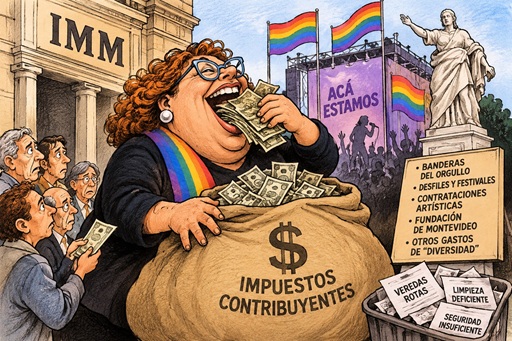
In 2023, as part of “March, Women’s Month,” the festival “Acá estamos” was held under Carolina Cosse’s administration, with a staggering US$340,744 spent on performance fees for Lali Espósito, Daniela Mercury and other artists.
The 2026 Carnival cost the IMM 47 million Uruguayan pesos (El Observador).
Under the banner of “Diversity,” the municipality decorates columns along the city’s main avenue with rainbow flags.
These activities are supported by an administrative structure and an ongoing program: the Diversity Secretariat, the Montevideo LGBTIQ+ Center, and agreements and projects such as Proyecto Paula and the LGBTIQ+ Observatory, developed with the Faculty of Humanities.
According to the ADEOM union, which has a love-hate relationship with the IMM authorities, around 15,000 people work for the municipality, nearly 7,000 of them through outsourced contracts. They, too, represent a public expense, even if their pay does not appear on the municipal employee payroll.
Is it now clear why, on top of our taxes, we have to pay for sidewalk repairs?
Responsibility for public sidewalks
Municipal budget priorities
Cultural spending and services
Continue reading in Global Order and Geopolitics

Apoyá la continuidad de Perspectiva Liberal
Perspectiva Liberal es un espacio editorial independiente que no cobra por las notas.
Si valorás este trabajo y querés colaborar con su continuidad, podés hacerlo mediante un aporte voluntario a nuestra cuenta Prex 13440.
o por Mercado Pagolink.mercadopago.com.uy/perspectivaliberal