
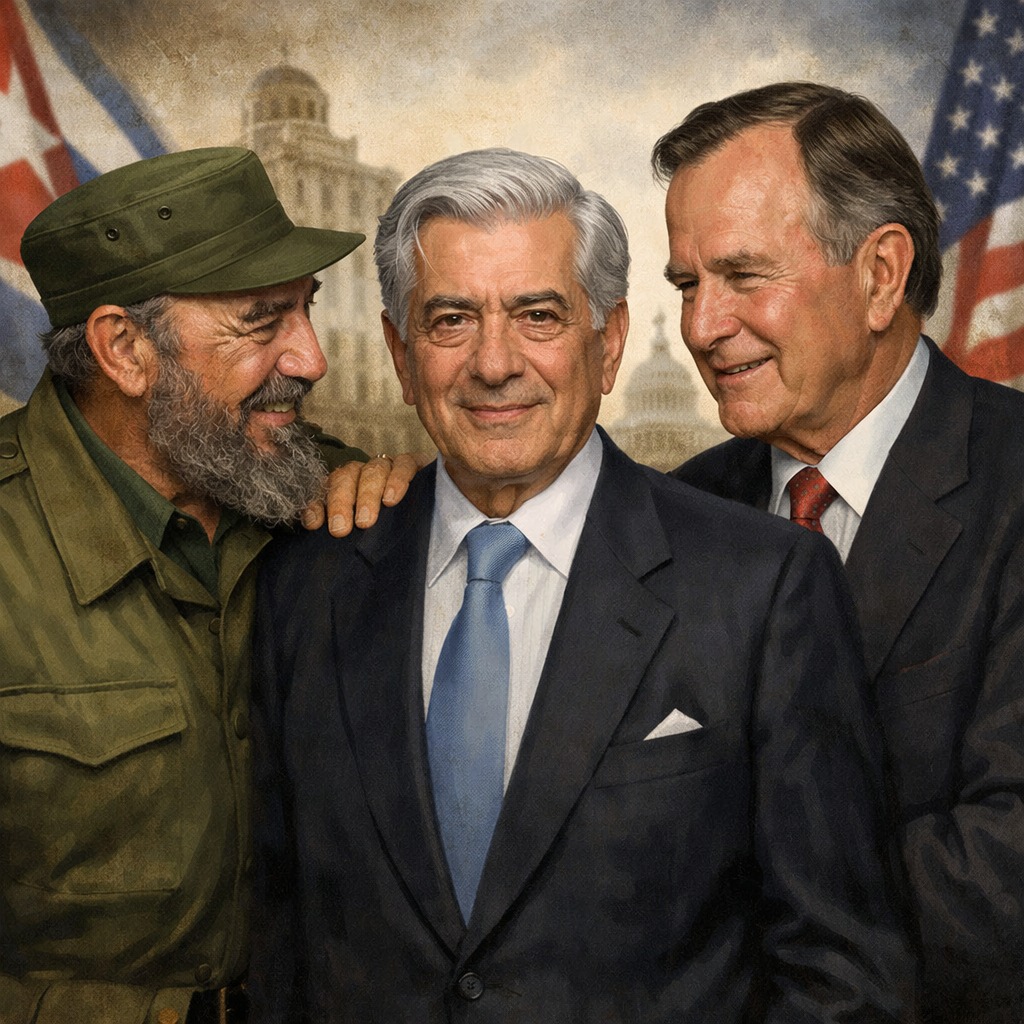
From Revolutionary Faith to the Justification of Just War.
Is it possible to radically change one’s ideology?
Or is it an exclusively religious phenomenon, one that occurs through a mysterious revelation?
We will examine the case of a famous writer and his journey from professing revolutionary Marxist faith to justifying military interventions when they aim to overthrow a tyranny.
The thin red line that separates the establishment of democracy through so-called “just war” from raw imperialism.
Between June 25 and July 6, 2003, Vargas Llosa was in Iraq.
Anglo-American forces, joined by Polish and Australian troops, had entered Iraqi territory with the objective of ending Saddam Hussein’s regime.
The tyrant was captured at the end of 2003, tried, and hanged three years later.
In Diary of Iraq, a text that records the Peruvian writer’s Iraqi experience, he states:
“…my opposition to the military intervention […] expressed unequivocally on February 16, became greatly nuanced, not to say rectified, after my trip.”
It was not the first time Vargas Llosa had changed his mind, which is not bad in itself.
But his initial stance would not prove so firm when he adds that he wanted to “find out on the ground – from the perspective of the Iraqis – whether the arguments for condemning the military intervention were still as persuasive as when I reasoned about the issue in the abstract, far from the place of events, in Europe.”
That is to say, he had issued a judgment without knowing what those directly involved in the matter – the Iraqis – thought about it.
He does question the justification put forward – weapons of mass destruction, links to Al Qaeda – considering it an excuse.
But he affirms that Saddam’s dictatorship, which he characterizes as “one of the cruelest, most corrupt and most insane in modern history,” provided sufficient reason for military action.
Later on, he recovers political correctness and points out that “it is dangerous to establish as a norm the right of democratic nations to act militarily against dictatorships.”
And he adds that “in some cases […] it could become a smokescreen for colonial-style adventures.”
So when would a military intervention be legitimized?
When, “by its extreme nature, its criminal and genocidal excesses, a dictatorship has closed off all avenues of freedom […] or when it becomes […] a serious danger to world peace.”
And who determines those extremes?
It should have been the United Nations, but “the opposition of France, which threatened to use its veto in the Security Council,” prevented it.
Without the approval of the UN – or of France – action was taken anyway.
And why this French attitude?
The Iraq war, says Vargas Llosa, served “to stoke hatred toward the United States, legitimizing a new anti-Americanism cloaked in an aura of pacifism and anti-colonialism in which nostalgic fascists and communists mingle with nationalists, social democrats, socialists, and anti-globalization movements.”
Despite this varied opposition observed by the future Nobel Prize winner in Literature, he nevertheless hopes that this war will open a future in which “democratic culture ultimately prevails over terror and authoritarian fanaticism,” just as it did with fascism and communism.
These introductory lines are dated Washington, September 25, 2003.
The Bible illustrates for us Saul on the road to Damascus.
The great persecutor of Christians receives the divine message and becomes the Apostle to the Gentiles.
With the same intensity with which he persecuted Christians, he transformed himself into their defender and a promoter of the faith.
Did Vargas Llosa experience a similar process, albeit gradual, in the political realm?
In 1965, Vargas Llosa was in Paris.
The beacon of the Cuban revolution dazzled many intellectuals, among them the group of Peruvians residing in ancient “Lutetia.”
Together with the Argentine musician and luthier Milton Albán Zapata, these gentlemen deemed it necessary to take a political stand.
In the midst of a comfortable Parisian summer, they issued what they pompously called a “Statement of Position.”
This meant, nothing more and nothing less, than explicit support for the Cuban revolution in its Peruvian chapter.
They asserted that governments had oscillated between military dictatorships and civilian representatives of the oligarchy.
That there was “no other path than armed struggle.”
And that, therefore:
“We approve the armed struggle initiated by the MIR, condemn the interested press that distorts the nationalist and vindicatory character of the guerrillas, censure the violent governmental repression – which, under the pretext of insurrection, seeks to eliminate the most progressive and dynamic organizations in the country – and offer our moral support to the men who at this moment are giving their lives so that all Peruvians may live better.”
The MIR was the Revolutionary Left Movement, an organization inspired by the model of the Cuban revolution which, had it achieved its objectives, would have turned Peru into a replica of what Cuba is today.
The document, sent to the Peruvian magazine Caretas, was signed by several Peruvian painters such as Sigfrido Laske, the ethnologist Humberto Rodríguez Pastor, the musician and luthier Milton Albán Zapata, and writers such as Julio Ramón Ribeyro and Mario Vargas Llosa, among others.
In 1965, Llosa also made his second trip to Cuba as a juror for the “Casa de las Américas Prize.”
A long distance separates that French 1965, his visits to Cuba, and the year 2003.
Although his political shift occurred earlier.
In the aforementioned Diary of Iraq, the future Marquis of Vargas Llosa, once convinced that “there is no other path than armed struggle” in the Cuban style, stated:
“Taking advantage of the noise and fury of the Iraq war, Fidel Castro dealt, with the brutality to which he has accustomed the world for 44 years, a new preventive punishment to the Cuban people…”
“In less than a week, nearly eighty dissidents were arrested, tried, and sentenced to excessive prison terms…”
“…three Cubans who hijacked a boat with the intention of escaping […] were executed after a sham trial, carried out in secret and at astronomical speed.”
How right is the line from that tango by José María Contursi, often sung by Polaco Goyeneche, which says:
“A lesson that I finally learned
How the years change things!”
At least, for some.
Apoyá la continuidad de Perspectiva Liberal
Perspectiva Liberal es un espacio editorial independiente. Si valorás este trabajo y querés colaborar con su continuidad, podés hacerlo mediante un aporte voluntario a nuestra cuenta Prex.
Cuenta Prex: 13440