
The Uruguayan case and the role of intelligence services operating under diplomatic cover.
During the Cold War, the Soviet Union openly identified the United States as its main enemy. From that premise, it sought to encircle it strategically while reinforcing its own borders through satellite states. Within that framework, Cuba’s attempt to export its revolution across Latin America must be understood. Uruguay’s democratic regime, open and institutionally tolerant, provided favorable conditions for communist espionage operations carried out under the protection of diplomatic posts held in foreign embassies.
In a previous article we referred to the revelations emerging from the declassification of the secret archives of the Czechoslovak intelligence service, the StB.
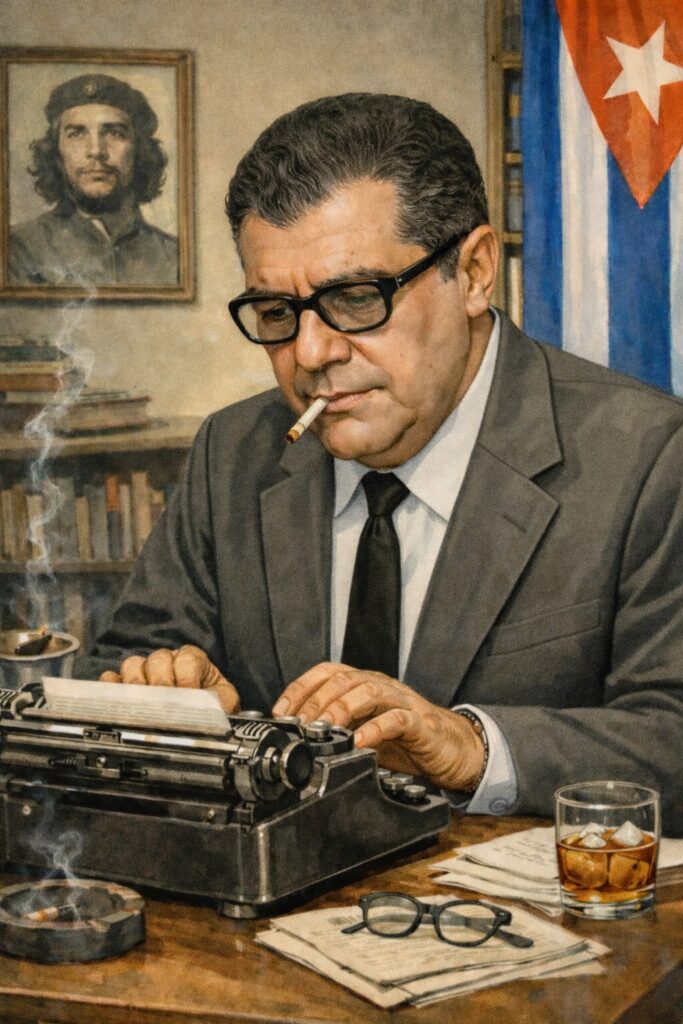
The central figure of espionage activity in Uruguay for sixteen years, between 1961 and 1977, was the well-known politician and self-proclaimed socialist Vivian Trías, born in 1922 and deceased in 1980, who operated under the alias “Ríos”.
The distinction is not trivial, since in principle a socialist is not necessarily a communist. However, in practice, which is ultimately what matters, both often ended up aligned as fellow travelers of those who promoted the violent replacement of capitalism with state-controlled capitalism.
From its headquarters in Prague, the StB trained its agents with meticulous care. Its bureaucratic obsession with documenting everything in writing allowed later researchers to reconstruct in detail the recruitment methods employed.
The starting point was always the concept of the main enemy. The idea that the United States had to be destroyed served as the initial ideological filter. Once that premise was accepted, the Czechoslovak diplomat-spy responsible for recruitment knew he was on the right path.
From there, the process was gradual and patient. At the appropriate moment, money was offered and a receipt was requested. With that signature, control was established. Diplomatic immunity protected only one of the two parties involved, and it was never the recruited agent.
Targets were generally individuals not formally affiliated with communist parties and not publicly identified as such. Recruitment was facilitated by the perception that the Czechoslovak regime was less oppressive than the Soviet one, often viewed as a “lighter” form of communism.
Beyond those perceived differences, the reality was that the StB was required to keep the KGB fully informed of its activities. The reverse was not true. Those who chose to believe otherwise did so out of a very human tendency toward self-deception, especially when silence was convenient.
According to the declassified archives, during his years of activity Trías carried out forty active operations. He also recruited several agents under false flags, including his own wife, María Alicia Laphitz Caraballo, known by the alias “Falda”.
He initially received 150 dollars per month, later increased to 200, along with an office, foreign travel, the publication of several books with themes suggested by the StB, dozens of bottles of whisky, and thousands of cigarettes, notably American-made, in exchange for the information he provided.
During that period he also requested weapons to equip Uruguayan socialist cadres, a request that was denied by his handlers. He succeeded in gaining access to Alberto Heber, then a member of Uruguay’s National Council of Government, extracting information that ultimately reached the KGB and, at times, Cuban intelligence services.
Trías’s activity in service of the KGB, whether fully conscious or not, came to an end in 1977, when the Montevideo rezidentura was dismantled.
When these revelations became public, Uruguay’s socialist movement faced a serious dilemma. Rejecting Trías outright would have amounted to political suicide. Instead, they opted for justification.
After prolonged internal deliberation, on December 26, 2018, the party issued a statement published on its website highlighting his “political coincidences in defense of the Cuban revolution” and arguing that his actions and ideas should not be judged ahistorically, since they were inspired by serving the interests of the national majorities and the country.
What remained conveniently undefined was which country those interests truly served. The archival evidence strongly suggests it was the Soviet Union.
And Trías was not an isolated case. The network included other Uruguayans, ideologically aligned and often financially motivated.
Apoyá la continuidad de Perspectiva Liberal
Perspectiva Liberal es un espacio editorial independiente. Si valorás este trabajo y querés colaborar con su continuidad, podés hacerlo mediante un aporte voluntario a nuestra cuenta Prex.
Cuenta Prex: 13440