
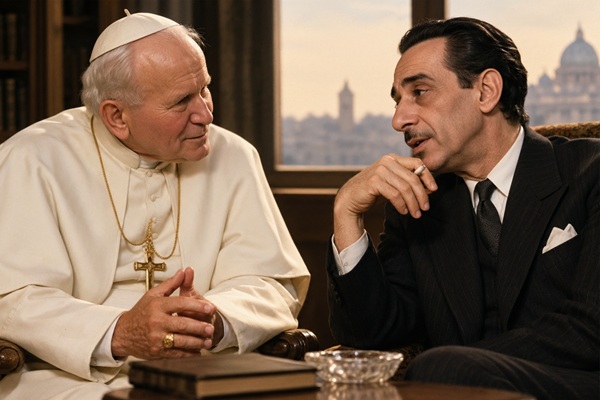
From Cambalache to Evangelium Vitae: The Right to Life
That Enrique Santos Discépolo (1901–1951) had a bitter view of life is evident throughout his work.
He was a composer, musician, playwright and filmmaker.
But his memory became associated above all with his tangos.
Historian Sergio A. Pujol suggests that Discépolo’s entire artistic production is permeated by a common style, a certain “Discepolian” spirit that people immediately recognize, as though his work —more than once described as prophetic— expressed something of the Argentine common sense.
In Cambalache, a word used for a shop where second-hand objects are bought and sold in seemingly random piles, Discépolo portrays a chaotic society in which moral values have collapsed and the boundaries between good and evil have become blurred.
“The world has always been and will always be a mess, I already know / in fifteen-oh-six and in the year two thousand too,” he says.
But he is referring especially to the world he knew, the world in which he happened to live.
Such evils have always existed.
“But that the twentieth century is a display / of insolent wickedness, no one can deny.”
Discépolo lived through the first half of the twentieth century.
He denounced a society that had lost its ability to distinguish between good and evil or, even more seriously, one that, despite distinguishing between them, ended up rewarding evil.
Because when people realize that honesty offers no protection and impunity is profitable, they begin to stop believing in the validity of the rules they had previously observed.
Yet the fact that injustice has been a historical constant does not mean that it is inevitable.
“I am I and my circumstance,” José Ortega y Gasset wrote in 1914.
But that does not mean that circumstance can justify any form of conduct.
The sentence continues: “…and if I do not save it, I do not save myself.”
Human beings can act upon their circumstances, modify them and assume responsibility for their decisions.
Forty-four years after Discépolo’s death, Pope John Paul II addressed his 1995 encyclical Evangelium Vitae to the clergy, the faithful and “all people of good will.”
The document deals with the “value and inviolability of human life.”
During the twentieth century, states demonstrated how far the persecution and extermination of human beings could go.
The Armenian genocide, the Holodomor and Stalin’s Great Terror, as well as the Shoah, caused the deaths of millions of people.
The international community declared that it had understood that terrible lesson.
In 1948, the American states adopted the American Declaration of the Rights and Duties of Man.
What is the foundation of those rights and duties?
Legislation?
The Declaration is clear.
Essential rights do not derive from belonging to a particular nation or from a particular body of legislation, but are based upon “attributes of human personality.”
And if someone possesses a right, someone else necessarily has a duty to respect it.
Those rights and duties are regarded as inherent in human nature.
Article I of the Declaration places the right to life first.
From this arises, in turn, one of the State’s primary duties: to protect it.
As early as 1830, Uruguay’s Constitution established that the inhabitants of the Republic had the right to be protected in the enjoyment of their lives.
In December 1948, the United Nations proclaimed the Universal Declaration of Human Rights.
Article 3 states: “Everyone has the right to life, liberty and security of person.”
But from this perspective, that right does not originate in a United Nations declaration.
It is not granted by an international organization.
The right arises from the human condition itself.
The duty of the State is to recognize and protect it, beginning with limits on the State’s own actions.
Legislation should be developed upon those foundations.
If the first of all rights is the right to life, it would seem that the matter should have been sufficiently clear.
Why, then, did John Paul II consider it necessary to return to the issue in 1995?
Because he perceived an “extraordinary increase and gravity of threats to the life of individuals.”
Legal rules and declarations of principle become little more than empty paper when there is no willingness to observe them or enforce them.
It may be argued that humanity’s progress is evident.
And it is.
But John Paul II warned that scientific and technological progress was accompanied by new forms of aggression against human dignity.
He also noted that broad sectors of public opinion were beginning to justify certain attacks on human life by invoking rights associated with individual freedom.
And he identified something deeper still.
Such practices were no longer demanding mere tolerance or impunity.
They sought legal authorization and, eventually, the participation of the State’s own institutions.
For John Paul II, this process represented a new way of understanding human life.
And that cultural transformation inevitably began to influence legislation, progressively distancing it from the principles that had inspired national constitutions and various international agreements.
The American Convention on Human Rights, known as the Pact of San José, was adopted on November 22, 1969, and entered into force in 1978.
Article 4, paragraph 1, states:
“Every person has the right to have his life respected. This right shall be protected by law and, in general, from the moment of conception. No one shall be arbitrarily deprived of his life.”
Uruguay signed the Convention on November 22, 1969, and ratified it in 1985 through Law No. 15,737.
And if we began with Discépolo, we can close this first part by turning to José María Contursi:
“How the years change things!”
Crisis of values
Right to life
Limits of the State
Continue reading in Global Order and Geopolitics
Apoyá la continuidad de Perspectiva Liberal
Perspectiva Liberal es un espacio editorial independiente. Si valorás este trabajo y querés colaborar con su continuidad, podés hacerlo mediante un aporte voluntario a nuestra cuenta Prex.
Cuenta Prex: 13440