
The evolution of the Cuban regime and its influence on segments of Uruguay’s university system raise historical questions that remain unresolved.
Radio Carve, a Montevideo radio station that at the time maintained a firm anti-communist editorial stance, used to fill its commercial breaks by juxtaposing two speeches by Fidel Castro.
I heard them so many times that I could almost quote them word for word.
If memory serves me correctly, one of them said:
“They are going around saying that the Cuban Revolution is communist. False words, slanderous words, spoken by all those interests that do not want to lose their land. But the Cuban people know better. The Cuban people know that the Cuban Revolution is not communist.”
These statements were made during Castro’s tour of the Americas in April 1959.
The journey began in the United States, where President Eisenhower did not receive him.
In July 1960, the Cuban regime began nationalizing American companies on the island without any compensation.
In May of the following year Castro would declare:
“I am a Marxist-Leninist, and I will remain a Marxist-Leninist until the last day of my life.”
With those words, Radio Carve completed its message.
Years later, the Cuban Revolution still enjoyed a certain romantic aura that made it attractive even within some liberal circles.
Such an attitude may have been understandable at that time, viewed generously.
Today, however, after the regime’s long and well-documented failure, the continued admiration shown by much of the political left is difficult to comprehend.
The left continues to portray Cuba as a beacon of hope, despite the country’s chronic electricity shortages, with power outages lasting many hours every day demonstrating precisely the opposite.
That is also the position maintained by Uruguay’s current administration, elected to govern until 2030.
Accordingly, during a recent public event held in solidarity with Cuba, a Communist member of Parliament declared:
“…our solidarity with the Cuban people and with their Revolution, believing that for us it continues to be that beacon in which so many of us see ourselves. We believe that Cuba represents hope, resistance and dignity.”
But let us return to the 1960s.
Ten years after the Organic Law of the University had effectively placed the institution under the influence of the radical left, the national government, acting under the constitutional provisions known as the Medidas Prontas de Seguridad (Emergency Security Measures), ordered an investigation into the country’s public institutions of higher education.
The report, issued in September 1968 and signed by the Inspector General of the Army, General Líber Seregni, together with his counterparts from the Navy and the Air Force, reached conclusions that deserve to be remembered.
Among them, the report stated:
“The premises assigned to student organizations […] have become headquarters for groups which, being beyond the control of the academic authorities, carry out subversive activities.”
It continued:
“Some student centers have been used as bases for attacks and as safe havens for those responsible […] while also serving as storage sites for materials intended to disturb public order (construction of street barricades, lighting of bonfires, etc.).”
The academic authorities maintained that they neither supported nor encouraged such activities.
However, the report concluded that adequate measures had not been taken to prevent actions that prepared or facilitated criminal acts which had already become matters of public knowledge.
Although this process reached its peak during those years, it had been preceded by sufficient warning signs to demonstrate that it was not merely a reaction directed against a particular government.
When the University Organic Law was debated in Parliament, legislators introduced among the University’s purposes the obligation to “defend the democratic republican form of government.”
That provision had not been included in the original bill submitted by the university authorities.
In fact, it was explicitly opposed by the representative of the Federation of University Students of Uruguay (FEUU), an organization then controlled by the Communist Party.
In 1963, the Council of the Faculty of Architecture resolved (Resolution No. 667/63) to publish Fidel Castro’s speeches.
That same year also witnessed the first public action of the National Liberation Movement–Tupamaros (MLN-T), when it raided a shooting club in Nueva Helvecia, in the department of Colonia.
Although the operation itself yielded little practical benefit, it attracted the attention of sectors of the political left increasingly drawn to the idea of armed struggle.
Many of those who later embraced political violence received military training in Cuba, traveling there through Czechoslovakia as part of what became known as Operation Manuel.
All these factors gradually converged until they culminated in the military coup of 1973, ushering in a period that lasted until 1985.
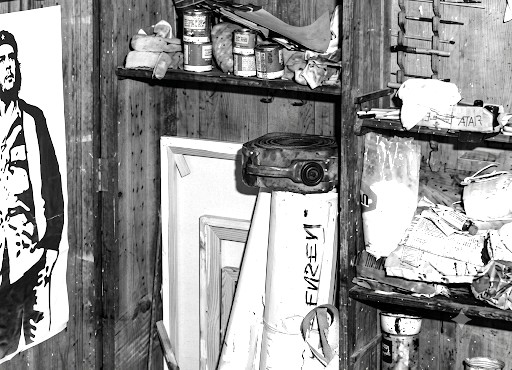
Many years later, the Council of the Faculty of Architecture decided to name the institution’s main auditorium after Commander Ernesto “Che” Guevara.
Curiously, none of the members of that governing body appeared to ask what relationship Guevara had with architecture.
But such details were apparently considered irrelevant.
One might say that Guevara “constructed” his own destiny and also became the “architect” of Cuba’s re-education camps.
Although decades have passed since the collapse of real socialism, and much of Latin America now seems to be moving away from the political left, the situation in my own country brings back to mind, with genuine sadness, that old radio announcement broadcast years ago by the National Association of Broadcasters, which declared—though with a very different meaning:
“Time passes, yet Uruguay preserves its most characteristic features.”
Today, regrettably, it seems to have lost them.
Cuba and ideology.
Universities and politics.
Historical memory.
Continue reading in Global Order and Geopolitics.
Note: The photograph accompanying this article shows a classroom at the Faculty of Architecture in 1968.
Apoyá la continuidad de Perspectiva Liberal
Perspectiva Liberal es un espacio editorial independiente. Si valorás este trabajo y querés colaborar con su continuidad, podés hacerlo mediante un aporte voluntario a nuestra cuenta Prex.
Cuenta Prex: 13440