Fear of change drives today’s global system to undermine its own future.
There are moments in history when uncertainty does not arise from a lack of information, but from the inability to interpret what is already unfolding.
The current global scenario seems to follow that logic.
It is not that the world lacks direction.
It is that those who lead it fail to recognize it.
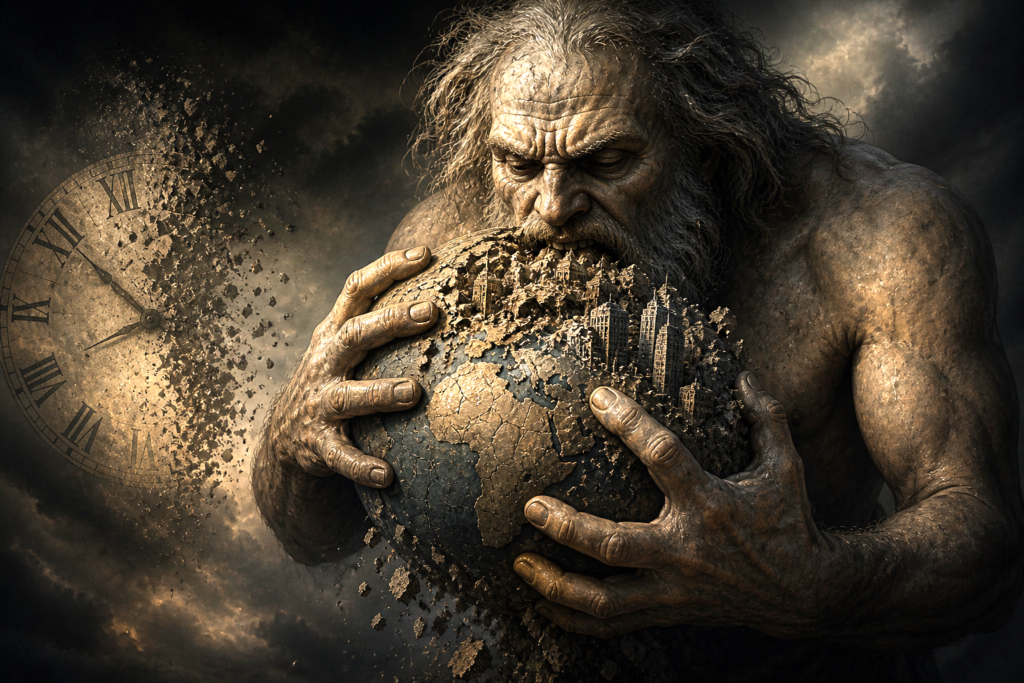
The allegory of Cronos offers an unexpectedly precise key to understanding this phenomenon.
In the myth, Chronos devours his children out of fear of being replaced.
He does not act out of ignorance, but out of fear.
He understands what may happen, yet instead of integrating that future, he attempts to prevent it.
That gesture, deeply human, is also deeply destructive.
Because in trying to avoid his fate, he accelerates it.
The contemporary world displays disturbingly similar signals.
Major structures of power, both political and economic, are facing a transformation they cannot fully control.
New actors emerge.
New technologies redefine the rules.
New social dynamics challenge what once seemed stable.
Yet instead of channeling that change, they often attempt to block it.
Innovation is restricted when it threatens dominant positions.
Global supply chains are fragmented without solid alternatives.
Regulatory frameworks multiply in an effort to contain processes already in motion.
These are not isolated decisions.
They reveal a pattern.
The pattern of a system that, when confronted with the possibility of being replaced, reacts by consuming the very forces that could enable its evolution.
Like Chronos.
But every allegory has its counterpart.
In the myth, one of his children escapes.
Zeus does not confront immediately.
He grows in silence.
He develops outside the control of the existing order.
And when he finally emerges, he does not merely defeat Chronos.
He establishes a new order.
The key is not to identify who plays that role today.
The key is to understand that this process is already underway.
The new order does not appear explicitly.
It takes shape at the margins.
In innovations that are not yet dominant.
In actors who still lack centrality.
In ideas that do not fit current frameworks.
The problem is not the absence of a future.
The problem is that the present attempts to devour it before it matures.
Here a deeper dimension emerges, one that goes beyond geopolitics.
We are not facing a crisis of resources, nor merely a crisis of power.
We are facing a crisis of consciousness.
Civilizations, when they reach a certain level of complexity, can become incapable of interpreting their own historical moment.
They confuse control with stability.
Resistance with strength.
And reaction with strategy.
That is the true chronian trait.
Not destruction itself, but the inability to recognize what must transform in order to endure.
In that context, the greatest global risk is not conflict, nor technological disruption, nor competition among powers.
The greatest risk is that the current system, out of fear of being replaced, ends up destroying the very conditions that would allow its continuity.
As in the myth, the outcome does not depend on force, but on understanding.
And that may be the scarcest variable in today’s global landscape.
Power and fear of replacement
Self-destruction of closed systems
Silent emergence of new orders
.You can continue reading in Global Order and Geopolitics.
Apoyá la continuidad de Perspectiva Liberal
Perspectiva Liberal es un espacio editorial independiente. Si valorás este trabajo y querés colaborar con su continuidad, podés hacerlo mediante un aporte voluntario a nuestra cuenta Prex.
Cuenta Prex: 13440