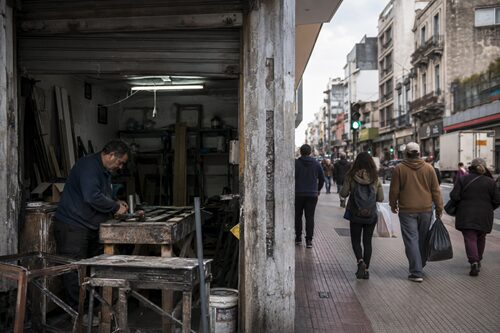
Low productivity, tax pressure, and the relentless growth of public spending are reinforcing a structure that punishes the formal sector and pushes economic activity into informality.
THE TRAP OF A HYPER-EXTRACTIVE STATE
The Relentless Onion: When the Obese State Suffocates Those Who Produce and Those Who Work
By Dr. Nelson Jorge Mosco Castellano
There is a Uruguayan postcard that repeats itself with the stubborn monotony of diagnoses that are all too familiar, yet never resolved.
On one side, official statistics once again shake us out of our lethargy by reminding us that one quarter of the country’s labor force operates in the shadows of informality.
On the other, the most serious technical analyses —such as the repeated assessments by research centers like CERES— warn us about the dangers of a state that spends poorly, grows beyond its means, and intends to finance itself by squeezing the same old “turnip” as always.
The politically correct narrative tends to tear its clothes, appeal to rhetorical sensitivity, and firmly demand that “everyone contribute” and that the economy be formalized by decree.
Yet there is an absolute divorce between that voluntarist aspiration and the harsh economic reality faced every day by thousands of small productive units —in ordinary terms, human beings who spend each day finding a way to survive.
The myth of formal wickedness and the real impossibility
To expect a micro-entrepreneur, a small-scale workshop, or a self-employed worker immersed in that 22.8% informality rate to absorb overnight the cost structure of Uruguayan formality is, quite simply, to ignore how the elementary mathematics of markets works.
The low productivity of these sectors, when forced to incorporate the cost of state inefficiency, is neither a moral whim nor fiscal rebellion: it is an insurmountable boundary.
With a stagnant economy, a strictly limited domestic consumer market, and hyper-competition for survival, profit margins are so narrow that full formality is not viable.
If that small income generator is suddenly burdened with taxes, employer contributions, insurance, and the bureaucratic formalities of a state designed for corporations, the result is not the long-awaited formalization. It is the outright extinction of the activity or its definitive push into complete clandestinity.
For these sectors, operating outside the law is not the luxury of serial tax evaders, but the only price adjustment available to avoid going under.
The absurd persecution and the burden on the captive taxpayer
While a huge segment of the economy logically operates outside the system because of that system’s own lack of viability, the state machinery persists with the wrong diagnosis.
Instead of reviewing regulatory rigidities, shrinking the public apparatus, and simplifying the tax labyrinth, the automatic prescription is bureaucratic persecution: going hunting in an increasingly smaller zoo.
The true silent drama of this system falls on the formal sector.
With Corporate Income Tax evasion rates comfortably exceeding 40% and rigid public spending expanding without pause, the fiscal gap is not addressed by shrinking the state, but by multiplying the pressure on the captive taxpayer.
Formal companies not only bear their own operating costs; they also carry the implicit financing of an obese state that spends inefficiently and compensates for what it fails to collect from the underground economy by squeezing those who show their faces every day.
Informality that barely survives is indirectly rewarded, while the sector that sustains the country’s macroeconomic balances is punished with suffocating taxes and regulations.
The appalling paradox is that even what used to be an advantage for public employees protected by job stability and a salary guaranteed by the morbid obesity of public spending now forces them as well into the exposed world of informality to supplement a meager income barely sufficient for survival.
And most ridiculous of all, the market obstructed by favors granted to the privileged —political salaries, endogamous unions populated by the privileged, paid idlers, and enriched beneficiaries of patronage— is itself losing its footing in this tangle of collective suffocation that they multiply every day, even as they push to increase the distribution that keeps them out of misery.
The gigantic and autonomous growth of public spending: a state that never stops creating recession
Added to this drama at the base of the pyramid is a macroeconomy running out of control. As Ignacio Munyo warns, public spending carries a historical inertia of continuous, autonomous growth without real control.
A review of its historical evolution shows that spending has done nothing but rise from one administration to the next: it grew by nearly 30% in real terms during Vázquez’s first government, almost 40% under Mujica, another 10% during Vázquez’s second term, continued climbing under the Lacalle Pou administration, and Orsi is now adding another 10%.
The result of this uninterrupted expansion is stark: since 2005, real public spending per capita has increased two and a half times.
National budgets are approved on the basis of blind inertia; barely 1% of resources are debated, while the remaining 99% is taken for granted, without being reviewed or controlled according to its actual impact.
State expenditure is systematically projected to continue rising well above inflation, consolidating a hypertrophied state apparatus that spends poorly and whose services —far from improving— are deteriorating in critical areas such as education and early childhood.
The famous “redistribution” that never touches the state is an invitation for all of us to live badly.
The absurd persecution and the burden on the captive taxpayer
How is this festival of uninterrupted spending financed?
Through a fragile financial structure in which, structurally, for every 100 pesos the country spends, 80 are paid through taxes and 20 are borrowed —generally from small savers, or AFAP pension funds with mandatory investments in public debt— feeding a chronic fiscal deficit and a heavy burden of indebtedness.
While a huge segment of the economy logically operates outside the system because of that system’s own lack of viability, the state machinery persists with the wrong diagnosis.
With Corporate Income Tax (IRAE) evasion rates comfortably exceeding 40%, the automatic prescription of the obese state is not to shrink or review its own inefficiency, but bureaucratic persecution: going out to hunt tax evaders in an increasingly smaller zoo.
Formal companies bear their own operating costs and, in addition, the implicit financing of an elephantine state that compensates for what it fails to collect from the underground economy by squeezing the captive taxpayer through taxation.
The sector that sustains the country’s macroeconomic balances is suffocated, making it chronically expensive and less competitive in the world.
To insist that the solution to relative underdevelopment and lack of competitiveness lies in tightening the regulatory screws even further is like peeling an onion until nothing is left in your hands but tears.
If Uruguay does not understand once and for all that the path forward is the liberalization of productive factors, the drastic reduction of the unproductive weight of the state, and the adaptation of regulations to the reality of our productivity, we will remain trapped in the same loop: an agonizing formal sector being punished through taxes to sustain an unsustainable model, and an informal economy that grows because the state itself, through its excessive demands, makes legality impossible.
Informality and productivity
Public spending and fiscal inertia
Pressure on the formal sector
Continue reading in Global Order and Geopolitics
Apoyá la continuidad de Perspectiva Liberal
Perspectiva Liberal es un espacio editorial independiente. Si valorás este trabajo y querés colaborar con su continuidad, podés hacerlo mediante un aporte voluntario a nuestra cuenta Prex.
Cuenta Prex: 13440