
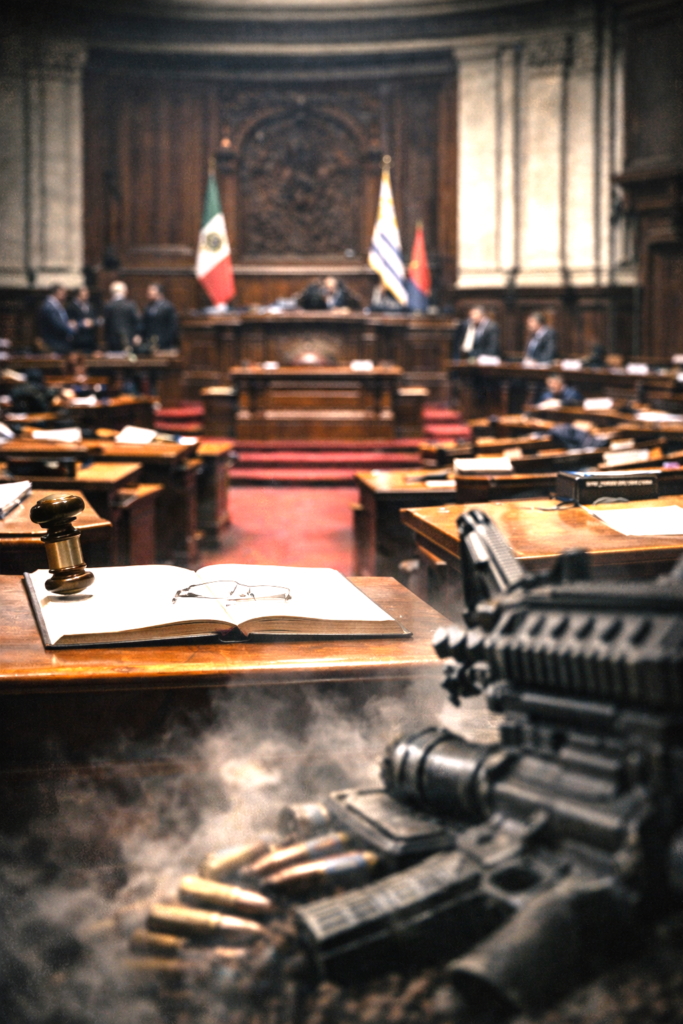
Why, if Tocqueville prescribed preventive medicine, does democracy remain in intensive care?
A sharp question: if Tocqueville gave us the preventive remedy — associational life and decentralization — why is the patient still in intensive care?
Analyzing the security policies of the current Mexican administration through the lens of Alexis de Tocqueville is fascinating, as it places us at the tension point between individual liberty, the rule of law and the degradation of the social fabric.
It is important to clarify that, although the narrative of “hugs, not bullets” and the emphasis on the human rights of alleged criminals — who are often granted rights denied to their victims — are pillars of official discourse, the claim that it is “illegal to confront the cartels” is generally presented in public debate as an interpretation of limited-force rhetoric rather than a literal new legal decree.
The Concept of Anomie and the Vacuum of Authority
For Tocqueville, democracy is not merely a system of votes, but a “social state.”
Anomie arises when the State abdicates its primary function: guaranteeing security so that citizens may exercise their freedom.
“Hugs, not bullets” (AMLO): From a Tocquevillian perspective, if the State renounces the legitimate use of force, it creates a vacuum that is not filled by peace, but by de facto powers — the cartels.
Erosion of the law: When authority suggests that confronting crime is “illegal” or morally questionable, citizens lose reference points about what is just.
This produces a society where laws become suggestions and impunity becomes the norm.
Individualism and Social Disengagement
Tocqueville warned against excessive individualism in democracies, where citizens retreat into private life and disengage from public well-being.
If security policy is perceived as capitulation, the average citizen opts for isolation or submission to local criminal power in order to survive.
This breaks what Tocqueville called “self-interest properly understood”: the idea that for me to be well, my community must be well.
The Tyranny of the Majority vs. the Rule of Law
The positions of Claudia Sheinbaum and AMLO rely on broad democratic legitimacy.
However, Tocqueville warned of the tyranny of the majority.
If a majority accepts that the law not be rigorously applied in exchange for rhetorical peace, the very structure of the Republic is endangered.
Human Rights as Paradox
Tocqueville valued rights, but understood they only exist under the protection of a strong civil authority.
If the rights of perpetrators are systematically prioritized over society’s right to security, the social contract is distorted.
Comparative Framework
Current Position (AMLO/Sheinbaum): avoid violence against criminals to prevent escalation.
No deaths of criminals without due process.
Crime deepens due to poverty and lack of opportunity.
Tocqueville’s Perspective: The State must exercise authority to avoid anarchy.
Rights require stable order to be effective.
Respect for the law emerges from institutional habit and credibility.
“When the past no longer illuminates the future, the spirit walks in darkness.” — Alexis de Tocqueville
Applied to Mexico, this suggests that in breaking with past “war-like” strategies, the current government risks falling into soft despotism or, worse, anomie where the State becomes a spectator of criminal territorial control.
Living in a democracy where organized crime surpasses the State in firepower and territorial deployment means inhabiting a fragmented sovereignty.
Not a full democracy, but a hybrid system where law coexists — and sometimes submits — to parallel powers.
To understand how societies operate in this scenario, three pillars must be analyzed.
Criminal Governance
When cartels possess better weaponry and preparation than the State, they cease to be mere criminal groups and become proto-States.
They substitute functions: resolving disputes, collecting “taxes,” punishing theft within their territory.
The powder keg: capturing a cartel leader is not always seen as justice, but as disruption of the local order.
Subsequent chaos demonstrates who truly controls the territory.
Tactical and Technological Asymmetry
Democracy faces bureaucratic disadvantage against criminal agility.
While the State must follow procurement procedures, cartels acquire military-grade equipment freely.
Drones with explosives, armored vehicles and heavy rifles place local police in suicidal conditions without military support.
The Cost of Mafia Peace
A tacit agreement emerges: peace in exchange for impunity.
If arresting a capo ignites a city, the political cost becomes “unpayable.”
This leads to non-confrontation policies that progressively transfer power to criminal actors.
Social Adaptation
Citizens develop dystopian normality.
They check social media to know if there is a curfew before leaving home.
Democracy is reduced to voting rituals, while daily rights depend on criminal permission.
The Risk of Anomie
Tocqueville warned that democracy without order precedes tyranny.
If citizens feel the State cannot protect them, loyalty fractures.
Institutional desertion follows.
Violence becomes normalized.
Institutions remain on paper, but life is governed by the law of the strongest.
Recent developments in Uruguay echo similar concerns, following statements by Interior Minister Carlos Negro and President Yamandú Orsi.
Not merely “hugs,” but institutional acceptance of defeat.
State Capitulation as Common Sense
If the State admits defeat in the war on narcotrafficking, it yields the monopoly of legitimate force.
For Tocqueville, law is respected only if perceived as effective.
If security authorities declare defeat, citizens conclude that law is symbolic.
The “Dialogue” Approach
Engaging with criminal actors risks recognizing them as political actors.
Democracy may drift toward cleptocracy or feudocracy, where territory is negotiated with warlords.
The Tyranny of Impotence
The democratic State becomes irrelevant.
It neither prohibits nor protects, it merely manages tragedy.
Society divides into protected enclaves and abandoned zones.
Anomie is not absence of law, but the presence of an alternative law that is faster and more lethal.
Conclusion
For Tocqueville, the remedy against anomie was strengthening intermediate institutions and civic courage.
If democratic governments continue declaring themselves incapable or defeated, they invite authoritarian figures promising order at any cost — or risk democracy collapsing under a State that no longer dares to act as a State.
Apoyá la continuidad de Perspectiva Liberal
Perspectiva Liberal es un espacio editorial independiente. Si valorás este trabajo y querés colaborar con su continuidad, podés hacerlo mediante un aporte voluntario a nuestra cuenta Prex.
Cuenta Prex: 13440