
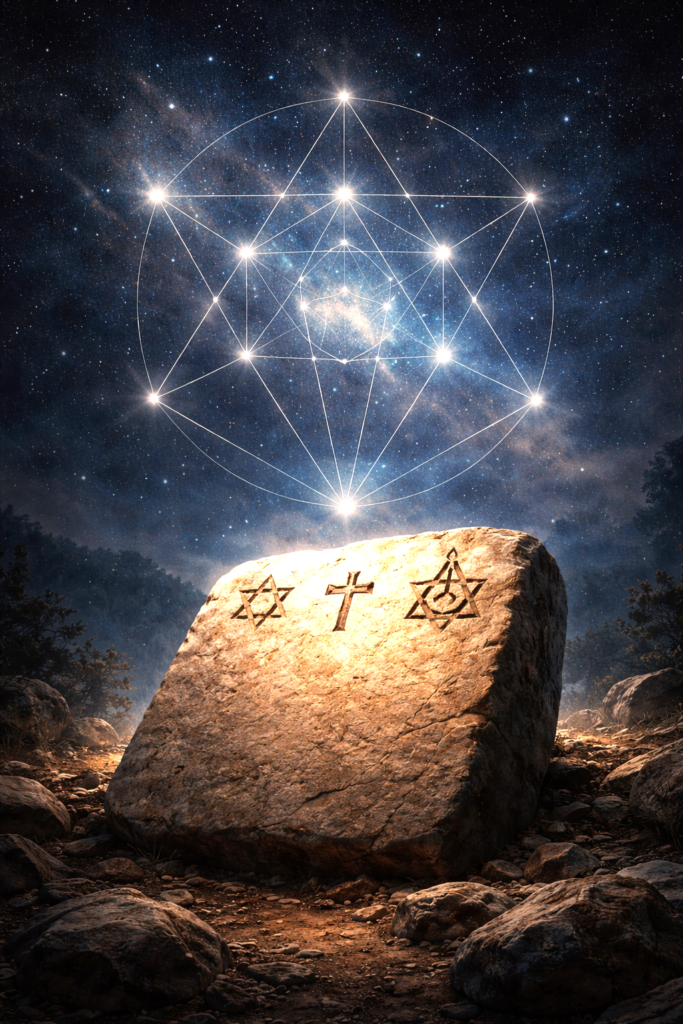
A philosophical reflection on the concept of God in Judeo-Christian tradition and its possible reading as an expression of Universal Laws
What if one of the most influential words in human history has not been mistranslated, but incompletely understood?
Elohim.
With this word, Genesis begins.
With it, civilizations were shaped, institutions justified, moral systems constructed, and spiritual traditions transmitted across centuries.
It has been translated as “God.”
Yet the Hebrew term carries a plural form that invites deeper consideration.
This reflection does not seek to dismantle faith nor to replace living traditions.
It proposes something more rigorous: to explore whether, beyond its symbolic language, Elohim may also express the totality of Universal Laws structuring both cosmos and conscience.
Creation as Order
Genesis does not begin with mythological conflict between rival deities.
It begins with ordering.
Separation. Distinction. Establishing boundaries. Naming.
Chaos becomes cosmos when law emerges.
If Elohim were understood as the totality of Universal Laws, Creation would not represent an arbitrary act of will but the progressive manifestation of structural coherence inherent in reality.
“And God saw that it was good” may then be read as recognition of achieved harmony.
The grandeur of the text remains intact.
Its relevance becomes strikingly contemporary.
Ethics as Alignment
Within this framework, sin ceases to be merely offense and becomes misalignment.
There is no need for divine temper to explain consequence.
Every fracture of structural order produces fragmentation.
Judaism has long understood Torah not merely as command but as instruction guiding human flourishing.
Christian thought developed the concept of natural law inscribed in human conscience.
Interpreting Elohim as universal law does not weaken moral objectivity.
It strengthens it.
Morality ceases to appear as external imposition and reveals itself as discovery of structural principles operating beyond preference or ideology.
The Personal Dimension
The crucial question remains: if we speak of law, where does the personal God of prayer and mercy stand?
Perhaps the dilemma is false.
Human consciousness requires relational language to approach transcendence.
Personification may be a higher symbolic translation of structural reality.
To speak of God as Father, Judge, or Creator need not be naive literalism. It may be the experiential dimension of encountering universal order.
The personal and the structural may represent complementary levels of apprehension.
Order and Inner Construction
If reality is sustained by laws independent of our will, freedom is not abolished but redefined.
Freedom becomes the capacity to understand order and consciously align with it.
Spirituality shifts from repetition of formula to inner construction.
It becomes the disciplined search for coherence with the order that precedes us.
Spiritual Origins of Scripture
This perspective allows us to consider that sacred texts may have arisen from profound experiential discovery rather than mere instruments of domination.
Ancient humanity observed regularities in nature. It perceived moral consequence. It intuited invisible structure sustaining life.
It named that totality Elohim.
Later institutional instrumentalization does not exhaust the source.
Conclusion
Is Elohim a personal God who establishes laws?
Or a symbolic expression of universal laws later personified for relational comprehension?
Perhaps both dimensions coexist.
What remains constant is the intuition of order — an architecture that precedes us and demands alignment rather than submission.
In that search for coherence, the biblical text remains alive.
Apoyá la continuidad de Perspectiva Liberal
Perspectiva Liberal es un espacio editorial independiente. Si valorás este trabajo y querés colaborar con su continuidad, podés hacerlo mediante un aporte voluntario a nuestra cuenta Prex.
Cuenta Prex: 13440