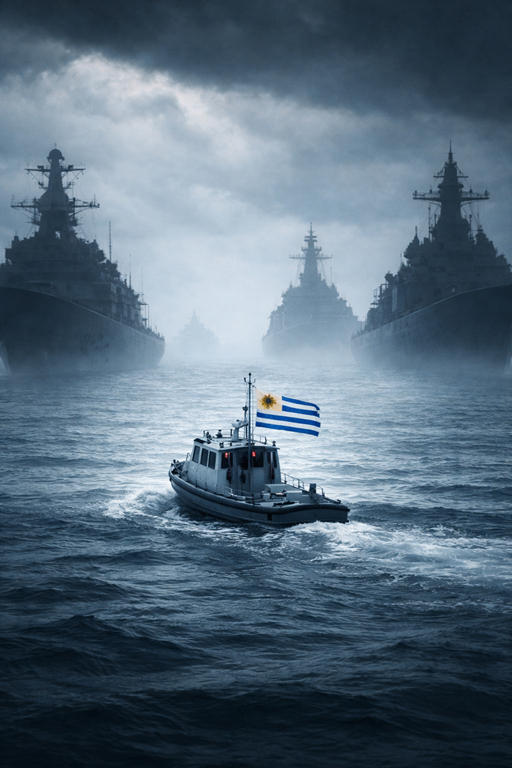
Several events that have recently impacted public opinion in Uruguay share a common thread that is not always addressed with sufficient clarity.
The passport issue, the construction of two naval vessels for the Uruguayan Navy in a Spanish shipyard, and the recent restrictions on migrant visas to the United States are different episodes, yet all point to the same underlying dimension.
International relations.
There is little value in revisiting every administrative or political twist of these cases.
What truly matters is the direction taken when an issue crosses national borders.
International relations are neither secondary nor a field open to improvisation.
They are an academic discipline, a university degree taught at the Faculty of Law, and a professional practice that demands training, experience, and sound judgment.
On the international stage, small-scale logic does not apply.
Uruguay is not a village where personal connections or clever shortcuts solve complex problems.
Decisions are assessed, interpreted, and remembered, especially when they come from a small country that must carefully manage every signal it sends.
Those trained in international relations are better equipped to assume such responsibilities.
Not necessarily at the very beginning of their diplomatic careers, but certainly as experience and individual capabilities develop.
From this perspective, Senator Pedro Bordaberry’s reluctance to approve diplomatic appointments without proper academic training becomes understandable, allowing only very limited exceptions in specific political trust postings.
The passport controversy shortly after the government took office, expecting Germany, France, and Japan to swiftly accept a unilateral decision.
The hasty announcement of canceling a contract with a European shipyard over an initially solvable issue, without even the presence of the Minister of Defense. Uruguay’s stance on Venezuela, aligned with Brazil but lacking the weight of “the largest country in the world”.
All these cases reveal the same risk.
Rushing decisions beyond national borders leaves the Uruguayan state exposed.
Diplomacy is essential for small countries, but it must be exercised with restraint, expertise, and a realistic reading of power dynamics.
It cannot be improvised, especially when dealing with superpowers that openly discuss acquiring territories such as Greenland, which belongs to the Kingdom of Denmark, a NATO ally.
Acknowledging reality, negotiating uncomfortable terms, and avoiding grandstanding are fundamental diplomatic skills.
Otherwise, a country risks becoming a caricature.
An unintended remake of the old film The Mouse That Roared.
And that, for a nation, is far more humiliating than any discreet compromise.