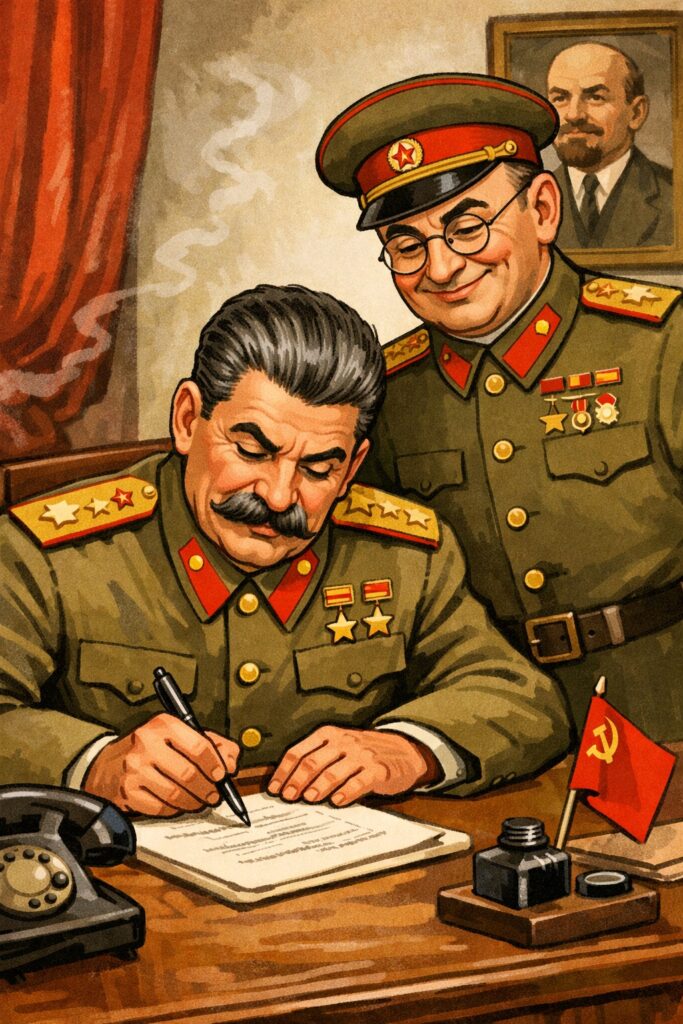
This reflection seeks to highlight how totalitarianism has transformed history into literature, using fiction as a political weapon to conceal its crimes. A tendency that survives on unredeemed dead.
In closed societies, history and fiction often walk hand in hand.
The past is constantly rewritten to justify the abuses of the present.
In the previous article, we referred to the horrific discovery of the mass graves of Katyn and the propaganda struggle between Nazis and Communists, each blaming the other for the massacre.
We presented the findings of the Red Cross investigation in 1941 and the Soviet investigation of 1944, known as the Burdenko Commission.
While the Red Cross blamed the Communists, the commission chaired by neurosurgeon Nikolai Burdenko dated the events to the period of German occupation.
The lie endured simply because the Soviets won the war.
Western powers also made no real effort to clarify the facts.
At that time, the global conflict was unresolved, and it was inconvenient to antagonize their powerful ally, “Father” Stalin.
Later, they divided the world, condemning hundreds of millions of people to confinement behind the Iron Curtain.
Berlin was split in two by an oppressive wall that stood unchallenged until 1989.
It was dismantled by the force of history, and its fragments were sold as souvenirs to tourists.
Many travelers returned from Europe carrying pieces of masonry to give to family and friends.
Lacking notarized certification, some of those fragments were likely taken from random construction sites along the way.
The wall reduced to rubble may seem amusing, but its tragic history is stained with the blood of many victims.
And curiously, those lives belonged to people who were trying to flee the communist paradise.
Soviet propaganda continued at Nuremberg, where they attempted to attribute responsibility for Katyn to the Nazis on trial.
The evidence appeared weak and was disregarded.
In any case, the Nazis already had enough crimes to their name for one more to make little difference.
But Communist crimes, just as grave as those being condemned, were never judged.
There was never a coherent judicial review of the Katyn massacre in Russia.
As Polish historian Karol Polejowski notes, it was not until 1951, in the context of the Cold War, that “the Madden Report, a U.S. Congressional investigation chaired by Congressman Ray J. Madden, clearly assigned responsibility for the Katyn massacre to the Soviet Union in December 1952.”
Of course, no one in the Soviet sphere of influence learned of it, and in the West, Communist support networks dismissed the news as “Yankee propaganda.”
The Madden Report broke a long silence on the issue.
Whether due to political calculation or fear, the result is equally tragic.
But the USSR collapsed.
The Soviet structure dissolved like a house of cards in a bath of acetone.
Only in 1990 did the government acknowledge the crime, placing the blame on Stalin.
According to Polejowski, the investigation was classified in 2004.
And he notes that “the Russian Federation does not consider the Katyn massacre to be genocide, but rather a common crime that has expired under the statute of limitations.”
As defined by the Royal Spanish Academy, genocide means the systematic extermination of a human group based on race, ethnicity, religion, politics, or nationality.
Perhaps the issue lies in determining how many people constitute a “human group” for the definition to apply fully.
Five thousand, ten thousand, twenty-two thousand.
On November 26, 2010, Spain’s RTVE reported that Russia’s State Duma approved, on first reading, a declaration attributing the crimes of Katyn to Stalinism.
The report added that Russia’s Federal Archives Agency had previously published documents proving that the massacre had been proposed by Lavrenti Beria and approved by Stalin.
And then?
Then nothing.
Twenty-six years into the twenty-first century, historian Karol Nawrocki, President of Poland, notes that Russia “practically glorifies its communist past and displays imperial tendencies.”
The curtain that concealed the Polish genocide was made of iron.
It remains one of silence.