
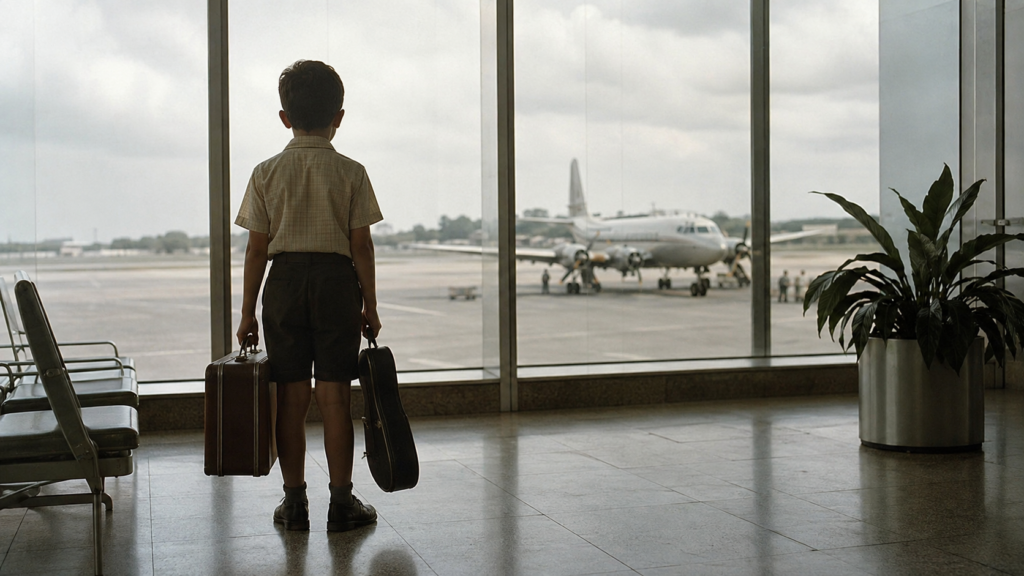
Manuel Prestamo’s story, as one of the Cuban children of Operation Peter Pan, is also a story of exile, freedom, and the possibility of building a life of one’s own.
There are political decisions that are debated for decades.
There are others that can be understood simply by looking at a child standing in front of an airplane.
Manuel Prestamo was nine years old when his parents decided to send him from Cuba to the United States.
It was January 6, 1961.
He traveled accompanied by an aunt.
His mother, his sister, and his grandmother remained in Cuba.
His father died before the family could be reunited.
He was part of that generation of children that would forever be associated with Operation Peter Pan.
Behind that episode of the Cold War were families facing decisions for which there were probably no good answers.
In Manuel’s case, his parents chose to separate from a son in order to give him a chance at a future.
Freedom Does Not Guarantee Destiny
Leaving an authoritarian regime did not mean that life immediately became easy.
His first years in the United States were difficult.
The brother of the aunt he lived with opposed his developing his artistic inclination.
Manuel wanted to study violin.
He ended up practicing it in a barn.
Freedom offered him no guarantees.
It offered him something less spectacular and much more important: the possibility of trying.
And he did.
At 16, he entered university on a full scholarship.
By 21, he had earned a doctorate from New York University and had become a university professor.
What followed was an extensive career as an orchestra conductor, educator, and cultural administrator.
He conducted ensembles such as the BBC, Uruguay’s Radio and Television Orchestra, and the Teatro Colón.
He was dean of Arts and Humanities at Oklahoma City Community College and carried out professional activities in numerous countries.
None of that was assured when that child boarded an airplane in 1961.
That is precisely the point.
A Story That Also Passed Through Uruguay
In 2000, Manuel Prestamo arrived in Uruguay as a Fulbright Scholar in the field of the Arts.
His mission extended far beyond musical activity.
He worked with Uruguayan cultural institutions in administration and management.
He collaborated with SODRE and the National Library.
He took part in work connected with a national performing arts project and conducted both the SODRE orchestra and the Municipal Orchestra of Montevideo.
His wife, Anne Prestamo, also carried out professional activities during that stay.
A specialist in library science, information sciences, and technology, she gave a lecture in Montevideo on American Memory, a Library of Congress project, organized together with the Association of Librarians of Uruguay, the National Library, and the United States Embassy.
There is something suggestive in the trajectory of both of them.
The musician who had lost his country during childhood and the specialist in documentary preservation ended up devoting much of their lives to two different ways of preserving what societies produce.
Culture and memory.
When the Child Speaks Again
Decades later, Manuel decided to return to that episode.
He did so through theater.
He wrote and performed From Cuba, with Love: The Story of a Peter Pan Kid.
The play began to be performed in 2019.
Manuel had begun thinking again about his own story after observing new separations of children and families caused by political and migratory conflicts.
On stage, that nine-year-old boy reappeared.
The departure.
The uncertainty.
The question of when he would return to Havana.
The wait for his family.
And finally, the realization that what had seemed like a temporary separation had changed his life forever.
Perhaps that is where the deepest dimension of this story can be found.
Political regimes tend to speak in the name of abstractions.
The revolution.
The homeland.
The people.
Equality.
But their consequences always fall on concrete individuals.
Sometimes they take the form of persecution.
Sometimes of silence.
Sometimes simply of a farewell at an airport.
The Possibility of Choosing
It would be too simple to interpret this story as proof that one country was bad and the other good.
The United States did not offer Manuel a clear path either.
He encountered difficulties.
He encountered opposition.
He encountered losses that no later success could repair.
What he found was the possibility of building.
The possibility of studying.
The possibility of persisting with that violin.
The possibility, ultimately, of turning the exiled child into a professor, orchestra conductor, cultural administrator, and actor.
That may be one of the deepest meanings of freedom.
It does not promise success.
It does not guarantee happiness.
It does not eliminate adversity.
It simply preserves a space within which each person can seek to build a life of their own.
In 1961, Manuel Prestamo carried a small suitcase.
He also carried a violin.
More than six decades later, that child is still telling his story.
And perhaps that is why it remains necessary to listen to him.
Because some discussions about freedom are better understood when they stop talking about political systems and return to talking about human beings.
Operation Peter Pan
Exile and freedom
Culture and memory
Continue reading in Global Order and Geopolitics
Apoyá la continuidad de Perspectiva Liberal
Perspectiva Liberal es un espacio editorial independiente. Si valorás este trabajo y querés colaborar con su continuidad, podés hacerlo mediante un aporte voluntario a nuestra cuenta Prex.
Cuenta Prex: 13440