
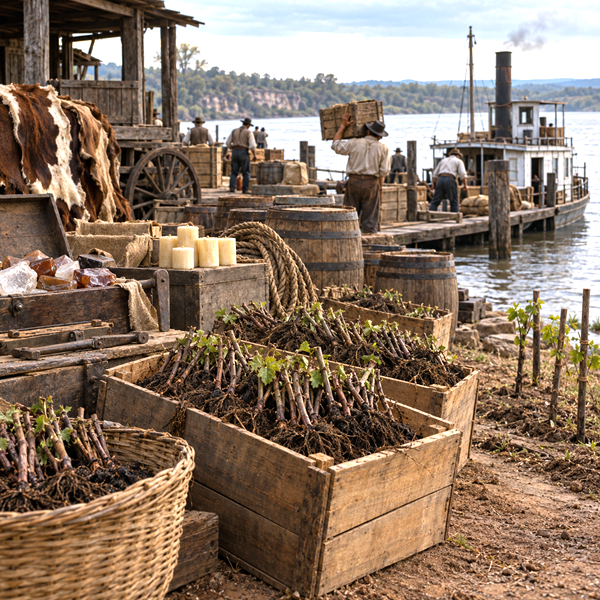
From slaughterhouse laborer to industrialist and Tannat pioneer, his trajectory shows how private experimentation ultimately gave Uruguay a productive identity recognized around the world.
PASCUAL HARRIAGUE: THE ENTREPRENEUR WHO TURNED A GRAPE INTO A NATIONAL IDENTITY
He arrived in Uruguay at nineteen, worked as a laborer in a slaughterhouse, and went through activities as diverse as a general store, a tannery, a candle and soap factory, the trade in semiprecious stones, and the meat-processing industry.
Then he began experimenting with vines.
One of those experiments would end up giving Uruguay something far more important than a good wine: an identity recognizable around the world.
By Santiago H. Pereira Testa
When Pascual Harriague arrived in Montevideo in 1838, he was nineteen years old.
He had been born in Hasparren, in the French Basque Country.
He did not arrive as a major capitalist or as the representative of a European company.
He worked as a laborer in a slaughterhouse in Cerro and later as an employee at a general store in San José.
In 1840 he moved to Salto, where he began an entrepreneurial career extraordinarily representative of the Uruguay that was being built during the nineteenth century.
Harriague was not initially a man of wine.
He owned a tannery, added a rendering operation, manufactured soap and candles, traded agates and quartz, and traveled to Germany in search of markets for those stones.
Later he returned to livestock, created a slaughterhouse with Juan Claviere, and developed La Caballada, where he worked with improved cattle.
His contemporaries regarded him primarily as an industrialist.
It is worth pausing on that.
We tend to look at the successful entrepreneur from the end and retrospectively construct a straight line that never existed.
Harriague tried different activities, changed course, sought markets, accumulated capital, reinvested, and also made mistakes.
When he began experimenting with vines, the first results were not good.
He tried different varieties for years.
While Francisco Vidiella was doing something similar in the south of the country, Harriague was following a parallel path in Salto.
They would end up sharing official recognition as founders of Uruguayan viticulture.
Toward the end of the 1860s, his trials began.
The solution appeared on the other side of the Uruguay River.
In Concordia, a variety from southwestern France that had been acclimatized in the region by Basque immigrants was being successfully cultivated.
It was known as “Lorda.”
Harriague brought those plants to Salto around 1874.
It was the variety we now know as Tannat.
Two years later he obtained a satisfactory harvest, and the venture began to gain scale.
The plantation at La Caballada reached around two hundred hectares, and his establishment became one of the great reference points of national viticulture.
But something even more significant happened.
People began calling that grape “Harriague.”
His name ceased to identify only a person and came to identify a product.
Over time, that product would end up identifying a country.
In 1887 Harriague publicly presented his wine.
Soon afterward, he received international recognition at the Barcelona exhibition of 1888 and the Paris exhibition of 1889.
Uruguay, which only a few decades earlier had mainly exported hides, jerky, fat, and wool, was beginning to show that it could also transform experimentation, knowledge, and capital into more highly processed products.
The government understood the importance of that process.
President Máximo Tajes awarded Pascual Harriague and Francisco Vidiella a special medal for the perseverance with which they had helped solve a productive problem considered to be of national interest.
The episode contains a lesson particularly relevant to this series.
The State had not carried out the trials, risked the capital, or suffered the failures.
But it knew how to recognize that this private effort was generating something valuable for the entire country.
More than one hundred and fifty years later, we can measure its consequences.
Tannat occupies around 26.5 percent of Uruguay’s vineyard area, and Uruguay has become its leading producer worldwide.
Every April 14, Tannat Day is celebrated.
The date corresponds to Pascual Harriague’s birth.
The story is difficult to imagine if we look at it only from the outcome.
A nineteen-year-old immigrant works as a laborer, tends a general store, sets up industries, trades stones, seeks markets in Europe, raises cattle, and finally plants vines.
He fails and tries again.
Until he finds a variety that works.
A century and a half later, that variety appears in restaurants and wine shops in numerous countries associated with one word: Uruguay.
That too is entrepreneurial creation.
It does not consist only of producing a fortune.
Sometimes, it consists of discovering a possibility that others do not yet see and transforming it into an activity capable of surviving the person who started it.
Pascual Harriague died in Paris in 1894.
His surname remains in streets and historical references in Salto.
But his most important legacy needs no monument.
It is served in a glass.
Because the entrepreneurs who built Uruguay did not only build companies.
Some created things that ended up seeming so naturally Uruguayan to us that we forget that, at some point, someone had to make them possible.
Tannat is one of them.
And behind that glass was Pascual Harriague.
Entrepreneurial experimentation
Persistence and innovation
National productive identity
Continue reading in From Lafone to Jodal
Apoyá la continuidad de Perspectiva Liberal
Perspectiva Liberal es un espacio editorial independiente. Si valorás este trabajo y querés colaborar con su continuidad, podés hacerlo mediante un aporte voluntario a nuestra cuenta Prex.
Cuenta Prex: 13440