
A reflection on the practical verification of international institutions and on the real performance of the United Nations in world conflicts.
– The verification of facts as a criterion of reality
– The gap between institutional design and historical reality
– The United Nations and the management of global conflicts
VERIFICATION…
Many people believe that without verification there can be no science.
Beyond the names that may be given, there are those who think that the essential characteristic of any science is the verification of facts. Thus, for example, if someone says that fire burns and another person doubts it, it is enough to bring a lit match close to a piece of paper or cardboard. When contact occurs, it becomes evident that fire indeed burns.
This almost childish example allows many people to think that Law, History, Sociology and other similar disciplines are not sciences because they lack that fundamental element: verification.
Not everyone agrees, however. There are those who maintain that these disciplines should instead be called social sciences or sciences of the spirit.
In any case, names matter little. Let us refer to Descartes, the great rationalist, so that he may illuminate this issue as he did with many others, for he is certainly qualified to do so.
Let us now descend to something more practical. Let us leave aside the French philosopher and also the great Viennese jurist Hans Kelsen and his reflections on the world of the OUGHT (the world of norms) and the world of BEING, that is, speaking somewhat loosely, the material reality. Let us move toward that reality which is visible, which we can touch and live.
In other words, let us analyze things with a simpler perspective, closer to that of the ordinary citizen than to that of the scientist, philosopher or jurist.
And for that purpose let us ask a very simple question.
Does the United Nations Organization — commonly called the UN — really exist?
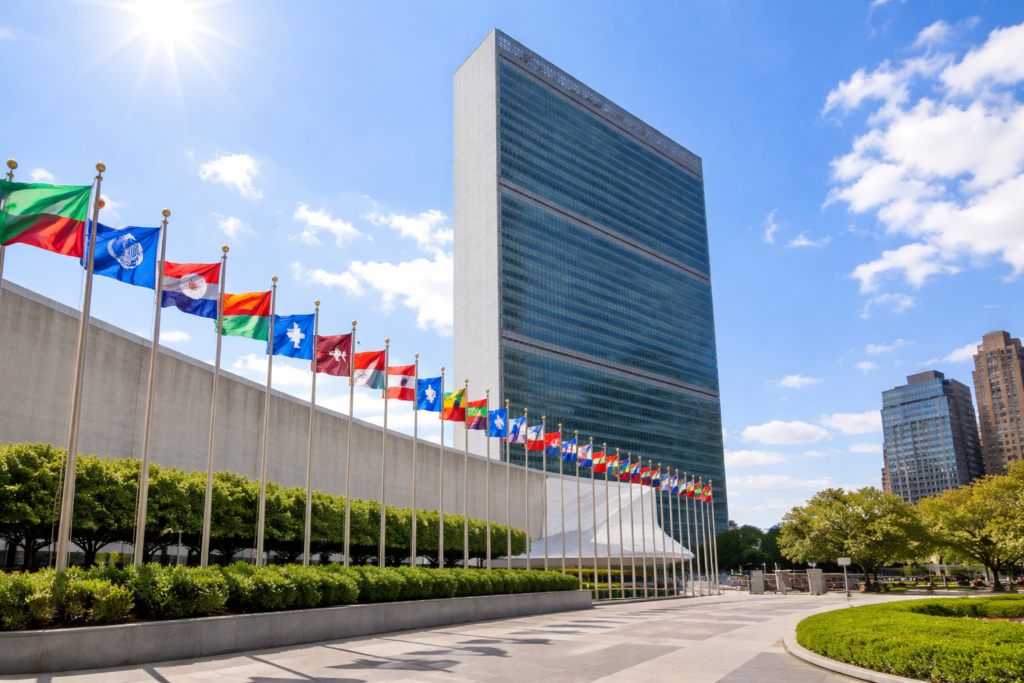
The answer seems obvious. Of course it does. It stands in a well-known building in New York City, full of delegates, officials, secretaries, ushers, security guards and the rest of the bureaucratic fauna. It pays generous salaries and includes several sub-organizations such as UNICEF and others.
But is that truly the case? Or is it more like a soccer ball that contains nothing but air?
Let us think for a moment. What is the purpose of a soccer ball?
To enter a rectangle called the goal — arco in Uruguay, portería in Spain, goal in England.
But if it never entered the goal, would it serve any purpose?
Frankly, it would not seem so.
With this in mind, and considering what has happened and continues to happen in the world, could the United Nations be something like a ball that never fulfills its function?
One must remember that Roosevelt lit hundreds of candles to Stalin — and even handed him half of Europe — in order to secure his support for the creation of what he believed would be a nearly perfect global organization, one that would prevent future conflicts and avoid the mistakes of the League of Nations.
Yet the world of BEING, that is to say reality, shows something quite different.
Founded in 1945 and up to the present day, the United Nations intervened in only one truly active conflict: Korea, between 1950 and 1953.
Indochina, the four Arab-Israeli wars, Vietnam, Cambodia, the Soviet invasions of Hungary, Czechoslovakia and Afghanistan, the two wars with Iraq, the Falklands War, the endless conflict in Lebanon, Syria, Libya, the removal of Maduro from his bed, or the overthrow of the ayatollahs — in none of these cases has one seen the United Nations do much more than talk in its General Assembly, which must be more boring than a Senate session at two in the morning during a winter night in our country.
The logical and almost inevitable answer therefore seems to be the following.
Yes, indeed. The United Nations resembles a soccer ball that does not serve the purpose for which it was created.
And such balls usually have a very predictable destiny: the trash bin or, worse still, total indifference.
Apoyá la continuidad de Perspectiva Liberal
Perspectiva Liberal es un espacio editorial independiente. Si valorás este trabajo y querés colaborar con su continuidad, podés hacerlo mediante un aporte voluntario a nuestra cuenta Prex.
Cuenta Prex: 13440