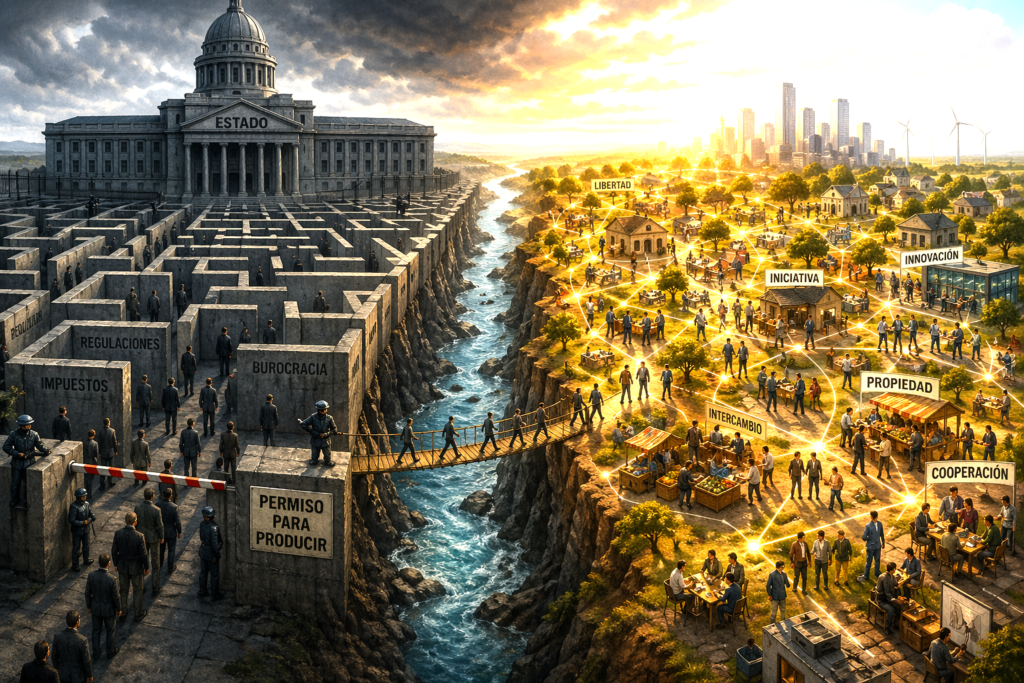
When the State claims to know better, it replaces freedom with control and destroys the wealth it seeks to direct
No one knows better what is convenient than those who create resources.
The arrogant man who imagines he can arrange the members of the entire society as if they were pieces on a chessboard forgets that, on the great board of human society, each piece possesses a principle of movement of its own, entirely different from the one the designer attempts to impose upon it.
When the State attempts to direct capital and labor toward where nature does not call them, it does not create wealth; it merely builds monuments to its own arrogance upon the ruins of the prosperity of others.
The invisible hand of the market is infinitely wiser than the visible fist of the tyrant, for the former seeks utility and the latter only obedience.
It is not from the trap of the feigned benevolence of the professional politician, the eternal bureaucrat, or the conditioned militant that citizens expect their sustenance, but from their own interest in preserving or improving their position with the least interference from impostors who use pressure to impose an additional sacrifice.
Those who preach collectivism as an act of superior charity are the first to exempt themselves from the sacrifices they demand from others, feigning excuses and plans that keep the most unfortunate trapped in poverty.
True compassion does not consist in distributing what belongs to others, but in allowing each man, under laws that protect his rights, to seek his own path and, in doing so, elevate the entire community.
There is no greater injustice than the one committed under the cloak of virtue by statizing everything, subjecting it to the bureaucratic scrutiny of ideal distribution, where the bread legitimately earned through effort is confiscated to feed the loyalty of the parasite.
The Duty of Austerity and the Crime of Debt
What is prudence in the conduct of every private family can hardly be madness in that of a political operator or a hardened bureaucrat.
The ruler who spends more than society produces is not a benefactor, but an abuser who confiscates the resources of the present and preys upon those that might be produced in the future.
By taxing tomorrow to sustain the waste of today, the State corrupts intergenerational justice and deprives posterity of the tools for its own development in freedom.
Public debt is the shackle that the ambition of the present imposes upon the arms of those not yet born.
A State that spends poorly and advances what it does not have ends up stealing what the citizen possesses, impoverishing the present and mortgaging what his children have not yet earned, nor will be able to earn, stripped of productive resources.
A tombstone over the evaporated creative investment that could have prevented poverty and benefited all.
Education as a Bastion or as a Chain
A man who lacks the use of his intellectual faculties due to indoctrination, and the critical judgment of reality, is less than a man; he is a shadow that follows the dictates of the power imposed upon him.
When education imposes from the State its narrative following union guidelines, it becomes an instrument of ideological indoctrination that undermines human dignity.
Education must be the cultivation of the liberal arts that allow the individual to discern truth from implanted propaganda, and not a factory of subjects designed to applaud their own servitude.
Knowledge imposed by decree is not light for the soul, but a blindfold placed over the eyes by those who fear the judgment of a free man.
The Corruption of Moral Sentiments
When the law rewards proximity to power and punishes excellence, effort and productive investment, the character of a people inevitably degrades.
The legitimate ambition to improve oneself ceases to be directed toward the creation of value and turns toward the capture of public rents, political favor, privileges, discrimination and corruption.
In a society where militancy weighs more than competence and merit, justice becomes a farce and public morality disintegrates, leaving a vacuum that only the force of the State attempts — and always fails — to fill.
Where the favor of the sovereign is worth more than the effort of the citizen, honesty becomes a burden and corruption the only law of survival.
The natural freedom of individuals to improve their own condition is a principle so powerful that, by itself and without assistance, it is capable of leading society to wealth and prosperity.
Those who cry out against “foreign intervention” while oppressing their own compatriots with taxes, regulations and dogmas are the true enemies of the nation.
Sovereignty does not reside in borders drawn on a map, but in the inviolability of property and the conscience of each citizen.
The most powerful nation is not the one that possesses the largest State, but the one where the citizen is so free that he does not need to ask permission to be prosperous.
For the most disadvantaged to embrace the change toward a prosperous nation, it must manifest itself in concrete improvements that dismantle the narrative of fear.
To pulverize the tax on the poor that is inflation.
The most unjust mechanism of wealth transfer that exists. A just leadership stabilizes the currency, offering immediate relief to the informal worker and the retiree, who have no assets to protect themselves.
The most economically disadvantaged tend to live in informality not by choice, but because the State makes formality prohibitively expensive and complex.
Eliminating barriers to entry into formality is an act of social justice that allows the citizen to progress without asking permission from the militant of the moment.
Replacing the intermediation of pseudo-assistants with direct technological transfer systems is not only more efficient, but also restores dignity to the individual, freeing him from the ideological pressure of those who use assistance as political currency.
The subtlety of liberal humanist leadership lies in changing the tone: moving from sterile confrontation to example.
It validates that the current system has failed and that despair is real.
To speak the language of those who suffer the consequences of productive paralysis.
To demonstrate with facts that the reduction of spending begins with the privileges of politics. One cannot demand austerity from an opulent office, a first-class seat, or luxury in political work.
The Narrative of the Future implies offering a vision where personal success is celebrated, not persecuted.
To show that a country with real legal security and protected private property is the only place where the children of the most disadvantaged can become independent from the power of the moment, accessing the position of those who provide for themselves. Those who produce, not those who receive.
To ensure that the citizen sees change not as a “foreign intervention”, but as an act of real national liberation, not staged like the old speeches from the public square.
State vs market
Debt and power
Freedom vs control
Apoyá la continuidad de Perspectiva Liberal
Perspectiva Liberal es un espacio editorial independiente. Si valorás este trabajo y querés colaborar con su continuidad, podés hacerlo mediante un aporte voluntario a nuestra cuenta Prex.
Cuenta Prex: 13440