
From Solferino to the Red Cross, the attempt to civilize war collides with its own limits
Humanity had already come a long way when attempts began to establish a legal framework for war.
Humanity had already come a long way when attempts began to establish a legal framework for war.
For many centuries, the justice of war had been grounded by doctrinal thinkers in the validity of its cause and in the intention of seeking peace.
But the truth is that war seems inherent to human nature, and even when it appears guided by good intentions, it always ends up generating injustice.
In 1859, Henry Dunant was traveling through northern Italy on business when he witnessed the famous Battle of Solferino.
Austrian forces faced a Franco-Piedmontese coalition.
We noted that war, according to Clausewitz, was to some extent limited by the chivalric code of honor of military aristocrats.
A good example is this passage from Dunant’s book “A Memory of Solferino”:
“In Guidizzolo, Prince Charles of Windisch-Graetz, an Austrian colonel, exposes himself to certain death while attempting to recover, at the head of his regiment, the strong position of Casa Nova; mortally wounded, he continues giving orders; his soldiers support him, carry him in their arms, remain motionless under a hail of bullets, thus forming around him a final shelter; they know they are going to die, but they do not want to abandon their colonel, whom they respect, whom they love, and who soon expires.”
A similar scene is recorded in historical accounts of the death of León de Palleja in 1866, fighting in the tragically named War of the Triple Alliance.
He fought at the head of his troops, and his soldiers, under enemy fire, rendered him a guard of honor when he fell.
Half a century earlier, José Artigas had sealed his victory at the Battle of Las Piedras with his famous order to respect the defeated and to care for the wounded on both sides.
He also had the defeated officer’s sword received by a priest.
Codes existed, and for the most part they were respected.
By contrast, in 1806 the British took the city of San Fernando de Maldonado and
allowed their troops three days of unchecked looting and abuse, during which they raped women, desecrated sacred images in churches, and tore doors from houses to fuel their fires.
The guns were still roaring when Dunant was among the first to reach the battlefield to attend to the wounded.
“When combat is taking place, a red flag raised on a high point indicates the location of the wounded or ambulances […] and, by tacit and reciprocal agreement, no one fires in that direction; but sometimes shells still reach it,” Dunant records.
“The entire battlefield is covered with the corpses of men and horses […] In several places, the dead are stripped by looters, who do not even spare the dying wounded…”
Dunant is not merely an observer, but a key actor in the relief efforts he himself provides with his work and resources (he was a wealthy and generous man), and in his book he proposes certain measures aimed at alleviating the suffering caused by war.
He proposes the creation of “voluntary relief societies to provide assistance, in times of war, to the wounded” in all countries.
He also maintains that an “international, conventional and sacred principle” must be established, in his words, to underpin these relief societies.
The text was published by Dunant in 1862, in a limited edition that he distributed among his acquaintances.
A year later, Henry Dunant, Gustave Moynier, General Guillaume-Henri Dufour, Dr. Louis Appia and Dr. Théodore Maunoir organized a congress in Geneva, attended by representatives of sixteen countries.
They recommended the creation of national relief societies and called for their protection and support by governments.
In 1864, the Swiss Federal Council convened a Diplomatic Conference in Geneva, attended by plenipotentiary delegates from sixteen countries, who drafted the “Geneva Convention for the Amelioration of the Condition of the Wounded in Armies in the Field”, signed on August 22 of that same year and later ratified by almost all states.
On the basis of the resolutions of the 1863 congress and the Geneva Convention, the humanitarian organization that would become the International Red Cross and the Geneva Conventions for the protection of war victims gradually developed.
Essentially, the rules prohibited attacks on hospitals and aid stations, as well as ambulances and medical transport; they established the neutrality of doctors, nurses and assisting personnel; and, most importantly, the wounded had to be treated regardless of their side.
Of course, that protection is valid only as long as a hospital is not used as a military base or an ambulance to transport weapons.
This has never been fully prevented.
And as modern warfare is also a confrontation of narratives, with media and social networks as ideal channels to shape them, it becomes increasingly difficult to discern whether something constitutes a legitimate attack or a war crime.
And that, generally, depends on who prevails, because that side will ultimately shape the narrative
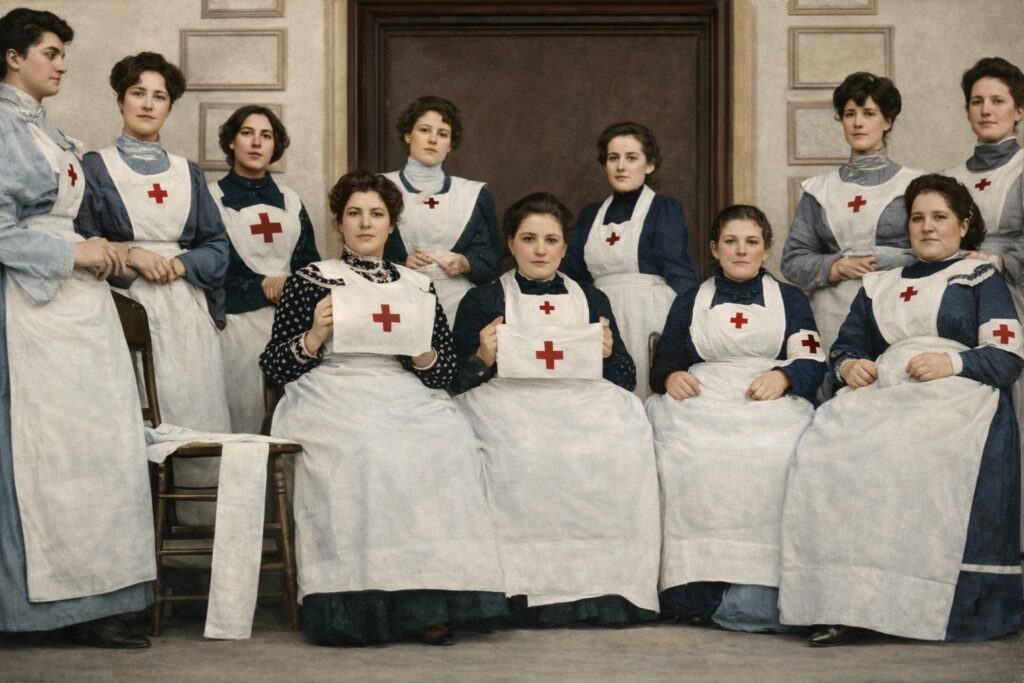
Note – The image shows an AI-colorized photograph of a group of Uruguayan Red Cross women during the 1904 civil war.
Moral limits of war
Birth of humanitarian aid
Narratives as battlefield
This analysis is part of the Global Order & Geopolitics cluster
Apoyá la continuidad de Perspectiva Liberal
Perspectiva Liberal es un espacio editorial independiente. Si valorás este trabajo y querés colaborar con su continuidad, podés hacerlo mediante un aporte voluntario a nuestra cuenta Prex.
Cuenta Prex: 13440