
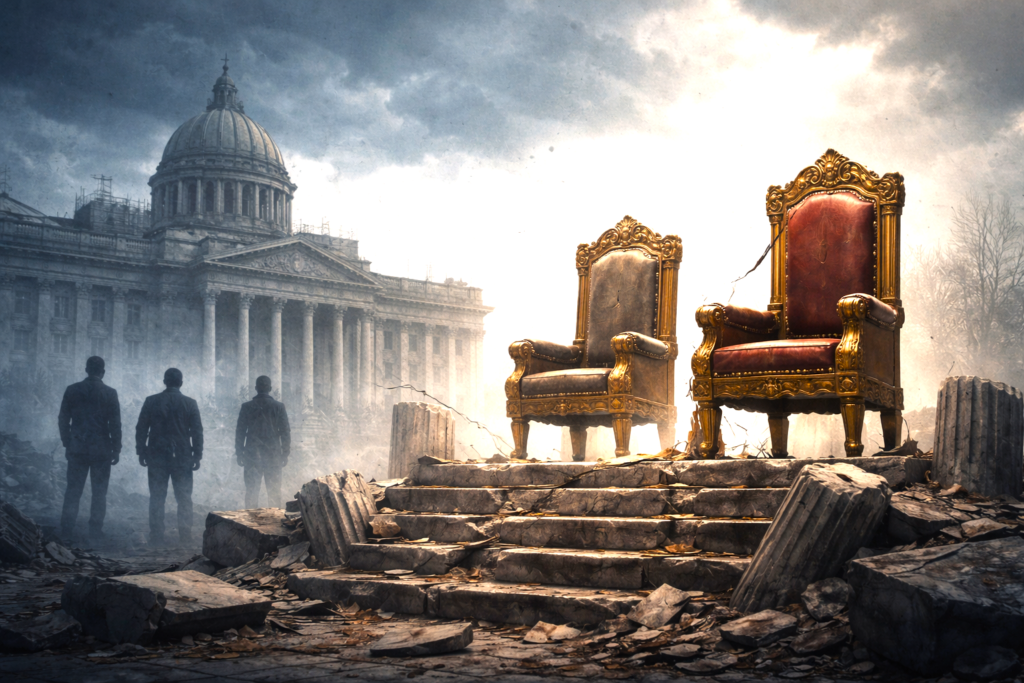
Ideological governance, corruption, and institutional breakdown in the Southern Cone
Useless leaders who marked the inexorable fate of their voters
Alberto Fernández (Argentina)
He left Argentina with inflation exceeding 211 percent, a poverty rate that surpassed 50 percent, and an economic and political paralysis that foreshadowed a social and economic catastrophe.
His internal conflict with Vice President Cristina Kirchner, who handpicked him as a candidate, exposed him as unfit to organize another corruption spree like hers.
His term ended stained by extremely serious judicial accusations which, as always, were not countered with evidence to the contrary, but rather with a permanent appeal to a fabricated narrative of persecution.
The “party time” anecdotes known as Olivosgate reveal that while the president ruled by decree one of the strictest and longest COVID-19 quarantines in the world — even banning medical emergencies, funerals, and family gatherings — photos leaked of a birthday celebration of the “first concubine” at the Quinta de Olivos.
The images showed the president dining with unauthorized guests, without masks or distancing, while the rest of the country remained locked down under threat of arrest.
In an attempt to appear intellectual before Spanish President Pedro Sánchez, Fernández uttered a phrase that was condemned internationally as racist and ridiculous: “Mexicans came from the Indians, Brazilians came from the jungle, but we Argentines came from the boats, from Europe.”
Ridiculous even in his references, his public apologies were repudiated as those of a buffoon.
The leak of videos recorded by himself inside the presidential office at the Casa Rosada, showing him drinking beer with an artist on the Rivadavia couch, added to accusations of gender violence made by his pregnant former partner, who ended up sleeping in the guesthouse.
His legacy sinks into the realm of the grotesque and the intolerable.
If we add Fernández to the previous group, a pattern emerges of leaders disconnected from reality, who demand sacrifices while operating under their own moral exemptions.
Cristina Fernández de Kirchner (Argentina)
She was sentenced to six years in prison for fraud against the State in public works contracts in the Vialidad case and permanently disqualified from holding public office. She faces twelve additional criminal cases that have turned her into a regular presence in courtrooms.
The intolerable anecdote.
The episode of the “Bags of López.”
Her Secretary of Public Works, José López, was caught red-handed throwing bags containing nine million dollars in cash, luxury watches, and an automatic rifle over the wall of a convent of nuns in the middle of the night.
Although she denied any connection, for society it was filmed proof of looting.
The common factor: Odebrecht.
Almost all these leaders, especially Brazilian and Peruvian ones, appear in the complex bribery scheme of the Brazilian construction company Odebrecht, which operated as an off-the-books fund to buy political loyalty across the continent.
As fascinating as it is tragic, it shows that reality overwhelmingly surpasses fiction.
José Mujica requires special treatment to dismantle a global deception that presented him as a “supreme life,” and he was a pathetic case.
The “poorest president” was a leading actor who loved entering banks armed with a .45, appropriately imprisoned as a criminal, who later reached government, placing ideological conviction above rationality.
Talking about the administration of José Mujica from 2010 to 2015 means navigating a great symbolic political deception and a series of state projects that, in practice, resulted in multimillion-dollar losses for Uruguayan society.
Closure of PLUNA and the “Cosmo Guarantee”
After the withdrawal of the private partner of the state airline Leadgate, the government decided to liquidate the national carrier in 2012.
The auction of the aircraft ended in a judicial scandal due to an illegal multimillion-dollar bank guarantee granted to the company Cosmo under “urgent” procedures by the president of the public bank, who was later convicted for abuse of office.
Uruguayan citizens had to absorb losses of around 300 million dollars and face international lawsuits that forced Uruguay to pay additional sums to former investors.
The Regasification Plant (Gas Sayago)
A nonviable public project that required incorporating Argentine consumption, already insolvent at the time, to install a regasification plant that never materialized.
Millions were spent on consultancy fees, salaries for executives of a company that produced nothing, except for the pilings left in the water as the skeleton of disaster.
It is estimated that Uruguayans lost 300 million dollars in this absurd project.
The FONDES (Development Fund)
Mujica promoted the use of profits from the public Banco República to finance companies “recovered” by their workers from bankruptcy.
“Candles to socialism” extinguished by reality.
Companies such as Alas U, Envidrio, or Pressur never repaid the so-called loans thrown away at a loss.
More than 70 million dollars were invested in projects that ended in bankruptcy and uncollectible debt.
ANCAP and the Historical Capitalization
During Mujica’s term, under the leadership of Sendic, massive investments were made that added another severe operational deficit.
In 2016 the State had to inject 622 million dollars and forgive an additional 250 million dollars in debt charged to General Revenues to prevent the collapse of the public monopoly.
Mujica defended these actions under the premise of “betting on work” and “productive sovereignty,” arguing that in politics one sometimes risks losing money to try to save jobs.
Within ideological alignment, he deepened ties with Bolivarian authoritarian regimes and with Lula.
These were not merely ideological or “true friendship,” as Mujica described them, but binational business structures that left behind unpaid debts and projects under well-founded suspicion of corruption.
The “Debt Trust”
Under the slogan of “complementarity,” a scheme was established to exchange oil for food.
At the end of Mujica’s term and the beginning of Vázquez’s, the Venezuelan government stopped paying Uruguayan producers, mainly dairy companies such as Conaprole and Pili.
Uruguayan taxpayers had to intervene to “alleviate” debts exceeding 100 million dollars.
ANCAP’s debt with PDVSA
Uruguay accumulated a massive debt for the purchase of oil financed under favorable terms.
Although early repayments with discounts were made, such as a 262 million dollar payment in 2015, those funds were diverted to local projects of dubious nature like ALUR, contributing to ANCAP’s financial hole.
The mediation of government-friendly companies such as Aire Fresco was strongly questioned, charging commissions of between two and three percent per export.
As a state-to-state agreement, the presence of a private intermediary was unjustified.
Millions of dollars in commissions were estimated to have been billed without real logistical infrastructure.
The BANDES Trust
A fund was created where Uruguay deposited payments for PDVSA oil, and that money was used to pay Uruguayan exporters.
Investigations indicated that the Mujica government allowed exporters to be selected arbitrarily and paid selectively.
When the fund ran out due to the Venezuelan crisis, the Uruguayan State absorbed the losses.
The chicken export case (Dienst S.A.)
One of the darkest points was the shipment of tons of chicken to Venezuela.
Overpayments of up to 50 percent above international prices were made with public funds.
When Venezuela stopped paying, Uruguay had to bail out local poultry companies that had not been paid.
Parliamentary investigations ended with divided reports.
Mujica’s party claimed no legal irregularities.
The opposition denounced crony capitalism and forwarded the case to organized crime prosecutors.
The case was closed without prosecutions.
The cost was not only the unpaid money but the lost opportunity of seeking stable markets.
When Venezuela collapsed, dairy sector debts exceeded 100 million dollars, which the State ultimately absorbed through subsidies and refinancing.
Envidrio is perhaps the clearest example of how ideology and public money were mixed during the Mujica era.
It was the flagship of worker self-management and ended as a case of severe labor and financial irregularities.
It received 11.5 million dollars from FONDES.
Technical reports warned it was uncompetitive, but capital injections continued.
When Venezuela stopped paying, Envidrio collapsed.
Workers were later forced to work illegally while officially unemployed.
Audio leaks implicated then-deputy Daniel Placeres, who resigned and was prosecuted for conflict of interest.
The loss was total.
Mujica later admitted that FONDES was “a gamble for workers.”
The link with Lula and the OAS case
Although Odebrecht had less weight in Uruguay, the Lava Jato corruption network reached Uruguay through OAS, close to Lula da Silva.
Lula traveled privately to Montevideo in 2013, financed by construction companies, to lobby Mujica in favor of Brazilian firms for Gas Sayago.
OAS was awarded contracts despite lacking technical strength.
When OAS collapsed, Uruguay was left with abandoned infrastructure and international litigation.
Mujica’s ethical tolerance toward allied corruption is recorded in his biography Oveja Negra.
On the Mensalão scandal, Mujica said: “Sometimes that is the infamous price of great works.”
Mujica is dead, but his useless anarchism lives on, causing productive and social damage.
Apoyá la continuidad de Perspectiva Liberal
Perspectiva Liberal es un espacio editorial independiente. Si valorás este trabajo y querés colaborar con su continuidad, podés hacerlo mediante un aporte voluntario a nuestra cuenta Prex.
Cuenta Prex: 13440