
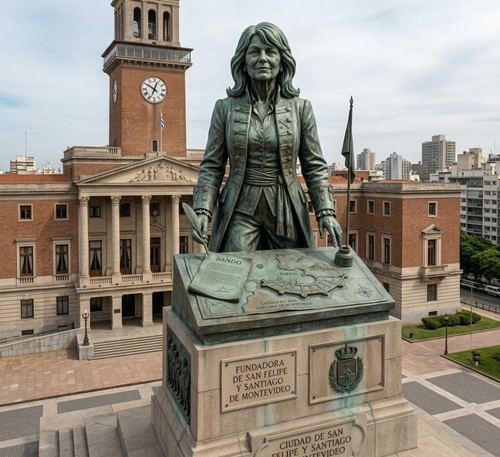
An apocryphal manuscript credits Doña Bruna Mauricia Carolina de la Cosa with an improbable succession of feats in Montevideo’s history.
True Lies (Part 2)
According to what we promised, we will make known to our exclusive readers the text of the manuscript serendipitously found by the historians Wells and Lovecraft who, attesting to its authenticity, compel us to reread the history we know.
And that strange phenomenon called serendipity, is it coincidence or Divine Providence?
While we reflect on this, we will dis-cover that surprising lady who was Doña Bruna Mauricia Carolina de la Cosa.
Since a promise is a debt, here is the text:
«On the day of Our Lady of the Forsaken and Saint Cyril, in the Year of Grace 1491, the remnants of the Spanish armada that had survived the storm reached an inlet where they were able to take shelter from the winds that were still lashing them.
They were the three caravels: El Niño, El Pinto and La Ingeniosa.
The officers had died of scurvy and other illnesses, so a woman was in command.
She was Doña Bruna Mauricia Carolina de la Cosa, who assumed duties as captain general of the Armada.
The next day, the captain noticed a bird, an omen that land was near.
She herself climbed up to the… [“little basket located at the top of the mainmast,” we have replaced the indecent term used in the original] and spotted a beach: we had reached the West Indies.
[Several pages are missing]
Upon returning to Spain, Doña Bruna was honored by His Majestaz [sic] with the title of Marchioness de la Cosa and, in command of a new flotilla, we returned to the Realm of the Indies».
The Ingenious Doña Bruna Mauricia Carolina
On December 18, 1723, the day of the Expectation of the Blessed Virgin’s Childbirth, we arrived at a bay.
Following it westward, it turned out to be the mouth of a great river, which the Marchioness Doña Bruna named Río de la Plata.
We then landed on the western bank.
The natives captured our patrol and cannibalized the corpses.
We headed east, where the Marchioness declared: “Montevideo is hereby founded.”
And so it was done in the Year of Our Lord 1724 [Uruguayan historiography that the city was founded by Bruno Mauricio de Zabala in 1726].
She then ordered that every hundred years the founding be celebrated by the City Council.
She then said: «Let the city be made.» And the city was made.
The main avenue had a central lane that she called a «bike lane».
She explained to the Cabildo that it was intended to protect cyclists.
For this purpose, she presented her latest invention: a two-wheeled, blood-powered vehicle that received the name «bicycle» [an invention erroneously attributed to Karl Drais in 1817].
From that moment on, the Crown granted her the title of “Royal Ingenious Woman of the Realm of the Indies».
During the British invasions, she defended the city and reconquered Santa María del Buen Ayre.
A small but strategic fort, located on the Western Bank, which the Marchioness had founded to combat the advance of the Portuguese, who were abusing that great cattle range while mocking the Treaty of Tordesillas.
The Lusitanians were a permanent threat.
The captain general gathered 32 volunteers and, with her at their head, defeated them at the Battle of Sarandí in the year 1825.
To facilitate the transport of the contingent to the Western Bank, she invented a machine attached to the ships, with a helical piece that, connected to an «engine», allowed rapid transportation.
She surprised the Lusitanians who, frightened by the sound of the engine, surrendered without fighting.
The victory was celebrated with great free popular festivities, enlivened by musicians, dancers, singers, trapeze artists, acrobats and sympathetic murga groups.
The Crown granted her permission to add to her Coat of Arms the inscription «Most Faithful and Reconquering».
Illustrious and Immortal
Her work on the port is especially noteworthy.
She turned Montevideo into the foremost port of the Realm.
For this, she was decorated by the French company awarded the contract for the works.
The street formerly called Patagonia was renamed in her honor.
Deep-draft ships, such as the English Fapitcnt and the French Antelic, found generous shelter in its waters.
She had a large vaccination center built, which was also commonly used for sporting or musical events.
When God decided to summon her to His side, she was buried, amid the tears of her beneficiaries, in the great mausoleum beneath her equestrian statue beside the gate of the Ciudadela.
Her physical body no longer belongs to this world, but her spirit will surely live on in her numerous descendants».
Thus ends the recovered manuscript.
Knowing History allows us to understand the present.
History and fiction
Deliberate anachronism
Montevideo memory
Continue reading in Global Order and Geopolitics
Apoyá la continuidad de Perspectiva Liberal
Perspectiva Liberal es un espacio editorial independiente. Si valorás este trabajo y querés colaborar con su continuidad, podés hacerlo mediante un aporte voluntario a nuestra cuenta Prex.
Cuenta Prex: 13440