
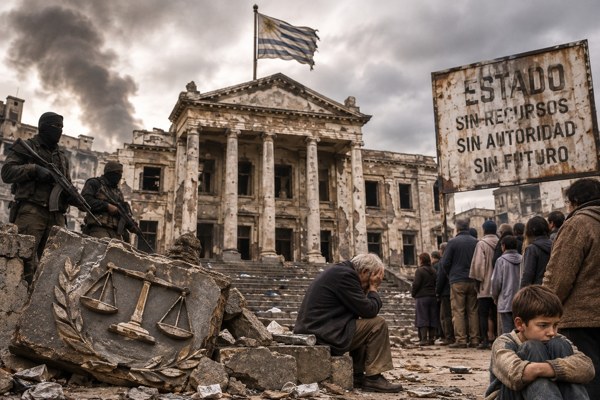
From the 1980 referendum to today’s insecurity: reflections on popular sovereignty, legitimacy, and public disillusionment.
After the 1980 constitutional referendum, in which the NO vote garnered 57% of the ballots, General Gregorio C. Álvarez assumed the country’s highest office.
The outcome fulfilled a joke that popular wit had already anticipated: YES meant “let them stay”; NO meant “let them not leave.”
De facto regimes and twenty-first-century socialist governments have a reputation for respecting election results only when those results favor them.
That is why elections are often rigged and the numbers made to conform to the dictates of those in power.
The best proof that no fraud occurred was that the regime lost.
Nevertheless, the government did not conceal the outcome of the popular vote. Looking back, moreover, the 43% who supported the reform did not constitute an insignificant base.
Álvarez’s assumption of office opened a preparatory phase for the return of the political party system.
It is in this light that we should interpret Dr. Tabaré Vázquez’s expression of support in his famous telegram published on the front page of El País.
That would be the most charitable interpretation.
Not everyone shared Dr. Vázquez’s enthusiastic optimism.
Many believed that the popular will had been thwarted and that the referendum result, beyond addressing a specific constitutional reform, amounted to a rejection of the regime as a whole.
In other words, citizens had been called upon to vote, but their verdict was not respected. The fact that the result was publicly acknowledged at the time mattered little.
Typical of “governments of force,” which, as Barbagelata taught, are the opposite of “governments of opinion.”
The Expiry Law
A few years later, the Law on the Expiry of the State’s Punitive Claims would be put to a referendum. This law sought to bridge the gap between the amnesty granted for crimes committed by subversives and the situation of those who had carried out repression. Wilson Ferreira Aldunate had played an active role in shaping it.
Curiously, the 1980 figures were reversed: 57% voted to keep the law.
In 2005, the Broad Front—a coalition comprising the Movement of Popular Participation, Assembly Uruguay, the Socialist Party, the Communist Party, the Progressive Alliance, the Artiguist Current, the New Space, the Party for the Victory of the People, the Revolutionary Workers’ Party, the Socialist Workers’ Party, and others—came to power.
Once again, attempts were made to repeal the Expiry Law.
I still remember the agitated remarks of one of the organizers about the difficulties they had faced in gathering signatures.
The plebiscite was held in 2009, alongside the presidential elections that brought José Mujica to the presidency, but it failed again, as its promoters had already expected.
Did the electorate, which exercises sovereignty directly, want to close that chapter once and for all and look ahead? It would seem so.
The rest is even more recent history: not even politics prevailing over law. For politically and legally, the matter should have been settled…
An Aristotelian View
In his classification of pure and corrupt forms of government, Aristotle says that the pure forms are those exercised for the good of the community rather than that of the rulers.
In this sense, we can understand the phrase: “I hope the government does well, because if it does, I will do well too.”
Coming from an ordinary citizen, this expression has a fully Aristotelian meaning.
It is not about beneficiaries or hangers-on of the current government, or the next one—who are often the same people—but about the innocent wish of the ordinary person who still believes and hopes.
The person who longs for job opportunities to support a family; the student who wants to finish school; the homemaker who hopes her husband will return safely from work and her children can play on the sidewalk; the rural worker who rides hundreds of kilometers on horseback to embrace a hope still locked inside Pandora’s box.
Color
Forty-six years have passed since the 1980 referendum. Colorado, Blanco, and Broad Front governments have come and gone. The color at General Álvarez’s inauguration was supplied by television.
On August 25, 1981, color television broadcasts began, although most television sets, of course, could receive them only in shades of gray.
A few days later, on September 1, the transfer-of-power ceremony would take place. But sales of color television sets rose with the 1982 World Cup.
The “feels-like temperature,” as a former interior minister once described insecurity, is that we are worse off today than before. She sought to play it down, but cold and heat are, after all, what each person actually feels.
Before taking office, the current minister in charge of that portfolio declared that “the war on drug trafficking is lost,” a statement the opposition viewed as defeatist.
Hope is fading, dispersing like morning mist in people’s hearts. Opinion polls bear witness: President Orsi faces widespread disapproval.
Trust in justice is waning, and public opinion questions the political system as a whole.
There are areas where crime prevails and shootings and casualties are reported daily, often involving people who had no part in the confrontations.
Public expression is under siege from partisan pressure and political correctness. Calls to censor social media are not lacking.
A journalist turned senator has called for criminalizing “hate speech.” Meanwhile, a legislator warns of the danger that this “legally undefined characteristic of ‘hate’ could become a gateway for punishing opinions.”
Some people say on those same platforms that life was better under the government of force. An alarming symptom of a democracy in free fall.
We have seen these processes in countries very close to us.
We know how they end.
What remains to be seen is whether they are merely the consequences of a continuing series of political mistakes or whether they are scripted to seize power, as Ortega did in Nicaragua.
Once the outcome is plain to see, the cause will no longer matter.
Popular sovereignty and legitimacy
Referendums and collective memory
Insecurity and public disillusionment
Continue reading in Global Affairs and Geopolitics

Apoyá la continuidad de Perspectiva Liberal
Perspectiva Liberal es un espacio editorial independiente que no cobra por las notas.
Si valorás este trabajo y querés colaborar con su continuidad, podés hacerlo mediante un aporte voluntario a nuestra cuenta Prex 13440.
o por Mercado Pagolink.mercadopago.com.uy/perspectivaliberal