
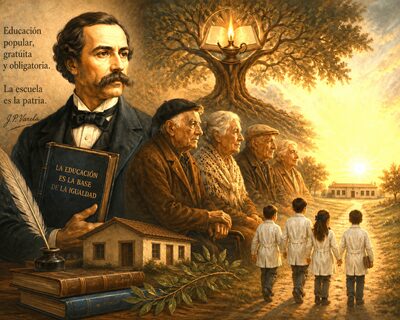
José Pedro Varela’s critique of state paternalism resonates a century and a half later in Uruguay’s debate over pensions, AFAP funds, and financial crisis.
We refer to the article written by our director, lawyer and political scientist Jorge Mosco Castellano, with his characteristic clarity of exposition.
On August 2, 2026, Mosco compares Uruguay’s social security system to a Ponzi scheme.
The fraud works, he says, “as long as new contributions continue to come in constantly and most investors do not simultaneously demand the return of their funds. However, lacking a legitimate economic foundation, it becomes unsustainable and ultimately collapses…”
In other words, it means using investors’ money to pay interest until the moment comes when the scheme blows up.
On the one hand, the article refers to the pension system itself, and on the other, to the mechanism of diverting part of the pension contribution toward the AFAPs (Pension Savings Fund Administrators).
And, in particular, to the socialist government’s attempt to take control of those private funds.
The Uruguayan State used that Ponzi scheme “when it nationalized savings while promising a pension payment later on. This system collapsed, consuming practically all the resources that workers and employers were forced to save, since the promised return far exceeded the yield, which in reality was nonexistent, given that the State itself used those private resources at will…”
But do the AFAPs invest that money? Yes, but…
The State forces them “to match almost all of that capital by massively purchasing national debt securities.”
That is to say: “leaving the future of retirees hanging by the fragile thread of the State never going bankrupt again,” Mosco says.
An Illustrious Predecessor
José Pedro Varela (1845–1879) wrote his text “School Legislation” in 1876.
The Reformer, with sound judgment, says that a bill must be embedded in the reality of the country.
And through that door he introduces a sharp criticism of the political and financial crisis in which the Republic was living.
“The example of a lack of morality in honoring the commitments it undertakes is set by the State,” he says, defining it as “a political axiom.”
He first criticizes the immovability of public employees, and then turns against the pension system.
It is because of a principle of “philanthropic guardianship that the Montepío deduction has been established for employees, from which retirements and widows’ benefits [pensions] are derived.”
The State “acts as a savings bank, compulsorily imposed […] since it proposes to exercise foresight on behalf of others and commits an abuse,” by disregarding “the effectiveness of individual judgment in regulating human conduct.”
Moreover, it generates abuses, he says, referring to an issue that is highly controversial in Uruguay today. “…we see among us men […] who have served the Nation for only a few years and who, nevertheless, have been retired with years of service credited to them for time they had spent abroad or in other occupations, on the pretext that, at some point, they had been improperly removed from the positions they held.”
Thus, “…the system of Montepío and of retirement and widows’ benefits costs the Nation thousands of pesos that, without it, it would not have spent.”
And this “is the gateway to a kind of disguised communism, whose effects on social morality are incalculable.”
He then turns to what concerns him most: “our endless financial crisis.”
There is excessive consumption in the State, just as there is in society: there is error, abuse, and wrongdoing in finances just as there is in politics.”
In short, he concludes: “our permanent financial crisis: in reality, it is nothing more than a permanent political crisis.”
“That the dangers threatening our future are grave if we continue as we have until now is an observation everyone understands and one that is made very often, although people always act as though they did not believe what they say.”
This catastrophe that Varela foresaw, that future which would one day inevitably arrive, was not formulated in the form of a Nostradamus-like riddle, but in language clear and understandable to any reader of the Spanish language.
That is why Dr. Mosco’s article must be reread: the future is already here.
The alternative seems to be the suggestion of Broad Front senator Constanza Moreira, defending the euthanasia bill in the sense of “ending the life of a patient with no prospect of a cure.”
The left-wing legislator said in the Senate of the Republic that, since Uruguay is “a super-aged country, it must have a policy that regulates these matters.”
Could this option be the “final solution” to the pension problem?
What do you think?
Social security and the State
José Pedro Varela
Political and financial crisis
Continue reading in Global Order and Geopolitics
Apoyá la continuidad de Perspectiva Liberal
Perspectiva Liberal es un espacio editorial independiente. Si valorás este trabajo y querés colaborar con su continuidad, podés hacerlo mediante un aporte voluntario a nuestra cuenta Prex.
Cuenta Prex: 13440