
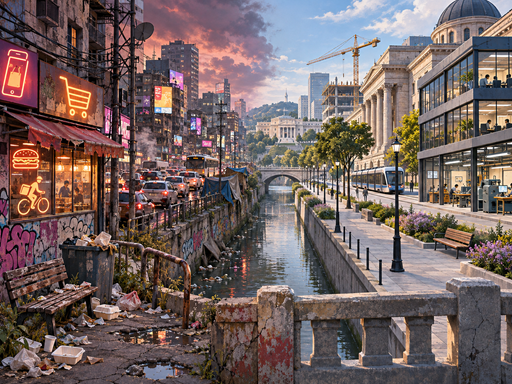
An X-ray of a Fragmented Civilization
Major historical crises rarely announce themselves with a bang; instead, they tend to develop silently beneath the surface of apparent normality.
When examining the current state of the West and advanced democracies, one phenomenon emerges with clinical clarity: we live in a society moving at two speeds. This is not merely an income gap or an ordinary generational divergence, but a profound, cross-cutting fracture that divides nations into two parallel realities, with diametrically opposed values, expectations, and rules of the game that barely come into contact.
The first speed: the culture of immediacy, hedonism, and “we’ll figure it out as we go”
The first speed of our modern age is shaped by the cultural and political currents that have dominated public discourse over recent decades.
It is the age of the absolute present, of screens and instant gratification.
The dogma of absolute entitlement: this is the world of generations raised on the premise that every legitimate desire automatically becomes an inalienable right, free of obligations, effort, or fiscal costs.
The notion of limits has faded, while tolerance for civic frustration has fallen to very low levels.
Destructive nihilism: as observers of the European crisis warn, when these expectations collide with the limits of reality, the response is not resilience but narcissistic withdrawal or anti-establishment fury.
It is the age of groups that reduce politics to the demolition of traditional symbols under the irresponsible slogan “tear it down and figure out the rest later,” without any constructive plan for governance.
In major cities, this first speed takes shape in peripheral ghettos and areas where the state has relinquished its monopoly on the use of force.
There, criminal economies and drug-trafficking networks challenge republican authority through tribal codes alien to the Western civic compact.
The second speed: quiet effort, merit, and productive resilience
On the opposite side lies the second speed: that of the silent majorities who sustain the material, institutional, and productive foundations of free societies.
The culture of work and responsibility: this is the outlook of those who understand that earning a living is not an automatic gift from the state, but the result of taking risks, exercising discipline, demonstrating merit, and accepting life’s limitations.
This is the segment of society that now feels deeply exasperated by disorder in the streets, insecurity, and the deterioration of public spaces.
These are citizens who demand firm public order, sustainable tax compliance, and the restoration of republican authority, because they understand that without law there can be no freedom.
Production versus paralysis
While the first speed expends its energy on identity debates, bureaucracy, and historical self-flagellation, the second struggles to keep society afloat and preserve economic competitiveness in a globalized, hypercompetitive world.
The forced coexistence of these two speeds within the same social structure creates an unsustainable tension.
On one side stands a cultural and political superstructure comfortably settled into welfare dependency and civic infantilism; on the other, a productive social base calling for order, security, and economic realism.
The fundamental question defining our century is how much longer this pendulum can swing before it breaks.
The way out of this predicament will not come through complacency or naïve narratives.
It will require profound cultural maturation, the restoration of the authority of the rule of law, and the civic courage to recognize that the foundations of a free civilization can endure only when each individual rediscovers a sense of duty, limits, and personal responsibility.
We must also consider the geopolitical interests that seek to bring societies to their knees before their own delusions.
These are difficult times for societies that have allowed political passivity to advance, bargained with intransigent minorities to accumulate power, and resorted to immigration to sustain a comfortable way of life whose consequences are now exacting a heavy price.
Western cultural fragmentation
Merit and civic responsibility
Public order and productive resilience
Continue reading in Global Order and Geopolitics
Apoyá la continuidad de Perspectiva Liberal
Perspectiva Liberal es un espacio editorial independiente que no cobra por las notas.
Si valorás este trabajo y querés colaborar con su continuidad, podés hacerlo mediante un aporte voluntario a nuestra cuenta Prex 13440.
o por Mercado Pagolink.mercadopago.com.uy/perspectivaliberal