
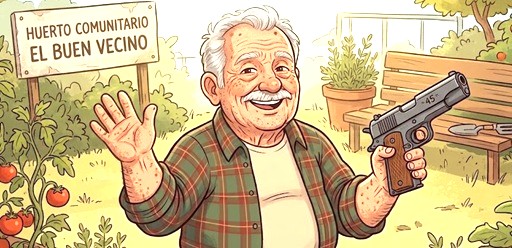
Children’s literature, political memory, and the making of José Mujica’s kindly public image
“Mi amigo Pepe” is a children’s book by Carolina Gorga, published in Uruguay in 2026.
Its promoters present it as a distinctive contribution to Uruguay’s publishing scene because it brings the figure of a former president into the realm of children’s literature.
The story therefore focuses on the everyday Mujica—the small farmer, his material simplicity, his love of the land, and his dog Manuela—rather than on his long political career and his guerrilla past.
Since the book is intended for tender young readers, it does not go into detail about where the money to buy his small farm came from.
And that makes sense, because little children’s minds would not yet understand that money is earned either by working or by stealing the fruits of other people’s labor, by the sweat of one’s brow (theirs, of course).
It is presented as an attempt to celebrate values of restraint and human warmth that the youngest readers can understand. The devil, too, is often presented as an angel of light.
Supported by expressive illustrations, the book supposedly offers early readers a gateway into “recent history” (in other words, the version imposed by the left) and the character of rural and contemporary Uruguay, according to its promoters.
As happens with many books about contemporary political figures aimed at children, it does not respect the boundary between an affectionate portrait and the construction of a myth or ideological sympathy. But that should come as no surprise: it is precisely the point.
From a critical standpoint, it is a clear example of how political memory is shaped through popular culture.
To present a biography confined to the years of a kindly, austere old man—leaving out his armed militancy in the Movimiento de Liberación Nacional–Tupamaros during the 1960s and 1970s—is a deliberate distortion.
The book amounts to a kind of ideological deception: an innocent format, the illustrated story, is used to construct a hagiography or an institutional whitewashing of a subversive figure, shielding him from rigorous historical scrutiny.
We are told that literature for young children is not a handbook of military history or a political treatise, but a literary story intended to convey certain values: austerity, solidarity, a bond with the land, and dialogue.
And that, from this perspective, the episodes of armed violence in the 1970s lie beyond the comprehension of a small child and belong to a later stage of formal education—where the children will be taught the very same version of history.
The newspaper Correo de los Viernes published a column by Argentine writer and screenwriter Marcelo Birmajer. It is not meant for children, but adult readers will be able to appreciate its contents.
What follows is an abridged version of his critique, reproduced as the author’s opinion rather than as independent verification of every assertion it contains:
Marcelo Birmajer’s critique
“My first problem with Pepe Mujica is that I cannot understand a word he says. He speaks with his mouth closed, like a ventriloquist, but without a dummy to interpret him. I have the same problem with him as I do with Spanish films on television: I can only understand them with subtitles. But Mujica is never subtitled, only applauded—although I am sure that those applauding him do not understand what he is saying either. They applaud him because he looks poor, because he has a three-legged dog, because he is of no consequence whatsoever in the world; but under no circumstances because of what he is actually saying.
My second problem is that Mujica entered politics as a guerrilla fighter in one of Latin America’s most stable and free countries. Until the Tupamaros’ violent entry into Uruguayan political life in the 1960s—Mujica being one of their leaders—they wanted blood, revolution, death, in opposition to democracy. That is Pepe Mujica’s political background.
The Tupamaros murdered defenseless civilians, kidnapped diplomats from countries that had never harmed Uruguay, set innocent people’s cars on fire, and robbed banks where honest workers kept their savings. Mujica himself shot a police officer in the back in 1971, during a democratic period, when the officer had done nothing more than wear his uniform to defend the security of a government freely elected by the people. A crime of that kind, atrocious and unjustifiable, should have marked the beginning of a prison career, not a political one.
Yet Mujica not only served out his presidential term; he also gives lectures. Hugo Chávez, president for life and a little longer besides (since he went on governing for a few months after his death), was no coincidence an ideological kindred spirit of Mujica. At least one could understand everything Chávez said, unfortunately, when he spoke…
Mujica belongs to that long tradition of Latin American leaders who ruined reasonably successful democracies and dragged them down to the point where those very leaders could be elected president. We might say that Mujica, in his political debut in the 1960s, helped ruin Uruguay to the point that the country elected him president.
Not chastened by his involvement in an organization that kidnapped diplomats from friendly democratic countries, Mujica, once president, sought to intervene in international affairs as foreign to him as the solutions he never found for Uruguay itself, such as reducing social inequality or raising educational standards.
Mujica brought two groups of refugees into Uruguay: former inmates of Guantánamo prison and Syrian refugees. A cursory look through Uruguayan and international news sites reveals that most of the Syrian refugees want to leave the country: they see a bleak future, disdain the place that welcomed them and, in particular, its bewildered former president.
To quote the respected Uruguayan newspaper El Observador: “The five Syrian refugee families who arrived in Uruguay in October 2014 under a refugee resettlement program continue to camp in Plaza Independencia in protest. They set up with suitcases, mattresses, blankets, and a tent on Monday morning to demand that the government allow them to leave the country and be accepted as refugees elsewhere. However, the Uruguayan government has no say in how other countries respond to people seeking refugee status. The Syrians living in Uruguay also lack the means to pay for tickets to other countries.”
He manufactured a conflict of identity-based hostilities when doing nothing would have been enough for Uruguay to recover the harmony interrupted decades earlier by Mujica’s own Tupamaros. Both Syrian refugees and former Guantánamo detainees have faced allegations of assaulting their partners. Recently, one of them, Omar Abdelhadi Faraj, was detained for assaulting his wife. Some former Guantánamo inmates granted asylum by Mujica call for an Al-Qaeda victory in Uruguay.
When one considers how much better it would have been for him simply not to shoot a police officer in the back, one discovers that a person’s great responsibility is not to make the world better, but merely not to make it worse.
During Mujica’s presidency, insecurity in Montevideo rose to alarming levels, unheard of in a city traditionally free of such upheaval.
It is also true that the dispute over the pulp mills [with Argentina] involved Mujica and Mrs. Kirchner in equal measures of clumsiness and chauvinism, two paragons of intellectual incompetence and erratic behavior.
Mujica is like one of those Impressionist paintings that nobody understands but everybody praises. His good-natured manner and advanced age make him the kindly pensioner; but that is a fine role for feeding pigeons, not for presiding over a country.”
Supporters of the book argue that its purpose is to inspire affection for certain everyday human virtues, leaving complex and critical political analysis for the time when readers are older and have access to specialized texts.
Is it legitimate to cut the biography of “friend Pepe” down so crudely under the pretext of adapting it for children? Or should those who construct these narratives be held accountable for what they deliberately leave out?
Children’s books and politics
Selective historical memory
The making of a myth
Continue reading in Global Order and Geopolitics
Apoyá la continuidad de Perspectiva Liberal
Perspectiva Liberal es un espacio editorial independiente que no cobra por las notas.
Si valorás este trabajo y querés colaborar con su continuidad, podés hacerlo mediante un aporte voluntario a nuestra cuenta Prex 13440.
o por Mercado Pagolink.mercadopago.com.uy/perspectivaliberal