
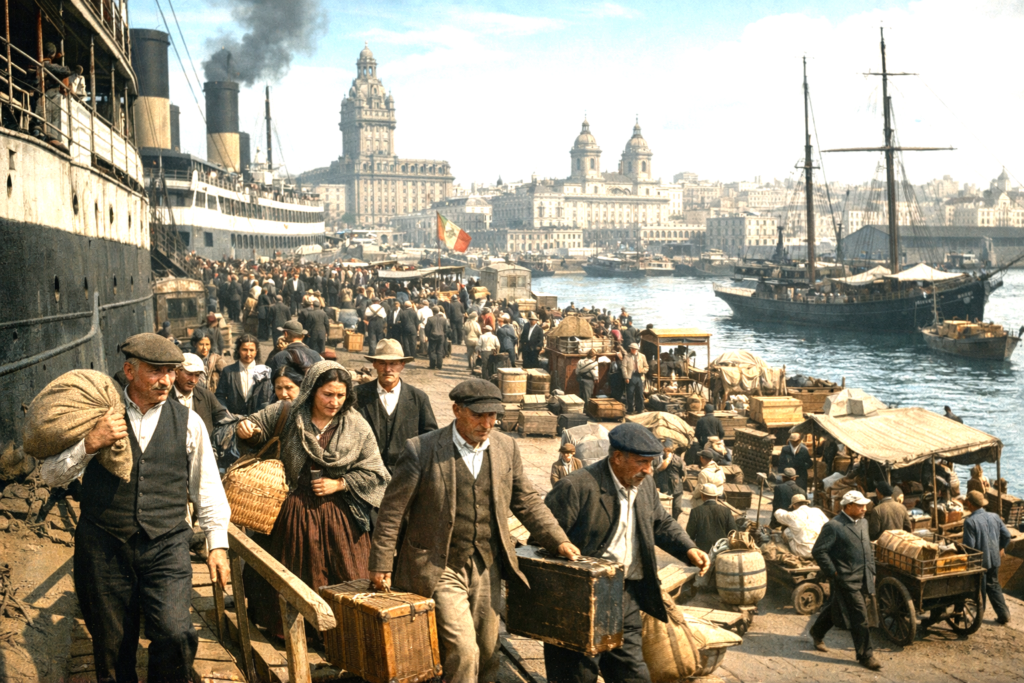
How early twentieth-century Uruguay allowed immigrants to prosper through economic freedom, property rights and individual initiative.
– Uruguay’s liberal environment and immigrant opportunity
– Individual merit as the engine of progress
– State expansion and the rising cost of entrepreneurship
The “Uruguayan Model” of Immigration:
A Real Example of Hayek and Rand
At the beginning of the twentieth century, Uruguay functioned under a framework that closely resembled the ideas of these authors.
Market openness (Hayek): The immigrants who arrived at the port of Montevideo were not “planned” by a centralized state committee. They arrived with their skills, tools and ambitions. The Uruguayan market of that time was flexible enough for someone to arrive with nothing and, within a generation, become the owner of a shop, a factory or a farm.
Individual merit (Rand): These immigrants did not expect a state subsidy, which did not exist. Their motivation was self-reliance. They understood that their well-being depended exclusively on their capacity to create value for others.
Why did it work? The “Golden Rule” of progress
It worked because certain basic conditions of freedom existed.
Social mobility: The State did not block the entry of new competitors.
Protection of property: If an immigrant saved enough to buy a machine or a piece of land, the legal system protected that right.
Stable currency: During much of that period Uruguay maintained a currency that did not suffer the devastating inflation and debt costs seen today, allowing savings to become a legitimate path to social advancement.
The current paradox: Why does it seem harder today?
If we compare an immigrant in 1920 with one in 2026, the difference is not in people’s willingness, but in the “cost of entry” to the market.
Today, to start even a small business, the multitude of regulations — public “kiosks” designed to collect revenue that no one removes — creates a mountain of procedures, licenses and taxes that did not exist one hundred years ago.
Inflation acts as a hidden tax that punishes those who want to work and build something, while an excessive tax burden to finance an inefficient public structure undermines the effort of anyone trying to move forward.
For Rand, this is “looting.” If the State keeps a significant portion of what a worker produces and returns nothing relevant for progress, it becomes almost impossible for that worker to accumulate capital and rise through personal effort.
The historical lesson
Uruguay’s history confirms what Hayek argued: progress is the result of voluntary human cooperation, not centralized planning.
When the State ceased to be merely an arbiter and became a “forced partner” through taxes and regulations, the engine of social mobility that allowed thousands of immigrants to prosper began to stall.
If today we want people — immigrants or locals — to regain that ability to prosper, the prescription of these authors would be to remove the obstacles that prevent talent from becoming value.
Modern Uruguay has lost the memory of that culture of individual effort due to public policies that gradually anesthetized it.
At the same time, the changing era has made markets more complex, making it harder to encourage someone to start “from zero.”
State intervention has expanded, often guided by political self-preservation rather than by the protection of individual freedom.
Political power has advanced over civil society, reducing spaces of freedom and weakening property rights.
This is the central thesis shared by both Ayn Rand and Friedrich Hayek. In light of current Uruguayan reality, it touches a critical point: the erosion of private property and individual autonomy.
For these thinkers this is not an accident but a logical consequence of allowing the State to abandon its role as arbiter and become a central planner of what often proves inefficient, costly, obsolete and intrusive.
Let us see how they would analyze this loss of freedom.
The State as an “unfair competitor” (Rand)
For Rand, when the State expands its intervention it is not merely regulating; it is invading.
The moral cost: Every time the State intervenes in an area that once belonged to individual freedom — a business, a service, a property — it tells the citizen: “Your judgment is not sufficient; we will decide better for you.”
The destruction of virtue: By making citizens dependent on licenses, permits and subsidies, the State replaces the independent producer with someone seeking political favors.
For Rand this represents the erosion of the national character that once made Uruguay an exceptional place to live and prosper.
The “Fatal Conceit” of political power (Hayek)
In his book The Fatal Conceit, Hayek argues that politicians believe they can manage society as if it were a machine, while society is actually a complex system that regulates itself.
The destruction of law occurs when the State modifies legislation not to protect inalienable rights but to favor specific sectors — political groups, allied companies or pressure groups.
Legal uncertainty appears when rules change constantly according to the government of the moment. Citizens can no longer plan long term.
If there is no certainty about property or about the value of money, investment and creation stop. That is when progress stagnates.
The result: a country forgetting its best history
If we compare the Uruguay of early immigrants with today’s Uruguay, the key difference is the cost of being free.
Before, the immigrant arrived and the limit was his own capacity.
Today, the limit is the country’s cost structure, bureaucracy, high taxation and the difficulty of starting a business without asking permission from the State.
The diagnosis of both thinkers
Both would conclude that a society that has experienced freedom but allows the State to gradually reduce it ends up exchanging prosperity for a false sense of security that never truly arrives.
The destruction of freedom rarely occurs suddenly. It advances through the “politics of small steps”: a new tax here, a regulation there, another layer of protection — until citizens realize that they are no longer the owners of their own effort.
Is this a path without return, or is it still possible to recover the culture of freedom and autonomy that once defined the founders of Uruguay’s prosperity?
Let us look at the very current debate: whether the political system is capable of dismantling itself to return power to society, or whether a deeper crisis will be required.
Apoyá la continuidad de Perspectiva Liberal
Perspectiva Liberal es un espacio editorial independiente. Si valorás este trabajo y querés colaborar con su continuidad, podés hacerlo mediante un aporte voluntario a nuestra cuenta Prex.
Cuenta Prex: 13440