
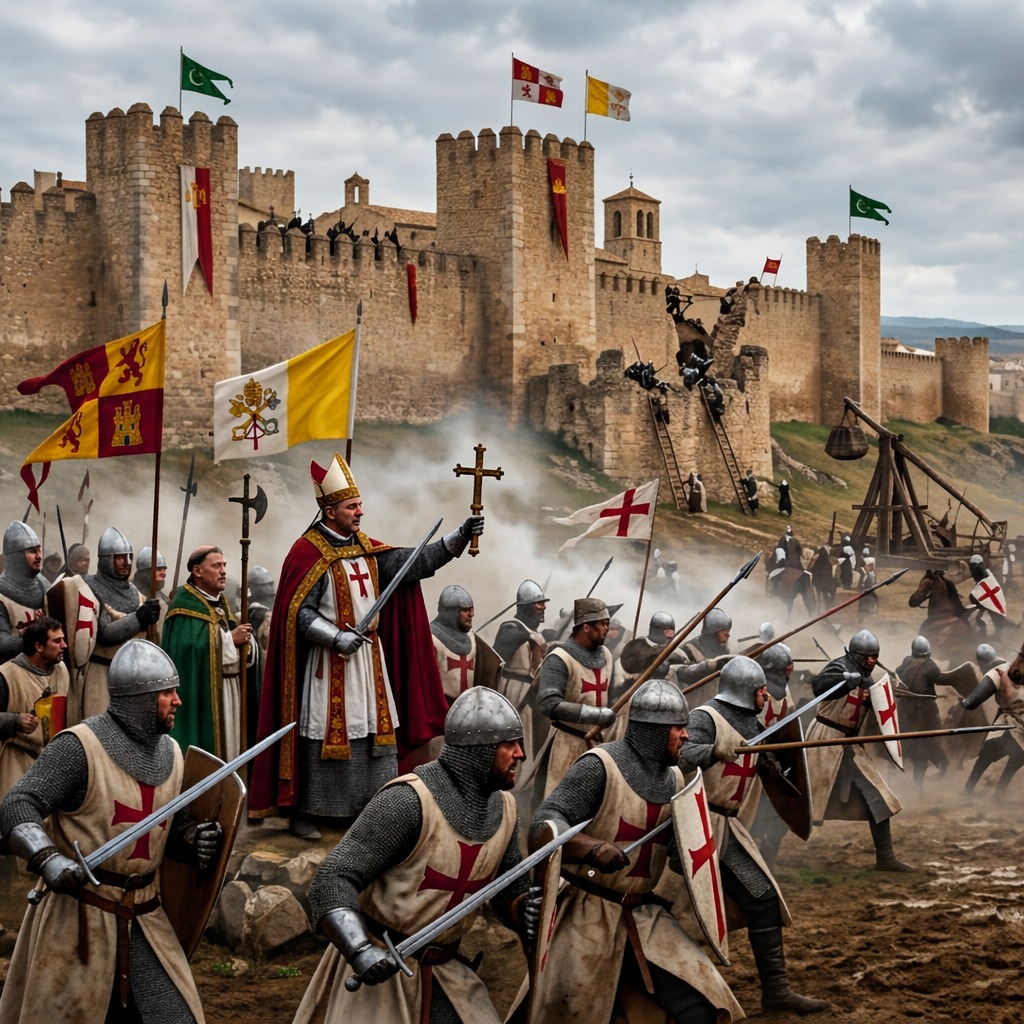
From Saint Augustine to Lenin: how war was justified and why its limits seem to have vanished today
We reflected in our previous article on the difference between the legality and legitimacy of a legal norm.
A problem that arises in everyday life and that, like so many others, allows for multiple interpretations.
It concerns a legal principle that states:
“Whoever wishes for a firm and democratic peace must support civil war against governments and the bourgeoisie,”
wrote V. I. Lenin in Socialism and War (1915).
With this assertion, Lenin identified two enemies: government and bourgeoisie.
As the ideologue and principal founder and leader of the USSR, he defined the targets to be destroyed: the “bad ones.”
Thus, labeling someone as bourgeois was not merely derogatory; it marked them as an object to be eliminated.
Is there perhaps a reminiscence here of that cry often heard during the Convention in the French Revolution: “Distrust that man: he has written a book”?
The logic, at least, sounds quite similar.
In the 5th century, a Christian philosopher argued that if war could not be avoided, an essential condition must be met:
“…that those against whom the war is declared be evil.”
“It would be worse for the wicked to dominate the good and peaceful,” but “even so, it would be more desirable to have a good neighbor as a friend than to subdue a hostile one by force.”
And he goes on: “…if, by waging just wars—neither impious nor unjust—the Romans were able to conquer such a vast empire, are they therefore obliged to worship injustice as a goddess?”
These quotations belong to Saint Augustine’s The City of God, Book IV, Chapter XV.
The Bishop of Hippo does not systematically address war, nor does he praise it, but writing sixteen centuries ago, he anticipates an idea of just war later systematized by Thomas Aquinas in the 13th century.
In the Summa Theologiae, Aquinas states:
“For a war to be just, three things are required.
First, the authority of the prince, by whom the war is to be declared.
For it is not the business of a private individual to declare war, as he can seek justice through a superior authority.
Second, a just cause is required, namely that those who are attacked deserve it because of some fault.
Hence Augustine says that ‘just wars are usually defined’ as those that avenge wrongs, when a nation or state has failed to punish wrongdoing committed by its citizens or to restore what has been unjustly taken.
Third, it is required that those who wage war have the right intention, namely to promote good or avoid evil.”
In Augustine’s proposal, the moral sense prevails.
Thomas Aquinas turns it into doctrine.
Both coincide: war is only legitimized by the justice of its cause and the intention to achieve peace.
For Augustine, “the peace of all things is the tranquility of order, and order is the arrangement of equal and unequal things, giving to each its proper place” (The City of God, Book XIX, Chapter XIII).
He refers to the natural order, a metaphysical and moral order created by God.
It is not an invention of man.
Man discovers this order—or violates it.
Aquinas spoke of the world he knew, where authority was distributed between two swords.
This refers to a biblical passage:
“He that hath a purse, let him take it, and likewise a bag: and he that hath none, let him sell his garment, and buy a sword” (Luke 22:36).
The disciples answered:
“Lord, behold, here are two swords. And he said unto them, It is enough” (Luke 22:38).
One spiritual, guiding toward salvation and morality, exercised by the Church.
Another temporal, belonging to political power, exercised by kings or princes, and subordinated to the former.
There was a shared faith, a common understanding of good and evil, and a general concept of justice.
This did not prevent wars from sometimes being justified after the fact.
But it undoubtedly acted as a restraint.
The Pope served as a court of last resort to which disputes could be submitted.
And what happens today?
Are there no longer any parameters by which to measure the justice of a war?
Just war and legitimacy
Moral authority and political power
From religious order to modern conflict
This analysis is part of the Global Order and Geopolitics axis
Apoyá la continuidad de Perspectiva Liberal
Perspectiva Liberal es un espacio editorial independiente. Si valorás este trabajo y querés colaborar con su continuidad, podés hacerlo mediante un aporte voluntario a nuestra cuenta Prex.
Cuenta Prex: 13440