
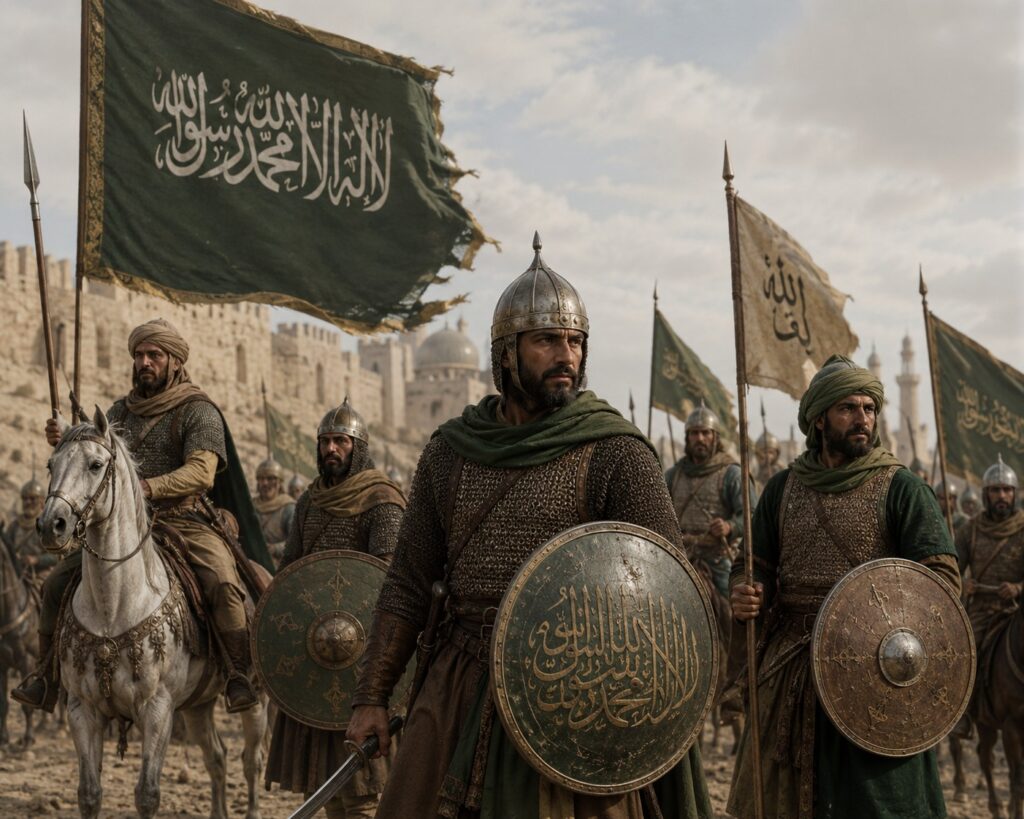
From Ibn Khaldun to Belloc, an essay on how small extremist minorities can reshape the historical perception of an entire civilization.
In 1377, the sociologist and historian Ibn Khaldun (1332–1406) wrote Al-Muqaddimah, or Introduction to Universal History.
The book covers a wide range of subjects, including war.
Chapter XXXVII of Book III refers to war as “the most natural thing to man.”
By then, Saint Thomas had already written his works and had precisely defined the concept of just war, although the Tunisian philosopher had no access to them.
War, says Khaldun, may have different motives.
“The desire for revenge caused by rivalry of interests and envy,
or the spirit of aggression,
or the anger that leads one to punish the enemies of God and His religion,
or, finally, that which is felt when defending the kingdom.”
He describes the first two as “iniquitous and perverse.”
The last two, however, are “just and holy.”
That is to say, when the issue is fighting the enemies of Allah and Islam, war becomes sanctified.
Ibn Khaldun had been appointed professor of Muslim law in Cairo, and in his Autobiography he recalls what he said in his inaugural address.
On that occasion, according to the Spanish translation by the University of Alicante (2015), he said that he “…had been judged worthy of occupying the teaching chair in this noble institution, the work of Sultan Saladin, who was the king of punishment and holy war, who annihilated from this country [Egypt] belief in the Trinity and the hypocritical ar-rafd [Rafidi doctrine], and purified holy Jerusalem, where bells and crosses had become familiar, like a stain of unbelief.”
The phrase is difficult to understand because it juxtaposes two different doctrines. On one hand, it condemns Catholicism, and on the other, Shiism.
That is, the external enemy and the internal enemy.
Of course, when the multifaceted Muslim thinker referred to just war and praised Saladin’s work, he was not innovating.
He drew his concepts from the Quran. A couple of examples will suffice:
Surah 9:38–52
“Go forth to war, whether it is easy or difficult for you!
Strive for God with your wealth and your persons!”
Surah 61:10–13
“…strive for God with your wealth and your persons […] He will forgive you your sins and admit you into gardens beneath which rivers flow, and pleasant dwellings in the Gardens of Eden. That is the supreme success!”
Although such reading must not be taken out of the historical context in which Khaldun was writing, much less out of the full context of the Quran.
The Jihad
In his doctoral thesis at the Complutense University of Madrid, Imad Absaoui states:
“For any Muslim, jihad forms an essential part of his belief; however, the interpretation of this concept differs among Muslims, since it is influenced by various schools of Islam.”
The manipulation of this term represents one of the central elements from which the ideologies of radical groups proceed.
Four categories of jihad are established.
The first is the jihad of the heart, or greater jihad. Here the struggle is spiritual.
It is the inner struggle to eradicate evil.
The second and third are those of the mind and of the word.
They refer to the defense of good behavior in others and to sound counsel for those who have lost their way in life.
The fourth is the jihad of the sword.
Other versions establish:
Jihad of the heart.
Jihad of the tongue: giving opinions or legislating with justice.
Jihad of the hand: adopting corrective measures to prevent believers from acting against the norms of Islam.
Jihad of money: contributing financially to the Ummah, the global community of Muslims.
Jihad of preaching: peaceful action to expand Islam beyond borders or strengthen it internally.
Jihad of the sword. And this is the basis for the ideological interpretation of international terrorism.
Nevertheless, most authors consider extremist sectors to be minorities and hold that jihad is interpreted by the broad majority of Muslims in its spiritual sense.
The Determining Number
In one of his texts, the English historian Hilaire Belloc coins the concept of the “determining number,” an aspect he considers “essential for understanding any social or political movement.”
And he says: “In the case of rare events, a very small number is enough to produce a predominant effect.” By rare, he means abnormal.
Belloc insists on the point and illustrates it.
He gives the example of an island where an earthquake occurs every ten years. If we added up the time the earthquakes lasted over a century, perhaps it would not amount to more than an hour, but the place would be considered cursed.
And without denying that the majority of Muslims are peaceful, could this “determining number” of extremist factions influence the perception of Islam?
Just war and religious history.
Spiritual jihad and violent jihad.
Extremist minorities and public perception.
This essay belongs to a broader reflection on religion, power, conflict and global order.
Apoyá la continuidad de Perspectiva Liberal
Perspectiva Liberal es un espacio editorial independiente. Si valorás este trabajo y querés colaborar con su continuidad, podés hacerlo mediante un aporte voluntario a nuestra cuenta Prex.
Cuenta Prex: 13440