
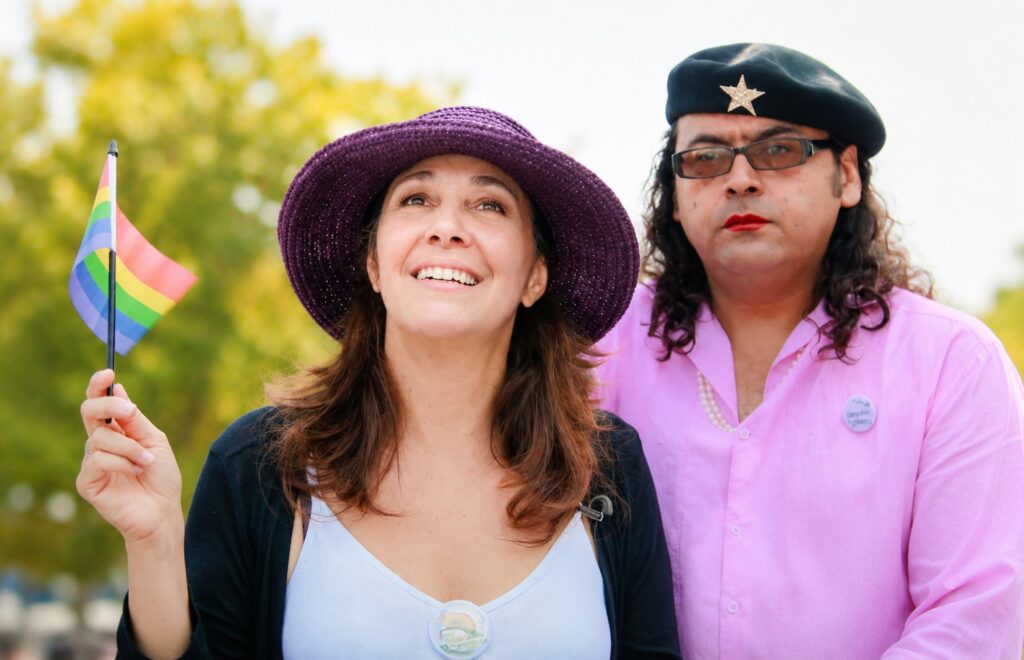
The regime that once persecuted dissidents, believers and homosexuals learned how to recycle its language without surrendering political control.
In our latest articles, we have tried to find answers to some of the things that, in these times, do not seem easy to understand.
We were asking ourselves how the left adopted wokism, and how, in turn, the knot was formed between Islamism, the left and woke culture.
The difficulty probably lies in the association between the left and real socialism.
Indeed, we recalled the euphemistically named Military Units to Aid Production, known as UMAP, which operated under the watchful eye of Che Guevara between 1965 and 1968, the year in which they were officially dissolved(?).
These labor camps had the purpose of reeducating those interned there.
And why reeducate them?
Simple: to break their resistance and make them functional to the communist system.
From the perspective of power, these people were considered antisocial and had to be subjected to that process of reconfiguration.
Thousands were subjected to that discipline, which, in addition to “helping” those poor misguided souls find light and truth, used them as slave labor to cut sugar cane.
The regime presented them as an opportunity generously granted to these people so they could reform themselves and contribute economically to the country.
What kind of behavior marked an individual as “antisocial”?
The examples were varied: open political dissent, applying for a passport, which denoted the desire to leave the country, religious dissidents, homosexuals…
Thus, members of Catholic Youth groups and seminarians were arrested and interned, together with members of other Christian churches and practitioners of Afro-Cuban religions.
They all rejected state atheism or refused to use weapons and honor national symbols, as was the case with Jehovah’s Witnesses.
Reeducation consisted of making them work for twelve hours under the relentless sun, and then attend “consciousness-raising” classes.
Those who could not endure the pace were punished.
They were deprived of water and forced to undergo the sadly famous standing punishments under the sun.
Those whose spirit of resistance drove them not to accept political education became known as “the planted ones.”
Huber Matos, 1918–2014, spent twenty years in Castro’s prisons.
Armando Valladares, born in 1937, suffered twenty-two.
In his autobiography, titled Against All Hope, he describes the tortures of sealed cells.
Let the reader imagine what it can mean to remain in a tiny space, in total darkness, with a bucket to use as a toilet, without any kind of ventilation, for years!
This was how they intended to form the New Man.
A model devised by Guevara, supposedly superior to that of the Homo sovieticus.
A new man who would work moved by pride in his revolution, and always ready to sacrifice himself for the cause.
An experiment in social engineering based on fear and the curtailment of individual freedom which, in essence, was not very different from that of the USSR, although they pursued different models.
And in opposite climates: the cold of the Gulag and the suffocating heat.
Besides, the Soviets did not seek bearded rebels, but conformist subjects.
Both were based on strictly regulating childhood instruction through the appropriation of children by the state, common to all totalitarian systems.
Although the most brutal reset experiment took place in Cambodia.
It was carried out by Pol Pot and his Khmer Rouge.
He did not want to reform, but to replace.
And he eliminated two million people for reasons such as speaking a foreign language or wearing glasses, which was a symptom of bourgeois identity, not to mention having a university degree.
Compared with the Cambodian experience, the Cuban one seems bearable.
But there can always be an even greater horror.
How did Cuba, which maintains the same repressive communist regime, come to authorize so-called “equal marriage,” that is, marriage between homosexuals?
In May 2008, Cuba celebrated the International Day Against Homophobia.
This event has been repeated year after year.
The initiative for the Cuban celebration came from the daughter of Raúl Castro.
Mariela Castro is a deputy and director of the National Center for Sex Education, from where she also promoted state funding for transgender operations.
Is this a symptom of a change in the regime’s orientation, or a way of adapting to the wokism of the times without touching the structure?
Reeducation as a tool of totalitarian control.
The New Man as social engineering.
Woke adaptation without real political change.
Continue reading in Global Order and Geopolitics.
Apoyá la continuidad de Perspectiva Liberal
Perspectiva Liberal es un espacio editorial independiente. Si valorás este trabajo y querés colaborar con su continuidad, podés hacerlo mediante un aporte voluntario a nuestra cuenta Prex.
Cuenta Prex: 13440