
A reflection on transhumanism, cyborgization and the temptation to reduce human dignity to something technically improvable.
I AM TECHNOLOGY
Magnífica Humanitas addresses the philosophical and cultural substrate in which the digital revolution is embedded.
Thus, it offers a harsh critique of transhumanism and posthumanism.
What are these ideological currents about?
Transhumanism aims at the elimination of disease, including old age within that category, and even proposes giving “death to death,” that is, the search for indefinite life.
In 1984, the German band Alphaville released a song that quickly became famous.
It was “Forever Young,” a song whose chorus says:
“Do you really want to live forever?
Forever, or never?
Forever young, I want to be forever young.”
Centuries earlier, the search for the Fountain of Eternal Youth, and mosquitoes, kept Ponce de León awake at night.
But eternal youth does not mean immortality.
In Wilde’s novel, it is the portrait that ages instead of Dorian Gray.
In the end, he destroys the painting and all the accumulated decades fall upon his person.
He dies as a decrepit old man.
Time’s revenge is fierce…
By contrast, the ancient Taoists did not regard death as an irreducible destiny, but as a technical problem to be solved.
Which, obviously, they did not solve.
And perhaps there one should trace the philosophical foundation of transhumanism.
An example of transhumanism in fiction is the character of “The Six Million Dollar Man,” Steve Austin, played by Lee Majors in the television series broadcast in the 1970s.
With his female counterpart played by Lindsay Wagner.
The super-powerful couple served the government, that is, “good.”
However, a new individual appears, whose reconstruction cost one million more, but who ends up becoming the opposite side of these bionic superheroes.
This is Barney Miller, a former racing driver reconstructed as a possible replacement for Steve.
But there is a problem.
Barney fails to internalize that he is now a set of circuits, and becomes emotionally unstable, violent, impulsive, arrogant and paranoid.
Although, in the end, the scriptwriters manage to correct him.
What would happen today, when these possibilities have jumped from the screen into the real world?
And this possibility is also what the encyclical refers to.
Because this philosophy, which appears tempting and fits perfectly with the prevailing materialist conception of life, acquired concrete forms when it was adopted by the powerful figures of Silicon Valley.
From that perspective, they consider it a priority to develop technologies that allow the life of the body to be extended for as long as possible and, at the same time, to advance toward the fusion of body and machine.
Cyborgization has ceased to be fiction.
Companies such as Neuralink have moved toward the implantation of brain chips to modify mobility in paralyzed people.
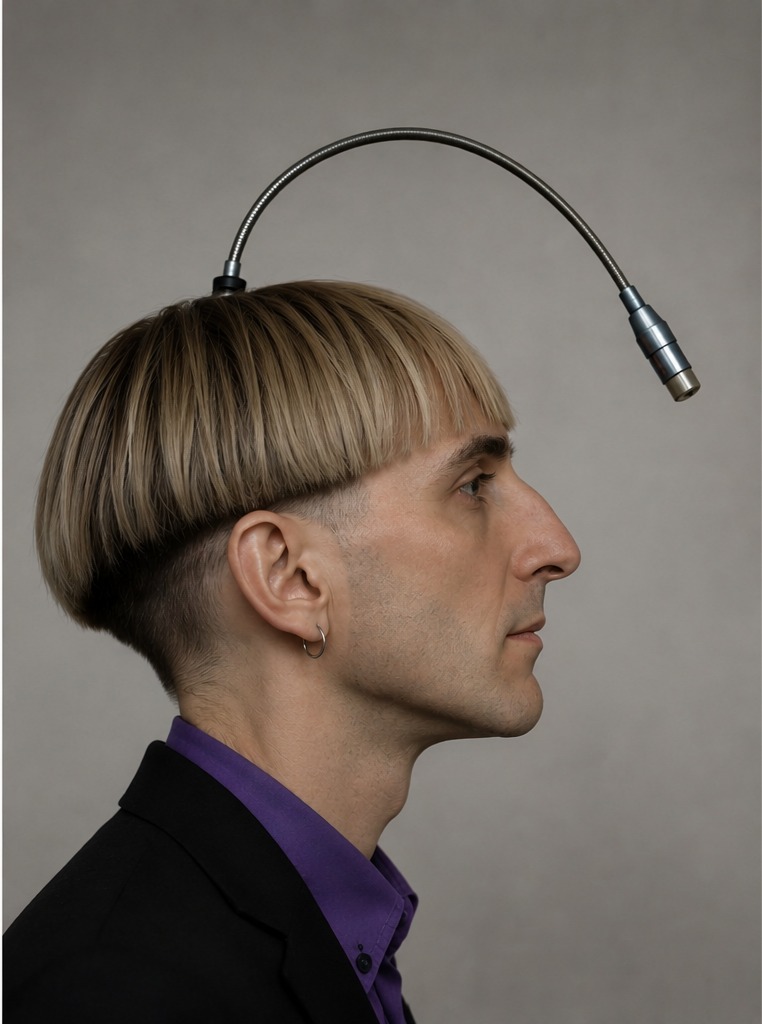
The case of artist Neil Harbisson, who considers himself the world’s first cyborg, is iconic.
He was born with an inability to perceive colors, a dysfunction known as achromatism.
In search of a solution, he had a sonochromatic antenna inserted into his brain.
That is, an element that allows him to convert light and color frequencies into audible sounds.
The antenna, when directed toward colors, interprets them by emitting sounds at higher or lower frequencies according to each color.
It also allows him to see infrared and ultraviolet.
The antenna, which also has internet and Bluetooth, is permanently installed, which means he needs to sleep face down or on his side.
On the other hand, he can shower without difficulty, because it is waterproof, though not submersible.
But nothing is perfect…
According to the BBC, Harbisson has declared: “I don’t feel that I am using technology, but that I am technology.”
For that reason, the greatest aspiration of the promoters of this philosophy is to transfer the contents of consciousness to a computer or a robot, or to whatever the human mind and AI may be capable of creating.
Is the concern expressed by Magnífica Humanitas understood?
Not in vain does it state that what is being denounced “is not the use of technique as such, but the vision that underlies it; if the human being is treated as matter to be perfected or surpassed, then it becomes easier to accept that some are considered less useful, less desirable, less worthy.”
That is why it affirms that “the creative intelligence of the human being is a gift that can relieve suffering and open new possibilities, but it must remain ordered toward the common good, justice, care for the fragile and care for creation.”
And one further note, which is not explicit in the encyclical, but is relevant here.
Queer theory and gender theory are grounded in transhumanism and posthumanism.
Do they not, after all, postulate the rejection of biological and natural models?
That is, the deconstruction of the body, under the pretext that these are social and cultural conceptions that simply must be changed.
There is abundant literature and filmography about posthuman dystopian futures.
The problem arises when they become reality.
Transhumanism and human limits
Body, technique and consciousness
Dignity before technological power
Continue reading in Global Order and Geopolitics
Apoyá la continuidad de Perspectiva Liberal
Perspectiva Liberal es un espacio editorial independiente. Si valorás este trabajo y querés colaborar con su continuidad, podés hacerlo mediante un aporte voluntario a nuestra cuenta Prex.
Cuenta Prex: 13440