
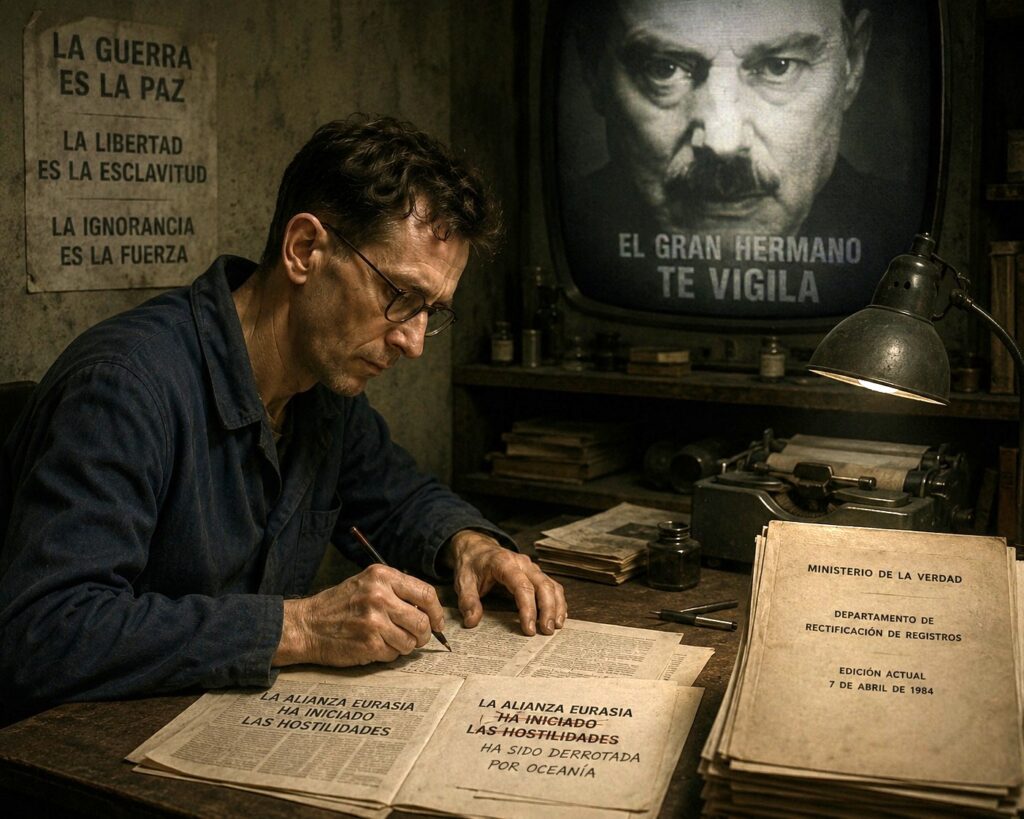
From Roman damnatio memoriae to the Ministry of Truth, the battle over the past remains a form of power over the present.
Communist totalitarianism should not be confused with what has come to be called the Roman damnatio memoriae, says University of Barcelona professor Edgar Straehle.
And he is right.
The difference is subtle, but it exists.
In Orwell’s brilliant depiction in 1984, it can be seen clearly.
His character Winston, an employee of the Ministry of Truth, collaborated, reluctantly, with the organization’s purpose: to turn history into:
“a palimpsest, scraped clean and reinscribed exactly as often as was necessary.”
The Roman use of damnatio memoriae was much more modest and limited.
That is obvious, given the two thousand years separating the two situations.
The control that existed over the vast territory of the Roman Empire was far inferior to the control exercised by the Soviet empire over its own.
And, one might add, much less strict.
Rather than entering into these laboratory-like disquisitions, the intention of this article points to a question:
Do we believe that this practice of confusing history with politics has fallen into disuse?
And if not, do we consider it foreign to us?
Rodó said that historical accounts often obey the intention of seeking “arms and supplies for the skirmishes of the present.”
For the master, history was an “august sanctuary” that had to be approached with serenity, sincerity and empathy, in order to “transport oneself in spirit to the times one must judge.”
If, as the popular saying goes, it is easy to be right with Monday’s newspaper in hand, it is even easier with the newspaper of hundreds of years later.
Did that sincerity demanded by Rodó exist among ancient historiographers?
How much of what has been written about this or that Roman emperor is true?
Roman damnatio memoriae did not operate as it did in the Soviet system, Straehle insists, and in truth, that practice was not even designated by that name.
Nor had the Romans invented it.
Let us admit that this is so, but beyond assigning it a name, as happened in this case in the seventeenth century, what matters is the intention.
The fifteen-year-old girl who cut her ex out of the photograph pasted into the album did not know either that she was applying a form of damnatio memoriae.
What is history for?
What is the purpose of remembering the past?
According to George Santayana, it is to avoid repeating it, because “Those who cannot remember the past are condemned to repeat it.”
Although it has also been said that every past time was better.
What past are we talking about?
The answer should be: the one we want to repeat, which opens a wide range, among those who do not want to and those who do, with their intermediate gradations.
Thus Manrique writes:
“how quickly pleasure goes away;
how, once remembered,
it gives pain,
how, in our opinion,
any past time
was better.”
Knowing the past requires a special gift that allows us to travel through time, a theme literature has exploited to exhaustion, or to unearth it as Schliemann did with Troy.
Most mortals are content to read what others have written.
Saint Thomas teaches, following Aristotle, that the essence of things is what does not vary through change.
Thus, that quality also exists in the human person.
It is what allows us to recognize ourselves, through the different stages of life, as the same person.
Human nature does not vary.
That is why history repeats itself.
And that is why we repeat today the same mistakes as yesterday.
History should show this to us, but one must read and, above all, carefully select where to do so.
Memory and power.
History and politics.
Disputed past.
Continue reading in Global Order and Geopolitics
Apoyá la continuidad de Perspectiva Liberal
Perspectiva Liberal es un espacio editorial independiente. Si valorás este trabajo y querés colaborar con su continuidad, podés hacerlo mediante un aporte voluntario a nuestra cuenta Prex.
Cuenta Prex: 13440