
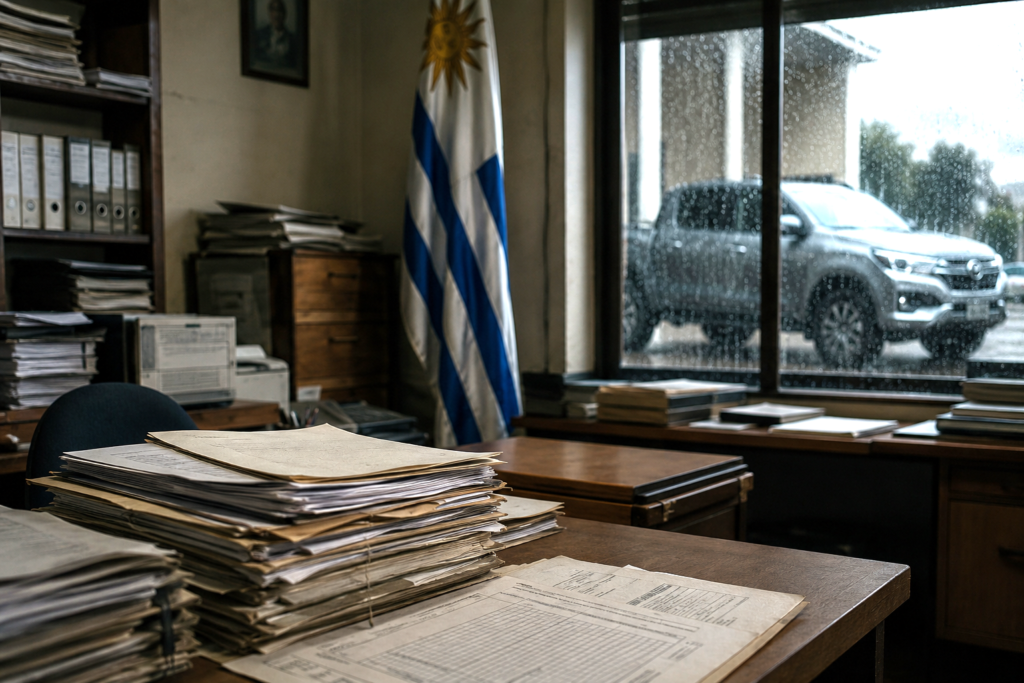
A Tocquevillian reading of power that promises humility, multiplies bureaucracy and ends up protected by its own excuses.
When Simplicity Becomes Corruption
Without complex analytical capacity to abuse power
By Dr. Nelson Jorge Mosco Castellano
Edgar Morin’s paradigm of complexity, developed by the philosopher and sociologist, is an approach that seeks to understand reality as a whole, avoiding fragmentation.
Its antithesis is the so-called “revolution of simple things”.
A notorious and natural political incapacity to use complex analysis in order to abuse power.
What a moving enterprise modern politics is: that stubborn mania for promising paradise and delivering, in exchange, a poorly printed form and an unsatisfactory bureaucratic justification.
The left-wing coalition came to power with the lyricism of great causes, but it has ended up succumbing to the most democratic of all baseness: turning existence into something frightfully predictable, gray and, above all, boring.
Alexis de Tocqueville, that Frenchman blessed with the gift of foreseeing the misfortunes of others, had already warned us that the true danger of democracy is not that it will cut off our heads, but that it will bend our backs.
The tyranny of the majority: The triumph of governmental bad taste
Tocqueville feared the majority as one fears a mob without aesthetic sense.
In Uruguay, that fear became the comfort of the “parliamentary steamroller”.
For three terms, the governing party discovered that having half plus one of the votes exempts one from the annoying need to be right.
The opposition became that uncomfortable piece of furniture kept in the living room out of pure courtesy, but on which nobody sits.
Government operated under the premise that infallibility is a numerical matter; if fifty-one Uruguayans say that water runs upward, the law is passed and gravity is forbidden.
Deliberation has died, replaced by the yawn of party discipline.
Soft despotism: Happiness in convenient installments
There is nothing more tyrannical than a State that insists on behaving like an overprotective mother with no talent, except for plundering through its imperial power.
This is what the French thinker called soft despotism: a web of small and infinite rules that do not kill you, but take away your will to live.
Thus, the average Uruguayan has been educated in the noble faith that the State must provide everything, from sustenance to opinion.
The Ministry of Social Development and its colossal structure were not designed to eradicate poverty, but to make it sustainable, orderly and electorally useful.
A selective militant elite that collects human spoil so as not to spoil the senatorial view from the window.
It is the perfect Revolution of Simple Things: human ambition was simplified until it was reduced to the punctual collection of a subsidy.
The citizen no longer seeks freedom; he seeks a State inspector to grant him permission to breathe according to regulation.
Corporate individualism: The homeland of committees
When the State takes charge of everything, the individual retreats into his small corner to complain in private, emerging only when his corporation orders him to do so; or when the pollster allows it.
The social fabric, which according to Tocqueville should have been sustained by free associations, has here hardened into the indissoluble idyll between the theologically Marxist party and the PIT-CNT.
Solidarity is no longer a Christian virtue nor a social elegance; it is a general strike on Friday mornings.
Public discussion has ceased to be a debate over the destiny of the Republic and has become a sordid outpatient negotiation in which education unions and municipal guilds decide how much mediocrity we are obliged to tolerate this week.
The apotheosis of the common man: From technical discretion to automotive mystery
But it is in its leaders that Tocqueville’s egalitarian prophecy reaches the level of comedy.
Democracy abhors excellence; it prefers to see itself reflected in the reassuring mediocrity of the everyday.
Yamandú Orsi, the standard-bearer of the “simple man”, that folksy style that confuses ignorance with lack of definitions and prudence with absolute inaction.
Orsi is the ideal ruler for a society that fears surprises: someone who speaks at length in order to say nothing and who manages the internal balances of the Frente Amplio with the delicacy of someone carrying eggs in a cart.
His detractors accuse him of lukewarmness, forgetting that lukewarmness is the exact temperature of his Cuban-style democratic comfort.
However, even the simplest and most folksy man may be tempted by the subtle charms of rolling materialism.
The idyll of simple things suffered a marvelous short circuit with the famous —and still unexplained— incident involving his pickup truck.
One must have a truly mystical talent for personal finance, or blind faith in the bargains of the automotive market, to acquire for the modest sum of fifteen thousand dollars a vehicle whose real value in the world of mortals reaches eighty thousand.
Buying an eighty-thousand-dollar pickup truck for fifteen thousand is not a management offense; it is an aesthetic stroke of genius that defies the laws of supply, demand and business common sense.
The opposition cries out, delicately, for transparency and demands explanations that never arrive, trapped in the limbo of investigative committees and evasive answers.
But analyzed through Tocqueville’s lens, the episode is a delight: it shows that when egalitarian discourse tires of committee austerity, it prefers to travel with all-wheel drive, a 15-inch screen and air conditioning, at a clearance price that ordinary citizens on foot will never obtain.
It is the perfect metaphor for late progressivism: public transport is preached for the masses while a high-end vehicle is driven, obtained thanks to the generosity of political providence.
The “Revolution of Simple Things” and “An honest government” have failed in the most predictable way possible: by becoming extremely expensive, unbearably bureaucratic and profoundly hypocritical.
In the end, Uruguayans have discovered that Uruguayan-style socialism consists of paying first-world taxes to receive third-world services, all while watching their leaders move around in vehicles worth a fortune but which, in the “sworn declaration”, cost less than a used car.
To crown this grand tableau of consented mediocrity, the president himself has taken it upon himself to prove us right with an involuntary lucidity bordering on genius.
As can be seen circulating on social media, before the sacred event of a national team match, President Orsi allegedly declared with complete shamelessness: “When Uruguay plays, nobody works, the country stops”, adding with enviable comfort his personal doctrine: “I take the day off to do the pre-match gathering and support the Celeste”.
If Tocqueville were to come back to life for an instant to contemplate this scene, he would fall to his knees, amazed that his theory of democratic drowsiness had become so brazenly literal.
There is no need for an autocrat to prohibit thought; it is enough to have a folksy president decree the voluntary holiday of intelligence and effort.
Sheltered by the sacred liturgy of football, the head of State elevates institutional laziness to the category of patriotic duty.
The Republic can wait, the economy can creak and the doubts about his miracle-priced pickup truck can gather dust; after all, there is a “pre-match gathering” to attend to.
It is the crowning touch for the Revolution of Simple Things: a country where work is an inconvenient option and governmental idleness of thought and action is the only State policy that the left-wing coalition understands as electorally profitable.
Tocqueville and power.
Protective State.
Feigned austerity.
Continue reading in Global Order and Geopolitics
Apoyá la continuidad de Perspectiva Liberal
Perspectiva Liberal es un espacio editorial independiente. Si valorás este trabajo y querés colaborar con su continuidad, podés hacerlo mediante un aporte voluntario a nuestra cuenta Prex.
Cuenta Prex: 13440