
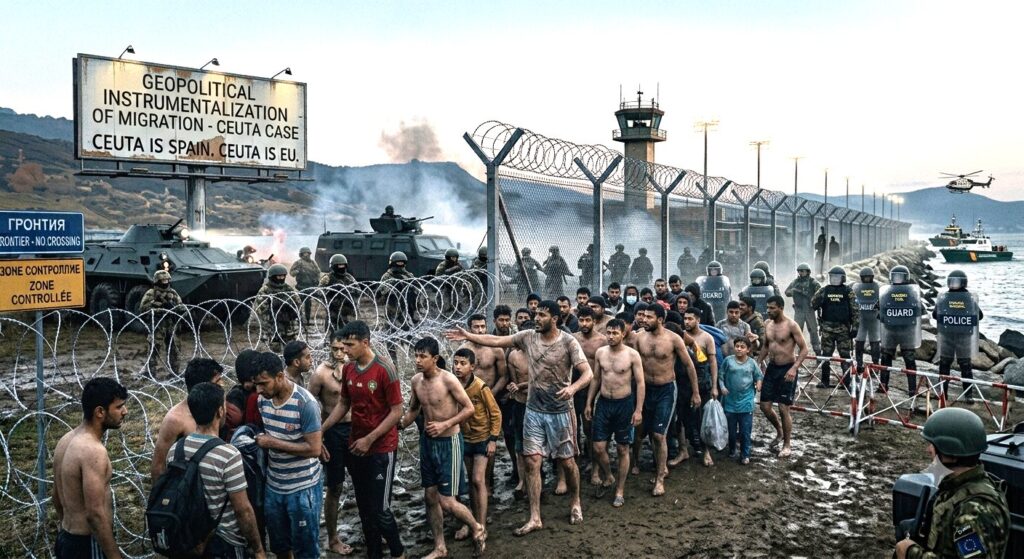
The crisis in Ceuta has reignited the debate over the use of migration flows as an instrument of geopolitical pressure and the consequences for European security.
In 2004, the renowned Italian journalist and writer Oriana Fallaci (1929–2006) wrote: “Europe is no longer Europe: it is Eurabia, a colony of Islam where the invasion advances not with armies but through birth rates and uncontrolled immigration” (The Force of Reason).
Twenty-two years later, in the first days of July, the Spanish Supreme Court issued a ruling establishing that migrants intercepted at sea while attempting to reach Ceuta or Melilla cannot be subjected to an immediate “hot return,” but instead each case must be processed individually according to the law.
For some observers, the ruling represented an open door.
Subsequent events showed that it was a dangerous one.
Before July had ended, fifty thousand Moroccans reached Ceuta by crossing the breakwaters or swimming the three kilometers separating them from the Spanish enclave.
Within days, thousands of people had gathered along the Moroccan coast.
These breakwaters extend from both Ceuta and the Moroccan shoreline, allowing people to walk along them until they reach the gap over the sea and then swim to the opposite breakwater.
On July 30, that massive crossing took place.
This large-scale influx caused the expected collapse of border control systems and the resulting humanitarian crisis, with several people dying during the attempt.
The Spanish government maintains that the court ruling was exploited by human trafficking networks, combined with the fact that Morocco deliberately relaxed its border controls.
This allegation was, as expected, emphatically denied by the Moroccan government.
Nevertheless, both governments quickly coordinated the return of the overwhelming majority of the migrants and reinforced border controls once again.
For her part, Italian Prime Minister Giorgia Meloni called for a tougher European Union response and strengthened controls regarding Spain, arguing that rulings of this kind affect the entire European area.
Hybrid warfare
Many analysts use the concept of “hybrid warfare” or “the instrumentalization of migration” to describe episodes such as this.
The idea behind hybrid warfare is that one state attempts to influence another without resorting to direct military confrontation.
To achieve this, it employs methods such as economic pressure, cyberattacks, disinformation, or migratory flows.
This appears to be the case in Ceuta, judging from the observable facts.
When a state deliberately weakens its border controls or fails to prevent thousands of people from leaving for the territory of a neighboring country, it is using migration as a coercive instrument.
In other words, it is employing an extremely inexpensive yet devastating resource: human desperation. Instead of bullets, it uses people.
A good example is the situation on the Belarus–Poland border in 2021. Belarus transported migrants from the Middle East to Minsk and directed them toward the Polish border, and it has continued doing so.
Poland’s Ministry of the Interior reported that attempted illegal crossings reached approximately 15,500 during the first half of 2025.
The Polish authorities installed a high-tech steel wall, suspended the right to asylum, and authorized border guards to use firearms, reducing crossing attempts to zero.
Another front is Algeria versus France. Algerian authorities became deeply dissatisfied after the French government supported Morocco in the strategic dispute over the Sahara.
As a consequence, Algeria refused to readmit its own nationals expelled by France, including the knife attacker involved in the terrorist attack in the French city of Mulhouse, where he attempted to kill police officers and fatally attacked a man who tried to assist them. According to the French Interior Minister, the attacker had been subject to an expulsion order that Algeria had rejected ten times.
The same pattern emerges, but instead of sending people, the strategy is to refuse to receive them.
Regarding the 2021 Ceuta crisis, eight thousand people entered the enclave within two days.
However, records were surpassed in 2026. It appears evident that Morocco’s relaxation of border controls contributed decisively to the episode.
Morocco maintains that the trigger was the Spanish Supreme Court ruling together with the activities of human trafficking networks.
Although there has been no definitive international conclusion identifying an organized hybrid warfare operation conducted by the Moroccan state, the concept of the instrumentalization of migration has gained considerable traction within European politics.
The European Union has used the term to describe situations in which a third country employs migratory flows to exert pressure on a Member State. The issue is particularly serious because the migratory pressure directed against Poland later extended toward Estonia and Latvia.
Voluntary return?
That is what the available information suggests so far, although many wonder what “voluntary” actually means.
According to the Spanish authorities, most of those more than fifty thousand people who entered Ceuta returned to Morocco within a very short period.
Many did so by their own means after realizing they would neither be able to continue toward mainland Spain nor remain in Ceuta.
One may ask what exactly those “own means” were. By swimming?
The Spanish government has also highlighted Morocco’s cooperation in facilitating those returns.
Nevertheless, a smaller group (how much smaller? Five thousand?) remained in Ceuta intending to request protection or attempt to stay.
The term “voluntary” appears overly generous.
In many cases it does not necessarily mean that people spontaneously changed their minds, but rather that they returned without the need for physical removal.
In other words, the return was voluntary only in the legal sense. Reality itself induced their return, while the presence of the Spanish Army in Ceuta reinforced the process.
The speed with which so many thousands returned to Morocco raises questions.
It is not unreasonable to hypothesize that many of these supposed migrants never intended to settle in Spain permanently but merely sought to take advantage of a temporary opportunity to cross the border.
The undeniable reality is that Europe, through its political correctness, is witnessing a process of self-demolition.
Instrumentalized migration
Hybrid warfare
European border security
Continue reading in Global Order and Geopolitics
Apoyá la continuidad de Perspectiva Liberal
Perspectiva Liberal es un espacio editorial independiente. Si valorás este trabajo y querés colaborar con su continuidad, podés hacerlo mediante un aporte voluntario a nuestra cuenta Prex.
Cuenta Prex: 13440