
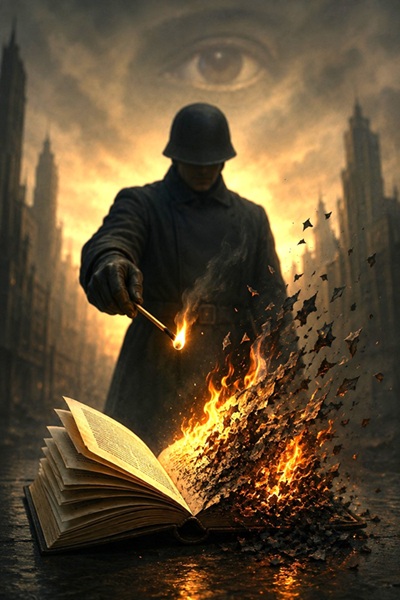
Seventy years after Fahrenheit 451, Bradbury challenges us to confront censorship, information overload, and happiness turned into an instrument of control.
People Want to Be Happy
Vargas Llosa recounts that, upon the death of the Inca, they buried with him not only his women, but also his amautas.
The great Peruvian writer does not subscribe to the sanitized version of the amautas as wise educators.
The new Inca surrounded himself with new amautas whose task was to reconstruct the official history. In this way, all the virtues of the former rulers were transferred to the new one.
That is why he says that no one has been able to recount a history true to reality, because it has been disguised. Dressed and undressed like a stripper.
Burning books is a sad custom that belongs to a past that is not so distant. Thus, in 2021 it emerged that books in Canada had been removed from libraries and used as fuel. But this was not an emergency in which, faced with the threat of hypothermia, anything that burns can serve as a source of heat.
According to The National Catholic Register: “More than 4,700 books were removed or placed under review because of allegedly outdated representations. The books were removed, burned or recycled.” The 30 that were burned were used as fertilizer for a tree. “We are burying the ashes of racism, discrimination and stereotypes…,” declared the organizers of the event. Thus, books featuring Asterix, Tintin and Disney’s Pocahontas went to the bonfire.
Still Being Spared
For now, the books of Huxley, Orwell and Bradbury are still being spared. Although nothing guarantees that any of their dystopias will not become reality and that, then, they will be the first in line.
Writer, essayist, screenwriter and poet Ray Douglas Bradbury (1920–2012) built his culture by reading in libraries. He wrote while his wife worked to cover the household expenses. Fame and money only came to him in 1953, when he published his novel Fahrenheit 451.
Comparisons are generally made between Brave New World and 1984. Nevertheless, Bradbury’s Fahrenheit 451 is, from my point of view, superior as literature. In that story of firefighters who burn instead of extinguishing fires, and where the central character is the firefighter Montag, the book is society’s most dangerous enemy.
Nevertheless, the soldiers of fire had their guidebooks, which also contained references to the first firefighters in America.
The rules were simple: Respond directly to the alarm. Start the fire quickly. Burn everything. Return immediately to the firehouse. Remain alert for other calls.
Because of that peculiar relationship with fire, they wore the number 451 on their helmets, which on the Fahrenheit scale indicates the temperature at which paper burns. But what warning does the author intend to give the reader?
Above All Else
Beyond the anecdote, beyond the firefighter’s relationship with his wife Mildred, or with Clarisse McClellan or the old professor Faber, what stands out in the text is Chief Beatty’s description of the world in his attempt to retain Montag, who was showing all-too-clear signs of disagreement.
One of those signs was pretending to be ill. The experience of the last burning, in which a woman had burned together with works by Swift, Dante, Marcus Aurelius…, had deeply affected his wavering resolve. The next morning, he tells his wife about the thousand books burned along with their owner and expresses his desire to leave his job for a while. Her reaction is explosive: “You want to give it all up? After all those years of working, because one night, one woman and her books…”. And she justifies her position by arguing: “She is nothing to me. She shouldn’t have had books. It was her fault, she should have thought about that before. I hate her.”
While he tries to convince his wife to call Beatty and tell him about his supposed illness, Beatty unexpectedly appears at Montag’s house.
It is then that, trying to explain to his subordinate the reason for his function, he says:
“What do we want in this nation, above all else? People want to be happy.” The problem is that there are too many elements that stand in the way of that purpose.
To achieve that, guidelines such as this one must be followed:
“If you don’t want a man to be politically unhappy, don’t teach him two sides of the same question; teach him only one. Or better yet, give him none. […] Stuff him full of noncombustible data, throw so many ‘facts’ at them that they feel overwhelmed, but completely up to date as far as information is concerned. Then they will have the feeling that they are thinking […] And they will be happy.”
Of course, that is not enough, and some complement is required: “So then, onward with […] the parties, the acrobats and the magicians, […] sex and drugs…”.
But there are forces that obstruct the path toward that longed-for happiness:
“Heredity and the home environment can undo much of what is instilled in school. That is why, year after year, we have been lowering the age for entering nursery school, until now we almost snatch the little ones from the cradle.” Those reactionaries must be fought by appealing to every possible means, so that: “What matters for you to remember, Montag, is that you, I and all the others [the fire-setting firefighters] are the Guardians of Happiness.”
Seventy Years Later
Critics debate whether Fahrenheit 451 was Bradbury’s best work or whether The Martian Chronicles is superior. However, on his gravestone at Westwood Village Memorial Park in Los Angeles, one can read, at the author’s own request, his own opinion.
Bradbury would declare to the press that his works were not intended to make predictions about the future, but to issue warnings.
The books of the trio he formed with Huxley and Orwell seem closer to prophecy. Although Bradbury’s discourse is closer to Huxley.
It is true that they wrote in a world that was not that of Michel de Notre Dame, but it must be acknowledged that they are much more explicit.
There is no need for overly convoluted reasoning to decipher them.
One only has to open the windows of the mind and observe what is happening around us.
Censorship and memory
Happiness and control
Fahrenheit 451 and freedom
Continue reading in Global Order and Geopolitics
Apoyá la continuidad de Perspectiva Liberal
Perspectiva Liberal es un espacio editorial independiente. Si valorás este trabajo y querés colaborar con su continuidad, podés hacerlo mediante un aporte voluntario a nuestra cuenta Prex.
Cuenta Prex: 13440