
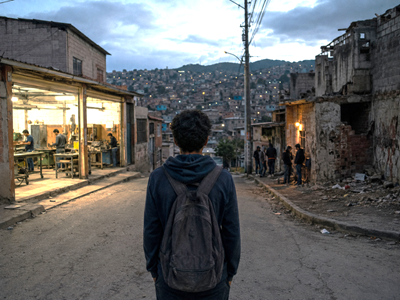
The exclusion from formal work, the advance of organized crime, and confrontational militancy as expressions of the same fracture in the social fabric.
THE DECLINE OF CIVILIZATION
Between Misery and the Political Shortcut
By Dr. Nelson Jorge Mosco Castellano
The reflection on how extreme material scarcity and the loss of opportunities erode the social fabric touches on one of the most complex institutional and cultural challenges of our time.
When the State or the formal labor market fails to integrate individuals into opportunities, or when those opportunities are lost through misfortune or a lack of natural talents, dynamics of survival and organization emerge that radically alter peaceful coexistence.
The Fracture of the Social Fabric
Confrontation as a political incentive gradually permeates contexts of chronic vulnerability; dependence on assistance or widespread scarcity often creates incentives for certain mutations of political leadership to channel frustration through polarization.
Social division becomes a mechanism of cohesion for corporatist or partisan groups, replacing merit and voluntary cooperation with identity-based confrontation, which is co-opted by subordinate interests.
When barriers to entry into the formal economy are excessive—due to suffocating regulations, high labor costs, or poor educational quality—informal or marginal markets gain ground.
Drug trafficking operates there not only as a criminal business, but also as an employer of last resort, or as a radical example of spurious forms of enrichment for young people without prospects, offering status, quick income, and a false sense of belonging in exchange for the destruction of communities.
Where the law and economic freedom retreat, the vacuum does not remain vacant; it is occupied by the arbitrariness of militant corporatist welfare or by the law of the strongest.
Faced with this diagnosis, the central dilemma lies in how to restore the foundations of individual responsibility and republican order:
Combat the structural causes; reduce fiscal voracity and the regulatory frameworks that suffocate private initiative and the genuine creation of formal employment.
The State has the nondelegable function of maintaining the monopoly on force and defending property rights and individuals against the advance of organized crime, which forms ghettos that expand and seek to dominate.
Rebuild an educational system focused on responsible freedom and on the technical and human skills that allow each individual to support themselves through honest work.
Perspectives from Harsh Reality: Authors and Diagnoses
To understand the disarticulation of the social fabric and the rise of atavistic forms of survival, it is necessary to turn to voices that have dissected misery with brutal realism:
In his work Our Lady of the Assassins, Fernando Vallejo portrays a society where the absence of the State and the breakdown of the economic order reduce human life to a disposable commodity.
For Vallejo, violence does not arise from a radical ideology, but rather reaches it through absolute desperation, or by escaping an environment where organized crime becomes the only viable “employer” for a youth without a future.
Through concepts such as “urban outcasts,” Loïc Wacquant analyzes how the withdrawal of the State’s protective and security functions, and the confinement of the dispossessed in ghettos that gradually gain free spaces, create territories where institutional law is replaced by the law of the strongest.
Here, the individual becomes an operational unit of underground economies, or cheap labor for ideologies that offer the illusion of an easy way out.
Some authors argue that, in the absence of access to the formal market, extreme marginalization generates forms of exploitation in which death and violence become the final resources of a structure that discards millions.
The Political Shortcut: Militancy as an Alternative to Merit
Poverty, when it spreads as a chronic condition, inevitably degenerates into two parallel paths: falling into crime as a drug-trafficking “foot soldier,” or seeking a shortcut to power through militancy based on radical social confrontation.
In this latter scenario, the lack of education or of an integrating humanistic perspective is not an obstacle, but an advantage for political recruitment.
Ultra-radical militancy results from the collectivization of anger and corporatist welfare, which ultimately rests on an implicit rejection of society, encouraged as the entity responsible for marginalization by contrast.
Reality shows that this marginality is promoted, either by obstructing vocational training or, worse, by postponing every possibility of a genuine way out through public actions that should facilitate access to dignified work.
The protection of criminality through the narrative of this “social responsibility for poverty” is the preferred means of failing to provide for the defense and security of people, or of criminal organizations that intermingle with politics.
There is a direct correlation between impoverishment and the recruitment of individuals for “militancy.”
Instead of promoting meritocracy or the development of individual skills that would enable entry into a competitive labor market, certain political structures encourage collusion with trade-union corporations and organizations financed for welfare provision.
This perpetuates the cycle of poverty because, as tax costs and social burdens increase, they destroy investment, preventing opportunities from multiplying for people to free themselves from dependence on the State.
This phenomenon of “advancement without preparation” can be seen in leaders who, having begun their lives in extreme marginality, reach power through involvement as a means of channeling social frustration. Not through formal education, the development of a professional career, or the generation of economic value resulting from fighting poverty through effort.
When political militancy clouds awareness of one’s limitations for holding public office, the notion of the harm that can be caused through obstinacy is lost; and disastrous results for society are justified through an imagined enemy of the poor. Having been poor becomes the justification for arrogating a false moral superiority that permits even the devastation of civilization.
This ascent represents the triumph of the “politics of the shortcut”: a system that values uncompromising partisan loyalty and the capacity for mobilization above all else, turning healthy criticism into a class enemy.
When politics becomes a means of climbing through militancy, and divides society between “them and us,” democracy deteriorates, leaving collective impoverishment as the consequence; replacing it with a rhetoric of confrontation that, paradoxically, deepens poverty through supreme ignorance elevated to the condition of an unshakable ego.
True freedom requires tools, not just speeches.
As long as political structures continue to offer militancy as the only path of “social mobility,” the outcome will remain a profound social division that encourages civilizational decline.
Breaking this vicious cycle requires restoring to the individual the opportunity to support themselves through honest work, to advance through education, and to cultivate individual effort as merit for overcoming one’s starting condition.
Far from both the drug trafficker’s rifle and the militant’s shirt.
Poverty and labor exclusion
Crime and urban marginality
Militancy and political shortcut
Continue reading in Global Order and Geopolitics
Apoyá la continuidad de Perspectiva Liberal
Perspectiva Liberal es un espacio editorial independiente. Si valorás este trabajo y querés colaborar con su continuidad, podés hacerlo mediante un aporte voluntario a nuestra cuenta Prex.
Cuenta Prex: 13440