
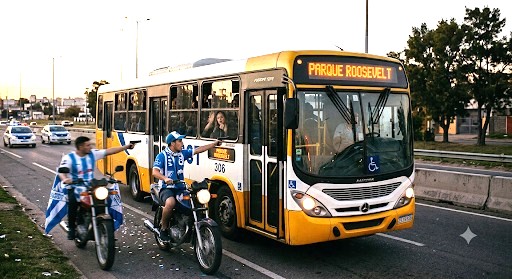
Two episodes involving football supporters and diverted city buses raise a deeper question about rules, coercion and the State’s capacity to respond.
It was a fairly serious incident and, judging by what has emerged from the investigation, it has some even more troubling details.
It happened on a bus on route 306 of Montevideo’s urban transit network, traveling from Casabó toward Parque Roosevelt.
In the Curva de Tabárez area, some fifty people identified as supporters of Club Atlético Cerro boarded the bus.
According to the driver’s account, one of them threatened him with a firearm and ordered him to change the route.
He was thus forced to drive some thirteen kilometers to the Belloni Interchange, where they got off.
From there, they walked to Danubio’s stadium, where the home team was due to play Cerro.
During the journey, the driver stated, two motorcycles traveled in front of the bus and their riders pointed weapons at him, while a car followed behind.
The passengers who remained inside the vehicle got off whenever they could. No physical injuries were reported, but the driver was left in a state of shock.
Although the company called 911 while the bus was being diverted, and the emergency service managed to contact the driver, the interaction was confusing. The driver, under threat, could not speak.
The police service only heard noises, and the situation was treated as a case of “disorder” and “agitated people.”
The incident occurred in broad daylight and the bus traveled through a large part of Montevideo, so it must have been captured by numerous security cameras.
So why was there no police intervention during the journey?
A question many people are asking and that, so far, has not been answered.
The authorities have ordered the corresponding investigation.
A few days later, another episode occurred: some thirty Peñarol supporters did the same thing with another bus.
There was a difference, however, according to the driver’s report. It seems they wanted to reach Peñarol’s stadium and asked the driver not to pass in front of the area around Nacional’s stadium, because there was a major event there for Nacional’s Children’s Day and they did not want to provoke a confrontation between the two groups of supporters.
They later asked the driver to let them off at Batlle y Ordóñez and 8 de Octubre, where they got out.
There was no violence or threats, only a polite request from thirty people.
The driver agreed to the friendly plea and did not file a complaint.
What crime, legally speaking, does what happened constitute?
After all, they only needed a means of transportation for the noble purpose of going to support their favorite team.
Of course, they took it by force.
As seen in the case of the Mirasol supporters, the manners were quite different. Or was it that the driver did not consider it necessary for them to go as far as acting like thugs?
The well-known criminal lawyer Juan Fagúndez offers a more disturbing hypothesis.
He stated that the episode may also have functioned as a test of the State’s capacity to react.
Is it possible to take control of a vehicle carrying passengers, make it cross Montevideo for three quarters of an hour, without any State force intercepting it?
What is truly worrying is that some criminals wanted to get to a football match and that this ended up showing how far they could impose their will on public space before encountering a State response.
Is this a demonstration of the insecurity that worries Uruguayans?
“Anomie” seems a considerably more precise concept to describe this incident.
Anomie is a concept created by the French sociologist Émile Durkheim.
It means the lack, absence or weakening of norms and moral rules in a society. And it occurs when laws and shared values lose their power to guide and control people’s desires.
And these cases are highly illustrative.
Because the social message they produce is: “If I need something, I can impose it by force.”
And the reverse message for everyone else is that rules exist, but perhaps they are not capable of protecting us when someone decides to ignore them.
Moreover, anomie can also take hold among those who are supposed to enforce the rules.
When transgression becomes so frequent that certain behaviors begin to be treated as “things that happen,” practical tolerance of the violation appears.
After all, if abortion was legalized because it could not be contained, would it be so strange for the same criterion to be applied to taking over buses?
Anomie and public space
Authority and State response
Normalization of transgression
Continue reading in Global Order and Geopolitics
Apoyá la continuidad de Perspectiva Liberal
Perspectiva Liberal es un espacio editorial independiente. Si valorás este trabajo y querés colaborar con su continuidad, podés hacerlo mediante un aporte voluntario a nuestra cuenta Prex.
Cuenta Prex: 13440