
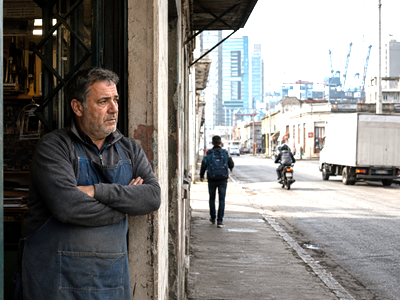
How the Real Uruguay Collides with Its Own Apparatus
THE WEIGHT OF INERTIA
How the Real Uruguay Collides with Its Own Apparatus
By Dr. Nelson Jorge Mosco Castellano
To fully understand Uruguay’s identity, it is essential to cross the mirror of its literature and the board of its economic challenges.
Both worlds reveal how that moderate and institutional temperament now needs to reinvent itself in the face of the demands of the twenty-first century.
Uruguayan literature and thought do not sing of great imperial epics, but of the dimness of offices, the corner bar, and the reflective solitude of the individual.
From the writing of Felisberto Hernández, with his everyday strangeness, through the skepticism of Juan Carlos Onetti in Santa María, to the sharp essays of José Enrique Rodó in Ariel, the Uruguayan intellectual engages in a permanent resistance against shallow utilitarianism.
There is a critical distance from power and an uncompromising defense of inner dignity.
Far from naïve optimism, the country’s great literature warns of the dangers of suffocating collectivism. The Uruguayan writer often takes refuge in a non-negotiable personal sovereignty, where humanist culture and the cultivation of the “liberal arts” act as the last barrier against massification.
The other face of national identity is now being contested in its economy. Historically, Uruguayans entrusted their fate to the protective umbrella of a “welfare” state, structured at the beginning of the twentieth century.
However, that model now collides with the urgencies of a hyperconnected world. We went straight from “the State takes care of you” to “the State squeezes you.”
The corporatism of trades and commerce became parasitic. The desire for stability and aversion to risk have often led to a web of rigid regulations and state monopolies that, fostered by idlers, suffocate individual initiative.
Contemporary Uruguay is trapped in a contradiction as silent as it is persistent.
On the one hand, it boasts enviable institutional stability within the Latin American context, a well-earned civic prestige, and a social coexistence in which moderation remains a cherished value.
On the other, it drags along an ossified economic structure, sustained by foundations designed for a world that no longer exists.
The diagnosis, although often repeated, does not lose its relevance through repetition: we have an oversized state, a domestic market of very limited scale, and an education system that has ceased to be the social elevator that once fascinated the region.
At a turning point dominated by global technological disruption, insisting on managing scarcity through extractive politics, with regulations and public spending financed through debt, is equivalent to trying to navigate a hurricane with the moorings of the last century.
For decades, the dominant framework of thought in the country established the premise that collective well-being depended exclusively on the State’s capacity for guardianship.
The expanded bureaucracy thus consolidated itself not only as a provider of services, but as the “great social shock absorber,” which turned into a handbrake; and as an “employer” of last resort, which turned into a substitute for structural unemployment and a multiplier of informality, unemployment, and poverty.
However, the bill for this model now falls on the shoulders of an increasingly suffocated formal economy.
The so-called “Uruguay Cost” —made up of public utility rates set in response to political demands, labor rigidities unbearable for SMEs, burdensome taxes acknowledged across the political system, and a hypertrophied regulatory framework— acts as an invisible and unbearable tax on competitiveness.
When the formal private sector must bear the burden of financing unnecessary, unsustainable, inefficient state structures, the predictable result is a loss of dynamism, informality, and the systematic expulsion of young talent toward markets more receptive to innovation.
The Education and Human Capital Trap
There can be no successful integration into the knowledge economy without a radical transformation of human capabilities.
Historically, Uruguay’s public education system was the engine of equal opportunity.
Today, unfortunately, it is witnessing an alarming divorce between the Precambrian content it teaches and the demands of a world driven by automation, artificial intelligence, and labor flexibility.
As long as education corporations continue to prioritize the defense of sectoral privileges over the quality of learning, the country will remain condemned to importing technology and consuming foreign added value instead of creating it.
Underdevelopment in the twenty-first century is not measured by a lack of natural resources, but by the mental rigidity that prevents institutional incentives from adapting to the dizzying pace of technological change.
The Urgency of Boldness
Uruguay’s dilemma is not one of resources, but of incentives and political courage. Continuing to postpone fundamental reforms —relieving the tax burden, making regulated markets more flexible, and opening up to the world with boldness— under the pretext of preserving a fictitious social peace is, in reality, to administer a slow agony.
Uruguay has every potential to become a beacon of stability, economic freedom, and talent in the Southern Cone.
To achieve this, it is imperative to leave behind parasitic corporatist nostalgia and understand that the only real sovereignty in the twenty-first century comes from agility, openness, and the ability to compete on equal terms on the global stage.
State inertia and competitiveness
Education and human capital
Openness and economic reform
Continue reading in Global Order and Geopolitics
Apoyá la continuidad de Perspectiva Liberal
Perspectiva Liberal es un espacio editorial independiente. Si valorás este trabajo y querés colaborar con su continuidad, podés hacerlo mediante un aporte voluntario a nuestra cuenta Prex.
Cuenta Prex: 13440